

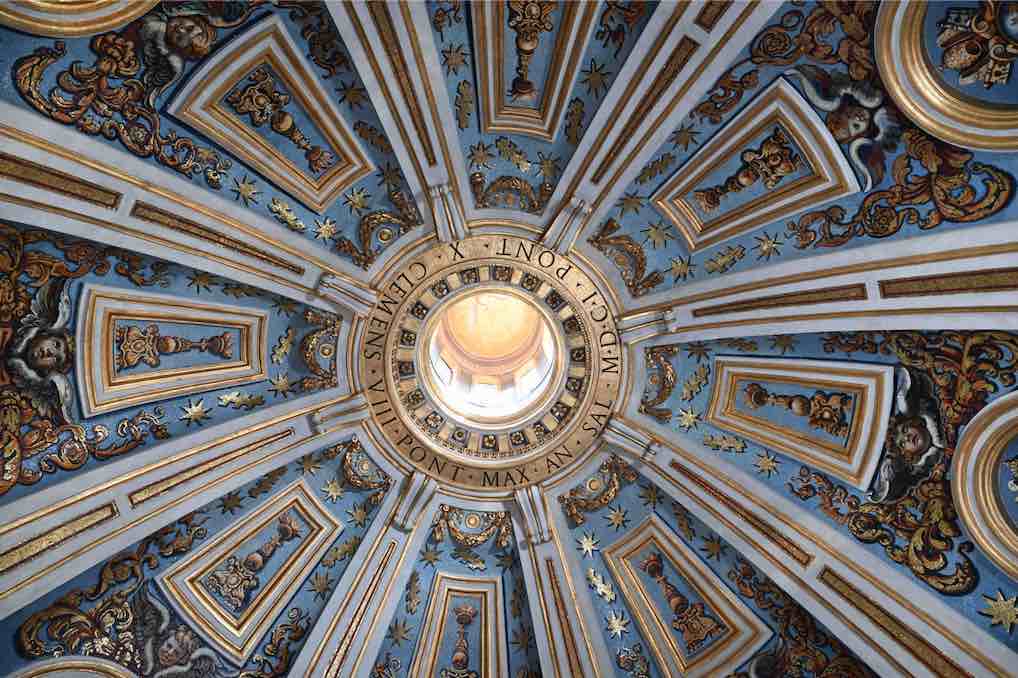
(ZENIT News / Vatican City, 09.21.2026).- The Fabric of Saint Peter announced the completion of the restoration and conservation of the dome of the Clementine Chapel in St. Peter’s Basilica, one of the most significant decorative works of early 17th-century Rome.
Begun in May 2025, the project covered 371 square meters of mosaics, created between 1601 and 1604, based on designs by Cristofano Roncalli, known as «Il Pomarancio.» The intervention also addressed the contemporary stucco decoration, restoring visual cohesion to the entire decorative ensemble.
Reasons for the Intervention
Periodic monitoring by the Fabric of Saint Peter revealed the need for conservation work on the mosaic decoration of the vaulted ceiling.
The erection of scaffolding in January 2025 allowed for a detailed assessment of the surface conditions and the identification of critical issues, stemming from both the natural material degradation process and interventions carried out over time.
The assessments also covered the stucco decoration, subsequently added to the work program, with the aim of ensuring stability, digitally mapping forms of deterioration, and conducting endoscopic examinations.
The Restoration
The work was preceded by an exhaustive diagnostic campaign that included photographic documentation, laboratory analysis of constituent materials, digital mapping of deterioration patterns, and endoscopic inspections.
Project surveying and documentation were managed using the BIM (Building Information Modeling) methodology. Survey data, deterioration mapping, and information regarding the interventions performed were linked to the three-dimensional model of the dome. This created a digital archive that can be consulted and updated over time, designed to facilitate future monitoring and maintenance activities. The operational phase encompassed preliminary cleaning and dust removal from surfaces, pre-consolidation of tesserae and loose sections, controlled cleaning, treatment of efflorescence, and both surface and deep consolidation.
Subsequently, discordant elements were removed, losses were filled, and the aesthetic finishing of the surfaces was carried out. In parallel, the restoration of the stucco decorations followed the same methodological and diagnostic procedures applied to the mosaic surfaces.
Following preliminary interventions, the work included cleaning as well as adhesive and cohesive consolidation, addressing both the structural matrix of the modeled elements and the gilded layer, followed by the filling of losses and the final aesthetic finish. All materials used met requirements for physicochemical compatibility, reversibility, and re-treatability, fully adhering to theoretical principles and current regulations regarding cultural heritage restoration.
The intervention ensured the structural consolidation of substrates at risk of detachment, mitigated the intrinsic and extrinsic causes of deterioration, and restored the work’s formal and chromatic legibility.
Historical Background
The Chapel takes its name from Clement VIII (born Ippolito Aldobrandini), who commissioned its decoration. Built according to a design by Michelangelo Buonarroti and completed by Giacomo della Porta in 1580 as a symmetrical counterpart to the Gregorian Chapel, it is part of the complex of spaces surrounding the Confessio of Saint Peter.
Its iconographic program reflects the context of the Counter-Reformation and was defined with the decisive contribution of Cardinal Cesare Baronio.
The mosaic decoration was executed by a team of about ten master craftsmen, including Marcello Provenzale, Paolo Rossetti, and Ranuccio Semprevivo. Four Doctors of the Church are depicted on the pendentives, while biblical scenes appear in the lunettes. The dome is notable for its rich ornamentation, which includes “putti,” festoons, and the heraldic symbols of the Aldobrandini family.

Publicaciones relacionadas:
 These Are All the Dates, by Ecclesial Categories, for the Pilgrimages of the 2025 Jubilee
 Vatican: Funeral Is Held for Homeless Man
 Abuse Is Not Related to Celibacy: Vatican Publishes First Annual Report on Policies for Protection of Minors
 Vatican Begins Restoration Work on Michelangelo’s Last Judgment in the Sistine Chapel
