

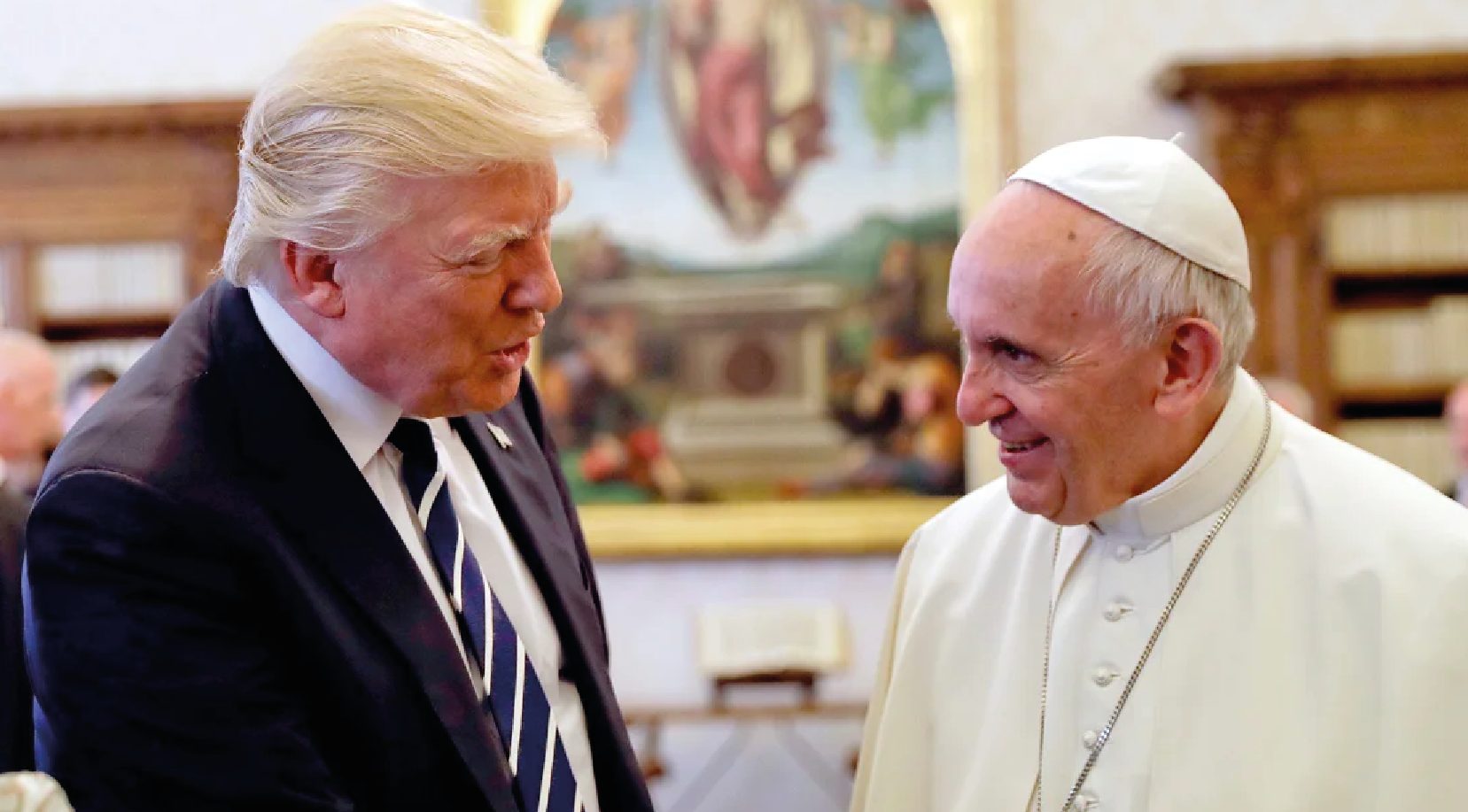
(ZENIT News / Vatican City, 04.25.2025).- As the sun rises over St. Peter’s Square on the morning of April 26, it will illuminate not only a historic farewell to Pope Francis, but a once-in-a-generation convergence of global power. Behind the solemnity of the occasion lies a meticulously choreographed protocol, a delicate ballet of diplomacy and symbolism, as presidents, monarchs, and dignitaries gather in one of the most politically and spiritually loaded spaces on Earth.
The Vatican Press Office confirmed the official seating and procedural arrangements for the funeral, a protocol steeped in both tradition and geopolitical nuance. The right side of the square, facing the Basilica, will be reserved for state delegations. Opposite them, on the left, will sit the College of Cardinals, robed in crimson.
In the very front row, as expected, are the presidents of Italy and Argentina—Sergio Mattarella and Javier Milei—representing the Pope’s adopted and native homelands. Their prominence reflects both protocol and sentiment: Argentina, cradle of Francis’ identity, and Italy, his final home.
Flanking them will be Europe’s Catholic royalty. King Felipe VI and Queen Letizia of Spain will be joined by Belgium’s King Philippe and Queen Mathilde, the Grand Duke and Grand Duchess of Luxembourg, and the sovereign couple of Monaco, Prince Albert and Princess Charlène. The Bishop of Urgell, co-prince of Andorra, Joan Enric Vives, and the Grand Master of the Order of Malta, Frey John T. Dunlap, will also join this noble procession, a rare meeting of altar and crown.
Just behind them sit the Protestant monarchs and secular heads of state. Sweden’s King Carl XVI Gustaf and Queen Silvia will be in attendance, along with Prince William of the United Kingdom, representing the British royal household in a moment of ecumenical respect.
Then comes the intricate dance of diplomacy. Presidents are seated according to the French alphabetical order of their countries—a seemingly neutral rule that often yields surprising proximity or distance. In an ironic twist of placement, Donald Trump and Emmanuel Macron will sit in the same row, while Volodymyr Zelensky of Ukraine will be positioned further away, potentially thwarting any informal exchange with the American former president. Zelensky is reportedly returning to Kyiv immediately after the Mass, leaving little room for spontaneous diplomacy.
The Holy See has also reserved spots near the altar for those leaders with whom Francis shared a particularly close bond. These include Germany’s Frank-Walter Steinmeier, Austria’s Alexander Van der Bellen, Brazil’s Luiz Inácio Lula da Silva, and Canada’s Governor General Mary Simon. Leaders from Cyprus, Albania, Angola, Ecuador, Cape Verde, and other nations round out this first-tier assembly.
A question still hovers over the precise role of Joe Biden, who reportedly confirmed his presence late Thursday, citing a personal connection with Francis. Vatican sources suggest he may not sit with the official U.S. delegation, likely placing him behind Trump.
Further back, ministers, ambassadors, and special envoys will fill the remaining diplomatic benches. Among them, Israel’s representative to the Holy See, Yaron Sideman, will occupy a place in the third row—symbolic of the often complex relationship between the Vatican and the Israeli state.
Security preparations around the event are staggering. Rome is under lockdown, with a destroyer deployed off its coast, Eurofighter jets on standby, and anti-drone systems positioned around the Vatican and along the funeral procession’s route. The unprecedented presence of so many heads of state, in a city already layered with historical and political volatility, has prompted one of the largest security operations.
Thank you for reading our content. If you would like to receive ZENIT’s daily e-mail news, you can subscribe for free through this link.

Publicaciones relacionadas:
 Pope Francis and his most important diplomatic speech of the year: here’s what he said
 These are Pope Francis’ 3 pieces of advice for diplomats
 Pope Francis sparks debate with call to investigate Gaza genocide allegations
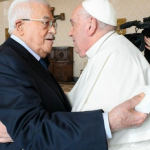 A Historic Icon and a Call for Peace: Pope Francis Meets Palestinian President Mahmoud Abbas
