

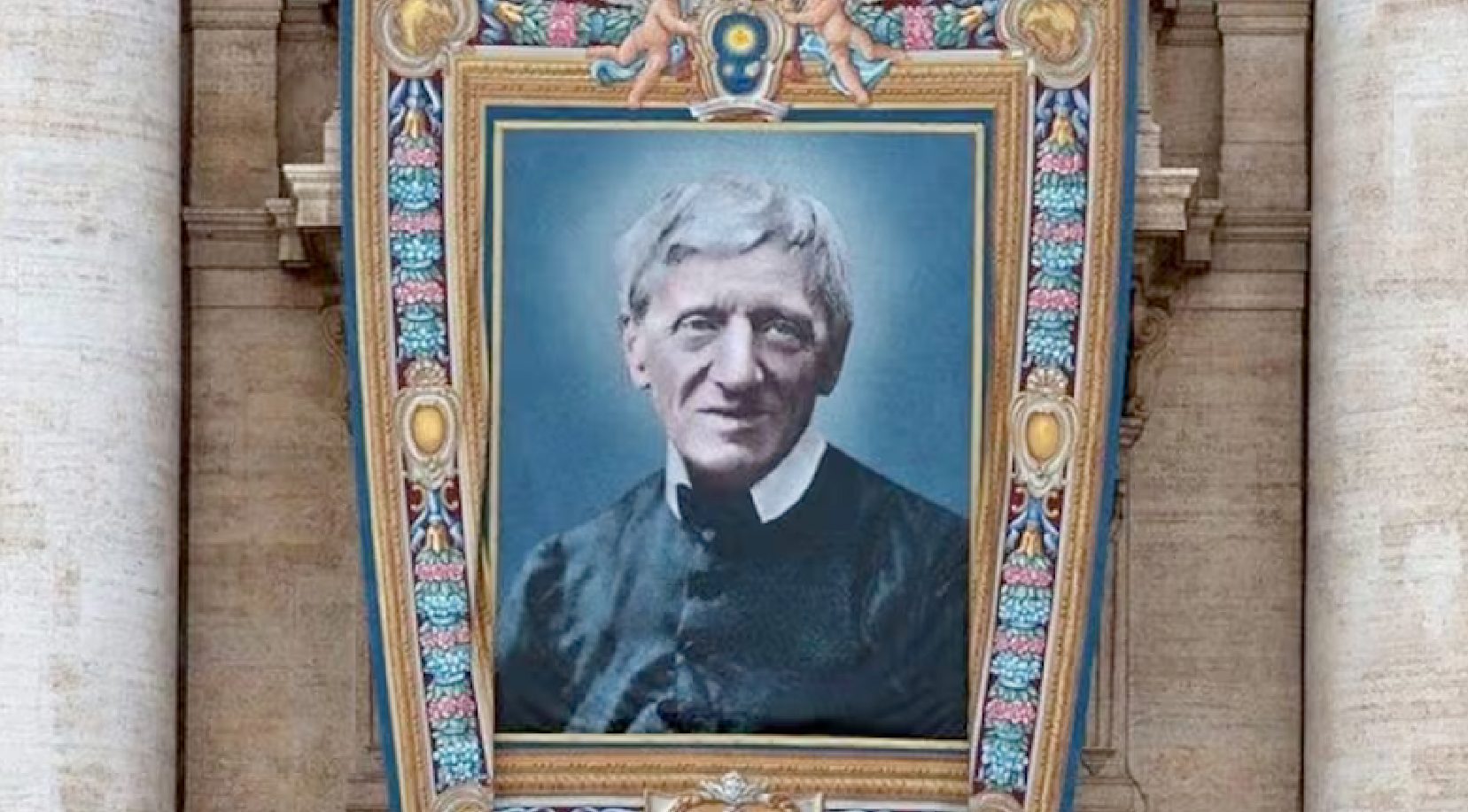
(ZENIT News / Vatican City, 07.31.2025).- In a gesture that bridges centuries of theological reflection and spiritual depth, Pope Leo XIV has confirmed that John Henry Newman, the 19th-century English cardinal, will be proclaimed Doctor of the Church — a title reserved for saints whose teachings have profoundly shaped Catholic doctrine. The announcement, made on July 31, marks the first such declaration by Pope Leo XIV since his election less than three months ago.
This recognition places Newman among a select group of 38 Doctors of the Church, only four of whom are women. The distinction is not given lightly: it signifies a life not only of personal holiness but also of enduring theological brilliance. Newman, a former Anglican priest who converted to Catholicism, has long been revered as a thinker whose influence resonates far beyond the confines of 19th-century England.
Born in London in 1801, John Henry Newman emerged as a prodigious intellect from an early age. Educated at Ealing and Oxford, he was ordained in the Church of England in 1825 and quickly rose to prominence as a preacher and scholar at Oriel College. His sermons at St. Mary the Virgin, Oxford’s university church, drew crowds and admiration — but also controversy.
Newman’s central role in the Oxford Movement marked a pivotal moment in Anglican theology. Seeking to reconnect the Church of England with its Catholic roots, he published the famous «Tracts for the Times», a series of theological reflections that challenged Protestant assumptions. His final installment, Tract 90, proposed a Catholic interpretation of Anglican doctrine — a step too far for many of his contemporaries. Denounced by 42 bishops and censured by Oxford’s academic authorities, Newman resigned his parish and withdrew to Littlemore, where he would ultimately make the decisive step toward Rome.
His conversion to Catholicism in 1845, received by the Italian Passionist Domenico Barberi, shocked Victorian England. No longer an Oxford don or Anglican divine, Newman became a Catholic priest and member of the Oratorians, the congregation founded by St. Philip Neri. He returned to England to establish the first English Oratory in Birmingham, which became both his spiritual home and the hub of his pastoral mission.
Despite his outsider status in an overwhelmingly Protestant society, Newman’s contributions to Catholic life in Britain were enormous. He served as rector of the Catholic University in Dublin and authored several landmark texts, including his spiritual autobiography «Apologia Pro Vita Sua» and the penetrating «Essay on the Development of Christian Doctrine». The latter offered a framework for understanding how Catholic doctrine evolves without betraying its apostolic roots — a concept that would echo a century later at the Second Vatican Council.
In 1879, Pope Leo XIII named him a cardinal, bypassing the traditional requirement of episcopal consecration. His chosen motto, «Cor ad cor loquitur» — «Heart speaks to heart» — captured the intimate, dialogical tone of his theological style. Though he never held high office in the Roman Curia, Newman’s thought has long influenced the universal Church, especially on the issues of conscience, education, and the relation between faith and reason.
Newman died in 1890 at age 89, leaving behind a vast intellectual and spiritual legacy. His tombstone bears the inscription: «Ex umbris et imaginibus in veritatem» — «Out of shadows and phantasms into the truth.» That journey from shadow to truth was not only personal but ecclesial: his writings paved the way for a more open, historically rooted, and intellectually confident Catholicism.
Beatified by Benedict XVI in 2010 and canonized by Pope Francis in 2019, Newman is now revered not only as a model of personal holiness, but as a master of theological insight. His works on the role of the laity, the function of conscience, and the purpose of higher education remain deeply relevant. The network of Newman Centers at universities across the United States stands as a living testament to his impact.
Pope Leo XIV’s decision, confirmed after consulting the Dicastery for the Causes of Saints, is both an ecclesial recognition and a symbolic gesture. In a time of renewed ecumenical dialogue and cultural tension over the role of faith in public life, Newman’s voice — careful, honest, and deeply grounded in the tradition — speaks with fresh urgency.
Though the date of the formal proclamation has not yet been announced, the message is clear: the Church continues to learn from those who searched for truth with humility and rigor. In naming Newman a Doctor of the Church, Leo XIV invites Catholics to rediscover a man who, in the words of Pope Benedict XVI, taught that “the truth is neither given to us ready-made, nor is it invented; it must be discovered.” Newman discovered it — and now, he teaches it to the Church he once sought so passionately.
Thank you for reading our content. If you would like to receive ZENIT’s daily e-mail news, you can subscribe for free through this link.

Publicaciones relacionadas:
 Discovering the true face of St. Nicholas: Brazilian designer reconstructs Santa’s face
 Pope Francis canonizes the nuns whose martyrdom meant the end of the French Revolution: famous for the book by Geroge Bernanos
 This is the 197-inch sculpture dedicated to Pope Leo XIV in his former Peruvian diocese
 Photo Gallery: Leo XIV Now Has An Official Mosaic to Enrich St. Paul’s Basilica, and This Is How He Reacted When It Was Shown to Him
