

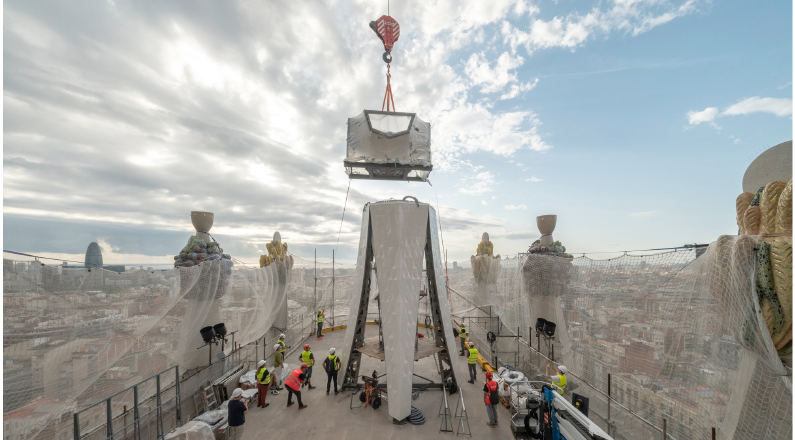
(ZENIT News / Barcelona, 09.23.2025).- Barcelona’s most recognizable silhouette is about to change. After more than a century of rising stone and scaffolding, the Sagrada Familia is preparing to lift its central spire, a tower that will make Antoni Gaudí’s unfinished basilica the tallest church in Europe.
Xavier Martínez, the project’s director general, announced that the monumental Tower of Jesus Christ—set to soar to 172 meters—should be completed either by the close of this year or in the first months of 2026. “We are accustomed to skyscrapers defining the modern skyline,” Martínez told the Associated Press, “but it is remarkable that in the 21st century, a cathedral is still being built to such a scale.”

When crowned with a luminous cross, the tower will eclipse Germany’s Ulm Minster, holder of the record since the 19th century at 162 meters. Surrounding it will be five other towers, one dedicated to the Virgin Mary and four slightly smaller ones symbolizing the Evangelists.
The basilica’s story is as extraordinary as its architecture. Construction began in 1882, yet Gaudí himself died in 1926 with only one tower completed, struck by a tram on his way to prayer. A century later, his vision, rooted in fervent Catholic faith and an organic aesthetic that drew from nature, continues to attract global fascination.
Next June marks the 100th anniversary of Gaudí’s death. The basilica will host commemorative events in his honor, and Pope Leo XIV has been invited to celebrate a solemn Mass on that day—a potential moment of continuity between Gaudí’s spiritual legacy and the universal Church. The Vatican’s response is expected in the coming weeks.

Pope Benedict XVI consecrated the basilica in 2010, elevating it to the rank of minor basilica. Yet even consecration has not halted the slow rhythm of cranes and stonecutters. Esteve Camps, the construction manager, admits the façades and interior still demand years of work, with completion hoped for around 2036.
What began as a devotional initiative has become one of Europe’s greatest cultural draws. Last year alone, nearly 5 million people visited the Sagrada Familia, 15 percent of them from the United States. Entry fees remain the primary source of funding for the ongoing construction—a fusion of pilgrimage and tourism that keeps Gaudí’s vision alive.

The tower’s ascent represents more than an architectural feat. It is an act of perseverance, binding together faith, art, and civic identity across generations. In an era when secular skylines are dominated by glass towers and corporate logos, Barcelona is preparing to raise a different kind of monument: one that points unmistakably toward heaven.
When the final stone is set in place, the Sagrada Familia will not only surpass Europe’s other churches in height. It will stand as testimony to a city’s patience, to the enduring magnetism of Gaudí’s creativity, and to the stubborn belief that the sacred can still shape modern skylines.
Thank you for reading our content. If you would like to receive ZENIT’s daily e-mail news, you can subscribe for free through this link.

Publicaciones relacionadas:
 Vatican Says to German Bishops: There Will Be No Negotiation. Full Text of The Note
 Five Hours with the Pope in the Vatican and “It Wasn’t to Pull Ears”: Thus Was the Meeting with the Entire Spanish Episcopate
 Bishop of Barbastro announces that the former shrine of Opus Dei in Spain will be diocesan
 Italian judiciary rules on accusation of Catholic archbishop in blasphemy case
