

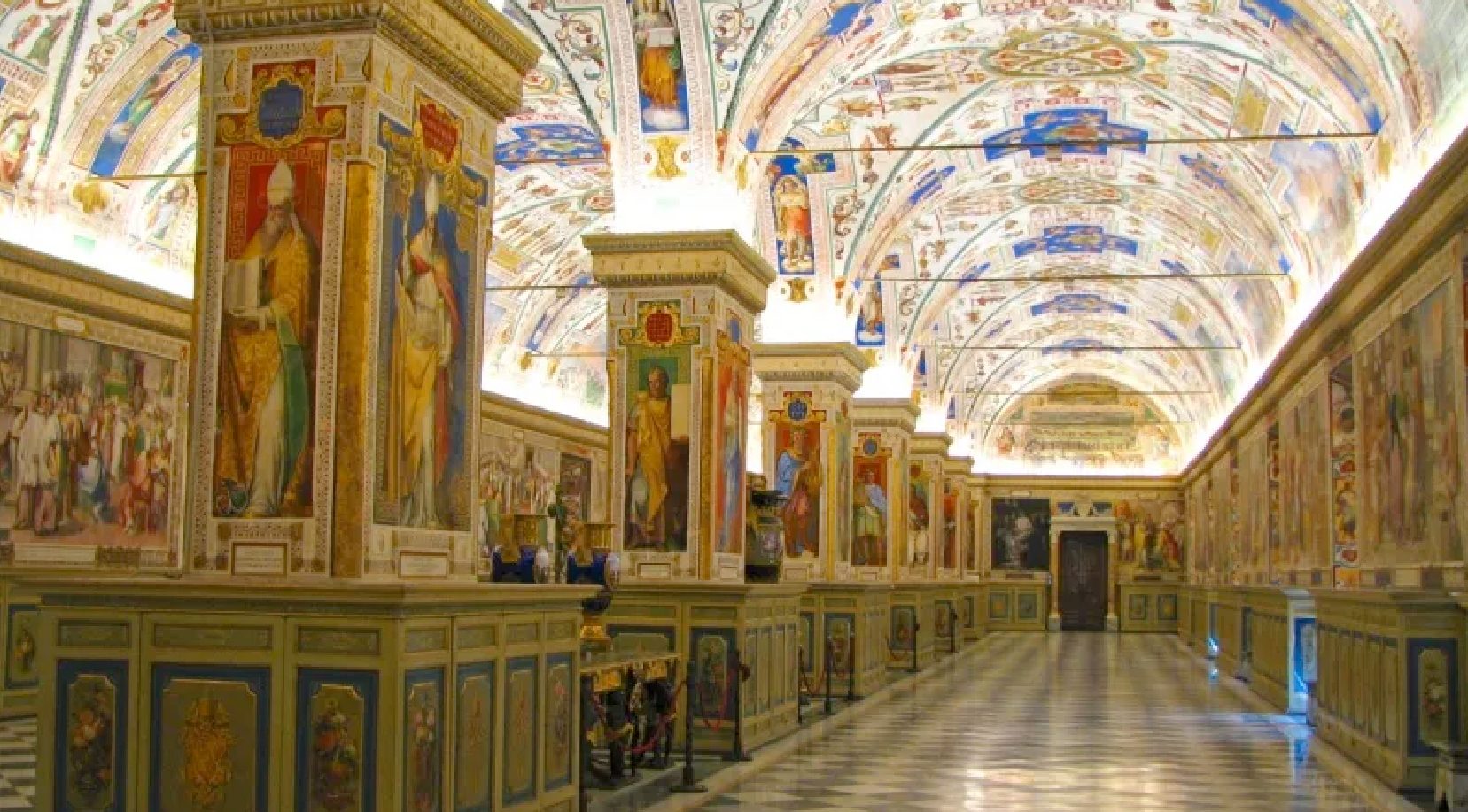
(ZENIT News / Rome, 10.10.2025).- What began as a gesture of hospitality toward visiting scholars has become a lightning rod for controversy within the Vatican walls. The revelation that Muslim researchers have been granted a dedicated room with a prayer rug inside the Vatican Apostolic Library has stirred debate over the limits of openness in one of the Church’s most symbolic institutions.
The disclosure came not through a press release, but in a casual remark during an interview with «La Repubblica» on October 8. “Of course, some Muslim scholars have asked us for a room with a carpet to pray, and we have given it to them,” said Father Giacomo Cardinali, vice-prefect of the Apostolic Library. The priest’s calm acknowledgment has since prompted a wave of critical commentary — not only because of what was offered, but because of where it was offered.
For some, the move reflects an admirable spirit of dialogue and respect for those who come from afar to study ancient manuscripts. For others, it represents a troubling confusion of mission and identity. “A library is for reading, not for worship,” one Catholic commentator wrote, echoing a concern quietly shared by many in the Vatican’s own academic circles.
Adding to the paradox, Cardinali described the library in the same interview as “the most secular of all Vatican institutions,” calling it “a humanistic institution.” The remark has left some observers wondering how such self-definition fits with the decision to provide a space explicitly designated for religious practice — and for a religion other than Catholicism.
Founded in the 15th century, the Vatican Apostolic Library has long been the beating heart of Catholic scholarship, a repository of both faith and intellect. Its vast collection — two million printed books, 80,000 manuscripts, 50,000 archival documents, and hundreds of thousands of coins, engravings, and medals — includes treasures from nearly every civilization and creed. Among them are some of the oldest surviving copies of the Qur’an, as well as rare Hebrew, Coptic, and Chinese texts.
Cardinali emphasized this universal scope as a point of pride. “We are a universal library,” he told «La Repubblica». “We hold Arabic, Jewish, Ethiopian, and Chinese collections of unparalleled richness.” In that sense, the small prayer room could be seen as an extension of this universality — an act of courtesy toward scholars who come not as pilgrims, but as researchers.
Yet the question remains: can a Catholic institution extend hospitality in this way without blurring the lines between welcome and witness? Critics argue that creating a designated prayer space, even as a pragmatic accommodation, risks signaling a kind of religious equivalence — a symbolic step too far in the age of interreligious sensitivity.
“If prayer rooms are offered to Muslims,” one theologian asked, “what will happen when Jewish, Hindu, or Buddhist scholars request the same? Will the Vatican provide separate spaces for all faiths?”
The episode touches a deeper nerve in contemporary Catholic life — the tension between the Church’s universal openness and its distinct identity. The Apostolic Library, though “humanistic” in function, remains part of the papal household, its collections preserved under the authority of the Holy See. Its ethos is rooted in the conviction that faith and reason coexist within the Catholic tradition, not outside it.
Seen from that perspective, the gesture toward Muslim visitors may seem, to some, less like inclusion and more like self-effacement — a well-intentioned step that unintentionally diminishes the Catholic character of a sacred institution.
Still, within the Vatican itself, voices of alarm remain muted. Many officials view the matter as a simple courtesy, unlikely to alter the library’s mission or atmosphere. “It’s a room, not a statement,” said one curator familiar with the situation, who spoke on condition of anonymity. “The manuscripts themselves speak louder than any prayer rug.
Thank you for reading our content. If you would like to receive ZENIT’s daily e-mail news, you can subscribe for free through this link.

Publicaciones relacionadas:
 Vatican in Saudi Arabia thanks to Vatican Apostolic Library
 Rupnik was not «the cause»: Vatican clarifies why Cardinal Ladaria asked for dispensation from Synod
 Fire in Popes’ Pontifical Villa
 National Vocation Awareness Week Invites the Faithful to Pray for an Increase in Vocations in the United States
