

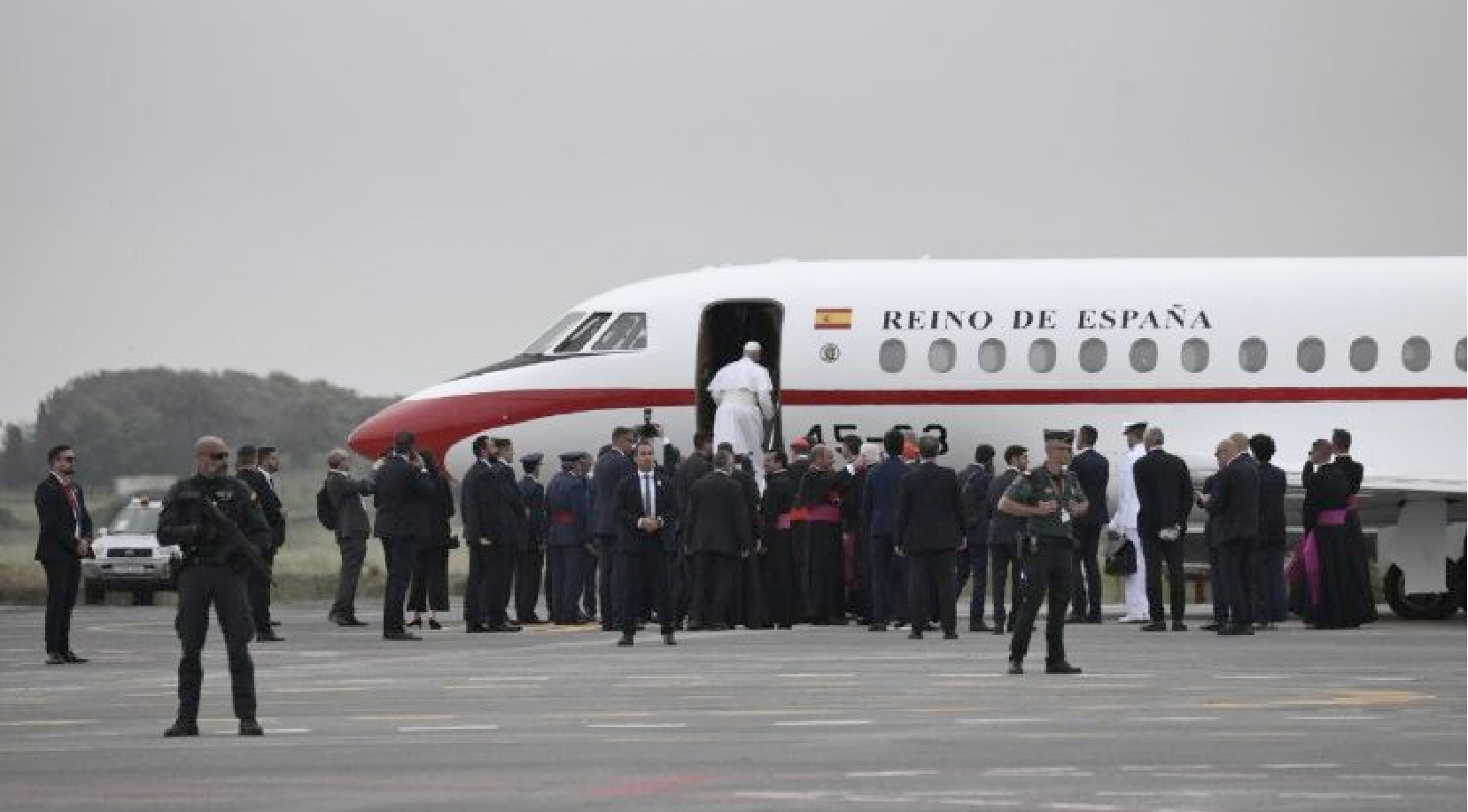
(ZENIT News / Tenerife, 06.12.2026).- Few apostolic journeys conclude with an aviation drama, a royal gesture, and a vivid reminder that even papal schedules remain subject to the unpredictability of ordinary life. Yet that is precisely how Pope Leo XIV’s week-long visit to Spain came to an end.
What was supposed to be a routine return flight from Tenerife to Rome on June 12 transformed into an unusual episode that forced the Pontiff to abandon his scheduled aircraft and accept the personal assistance of King Felipe VI of Spain.
The Pope had arrived at Tenerife Airport after completing the final events of a demanding seven-day apostolic journey that had taken him from Madrid to Barcelona and then to the Canary Islands. The Iberia Airbus A320 assigned to transport him and his delegation back to Rome was prepared for departure, and the more than 80 journalists accompanying the papal flight had already boarded.
Everything appeared normal until shortly before takeoff.
After the aircraft doors had been closed and preparations for departure were underway, the crew detected an anomaly affecting one of the plane’s systems. As technicians investigated the issue, passengers were informed that maintenance personnel were attempting to resolve the malfunction. Initial expectations suggested only a brief delay.
Those hopes quickly faded.
According to information communicated from the cockpit, one of the aircraft’s engines was not responding as expected. Maintenance teams attempted several procedures, including repositioning the aircraft into the wind to facilitate a new engine start. The unusual maneuver reflected the possibility that strong winds affecting Tenerife Airport might have contributed to the problem.
The attempt failed.
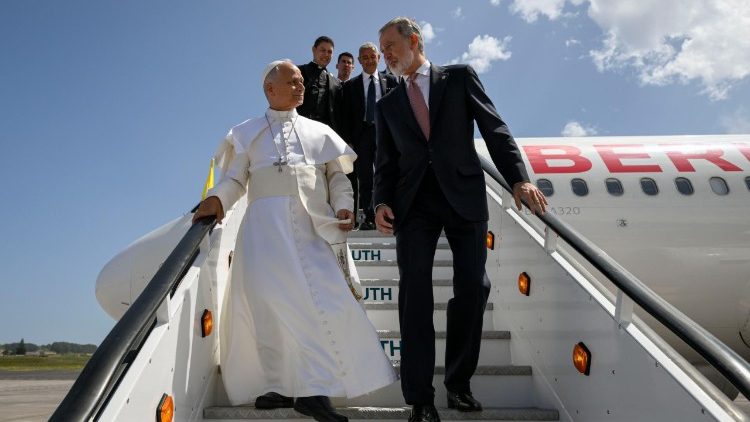
As uncertainty mounted, passengers remained on board for more than an hour while technicians assessed the situation. Eventually, the decision was made to disembark everyone. Iberia later confirmed that the technical issue could not be repaired immediately and announced that a replacement aircraft would be dispatched from Madrid.
By then, however, another solution had emerged.
King Felipe VI, who had accompanied the Pope to the airport and had already formally bid him farewell, personally intervened by offering the use of his Falcon military aircraft. The gesture allowed Leo XIV and a reduced Vatican delegation to avoid several additional hours of waiting and continue directly to Rome.
The offer was accepted.
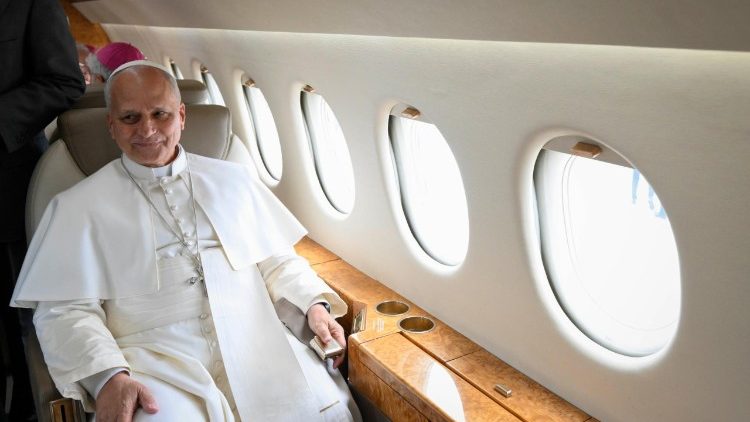
Shortly after 6 p.m. local time, the Pope departed Tenerife aboard the Spanish royal aircraft, while Vatican personnel, cardinals, bishops, and members of the media remained behind to return later on the replacement Iberia flight.
The Falcon landed at Rome’s Fiumicino Airport at approximately 11:05 p.m., bringing to a close one of the most eventful papal trips of recent years and one of the most unusual returns ever recorded in the history of modern papal travel.
Veteran Vatican observers struggled to recall comparable incidents. Although rare, technical difficulties have occasionally disrupted papal flights. In 1990, Pope John Paul II was forced to make an emergency stop in Malta because of technical problems. Earlier, severe weather prevented his aircraft from landing in Rome after a trip to India, requiring an unexpected arrival in Naples and a subsequent train journey to the capital. Even so, a reigning monarch personally lending his official aircraft to a Pope remains an exceptional occurrence.
The incident overshadowed neither the success nor the significance of the Spanish visit itself.
Over seven days, Leo XIV completed one of the most ambitious international journeys of his young pontificate. In Madrid, he met King Felipe VI and Queen Letizia and celebrated the Corpus Christi Mass before an estimated 1.2 million faithful in Plaza de Cibeles. He later presided over a youth vigil attended by approximately 600,000 young people and addressed Spain’s Parliament, becoming the first Pope in history to speak before that institution.
In Barcelona, he visited the Monastery of Montserrat and presided over a historic ceremony at the Sagrada Família, inaugurating and blessing the Tower of Jesus. The event carried particular symbolic weight as it coincided with the centenary of the death of architect Antoni Gaudí and elevated the basilica to the distinction of being the tallest church building in the world.
The final days in the Canary Islands revealed another defining theme of Leo XIV’s pontificate: concern for migrants and vulnerable populations. During encounters with migrant communities, he delivered some of his strongest remarks to date against human trafficking, warning those who profit from the exploitation of the poor that neither wealth nor power can shield them from divine justice.
As he crossed the Mediterranean on his unexpected royal flight home, the Pope sent telegrams of gratitude to the leaders of the nations connected to his journey. To King Felipe VI, he expressed heartfelt thanks for the warm welcome and generous hospitality received throughout the visit. He assured the Spanish people of his continued prayers for peace and national unity. Similar messages were sent to King Mohammed VI of Morocco and to Italian President Sergio Mattarella.
Notably absent from those communications was any mention of the aircraft malfunction that had unexpectedly altered his return.
Perhaps that silence was itself revealing. Throughout the week, Leo XIV repeatedly emphasized trust in Providence, gratitude, and Christian fraternity. In the end, a technical failure that could have become a source of frustration instead became an illustration of international courtesy, cooperation, and goodwill.
For Spain, the image that may endure is not that of a grounded airliner on a windy runway in Tenerife, but that of a King and a Pope walking together down an aircraft staircase, smiling despite the disruption, before finding an unexpected solution to an unforeseen problem. It was a fittingly human conclusion to a journey marked by faith, encounter, and hope.
Thank you for reading our content. If you would like to receive ZENIT’s daily e-mail news, you can subscribe for free through this link.

Publicaciones relacionadas:
 Pope Leo XIV’s homily for catechists and the vindication of the catechism as an instrument against ecclesial discord
 What did the Pope say to the Knights of Columbus? Leo XIV receives them in audience
 What do humility, wounds, and the Resurrection have in common? Pope Leo XIV explains it this way
 How does Jesus quench our thirst for fulfillment? The beautiful catechesis of Pope Leo XIV that you will identify with
