

(ZENIT News / Rome, 10.18.2025).- When the wooden hull of the Bel Espoir glided quietly into the port of Ostia, the ancient harbor of Rome, its sails carried more than Mediterranean wind — they carried eight months of stories, friendships, and encounters stitched together across thirty ports and a dozen nations. The three-masted schooner, whose name means “Beautiful Hope,” has become a floating parable of the sea’s power to unite rather than divide. And on October 17, the vessel received an unexpected visitor who understood that language better than most: Pope Leo XIV.

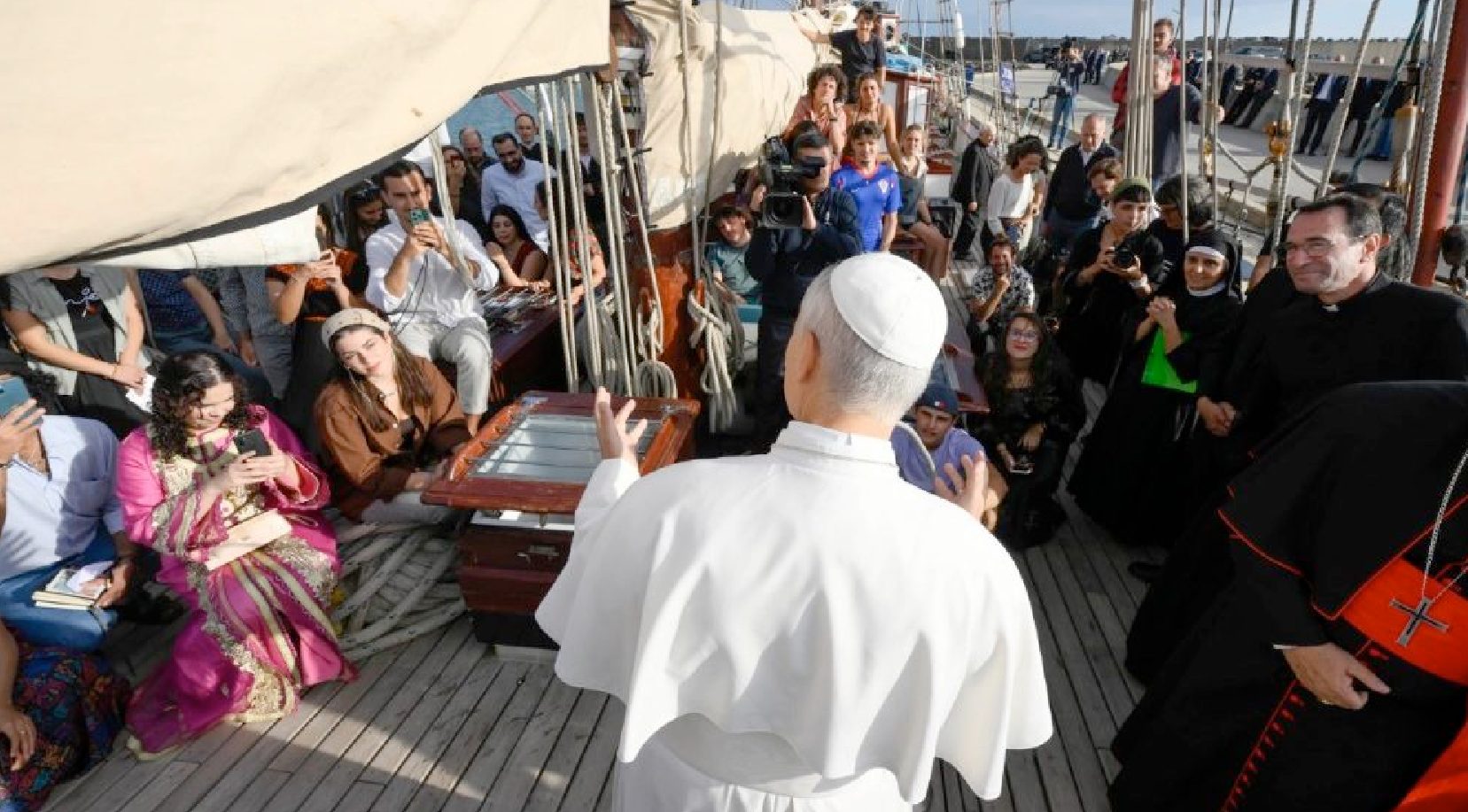
The Pope’s arrival was unannounced, though rumors had swirled since the ship dropped anchor two days earlier after sailing up the Tyrrhenian coast from Naples. Dressed simply in white, Leo XIV stepped aboard, greeting the crew of young sailors — Christians, Muslims, and others — with an embrace and a smile that seemed to dissolve the formality of the moment. “You are a sign of hope for the Mediterranean and for the world,” he told them.
His words resonated with the very journey of the Bel Espoir, which set sail from Barcelona last March under the blessing of Pope Francis. Now, in what many have called a “journey from one Pope to another,” the ship’s odyssey is nearing its end. The young participants — nearly 200 over the course of the voyage, sailing in small rotating groups — will soon return to Marseille, completing a circular voyage that was never just about geography. It was about humanity.
For the Pope, this visit wasn’t a photo opportunity but a pastoral moment rooted in three convictions he repeated like a refrain: dialogue, bridges, and peace.
“Learning to speak with one another, to listen, to share what we hold dear — that is the foundation of any lasting peace,” he told the young sailors gathered on deck. “Not a bridge of stone across the Mediterranean, but a bridge between hearts and peoples.”

As the pontiff moved among them, shaking hands and listening to their stories — from Albania, Egypt, Palestine, Malta, France, and beyond — the air filled with laughter and languages. The Pope leaned over the wooden rail and said quietly, “Living together on such a small boat must teach you patience, respect, and forgiveness. That is a school the world needs.”
Below deck, a small table had been set for a simple afternoon snack: apple pies, pastries, and crepes. The Pope sat among them, chatting informally about their lives and the storms — literal and human — they had weathered. Lama, a young woman from Ramallah, spoke about the fragile hope of dialogue in the Holy Land. Hanan, a Muslim from Bosnia, described how sharing prayer with Christians had changed his idea of faith. From Libya, Muhamad recounted his migrant journey across the sea he was now sailing freely.
The Pope listened, then prayed with them — an interfaith prayer composed by cloistered nuns in Pennabilli, whose monastery has accompanied the Bel Espoir spiritually since its departure. “Having him in our small world, on our boat, was overwhelming,” said Aurore, the group’s coordinator for this final leg. “He understood instantly what we’ve been living — our unity in difference.”

Cardinal Jean-Marc Aveline, the Archbishop of Marseille and founder of the Mediterranean Youth Network behind the project, called the ship “a school for building institutions of peace.” Quoting a phrase that has become a motto for the initiative, he said, “If you want peace, prepare institutions of peace — and sometimes those institutions begin with a friendship at sea.”
The Bel Espoir has been precisely that: a moving classroom of coexistence. Along its route, the young crew met Muslim and Christian leaders, survivors of migration, and scholars of ecology and theology. They were supposed to dock in Beirut, but conflict in the region forced them to change course. “At one point,” Aveline recalled with a wry smile, “there were more aircraft carriers than sailboats in the Mediterranean.”
Before leaving Rome, the group visited the tomb of Pope Francis in the Basilica of Santa Maria Maggiore and met with Vatican officials responsible for interreligious dialogue and human development. They also shared tea with Imam Salah Ramadan Elsayed of Rome’s Grand Mosque.

On the evening of October 17, as the sun dipped into the Tyrrhenian Sea, the Pope blessed the ship and its crew. Some of the youth, moved by the moment, jumped into the water laughing — a spontaneous baptism of hope.
Now the Bel Espoir sails westward once again, toward Marseille and the end of its long odyssey. From the deck, their multilingual hymn echoes over the sea:
“Peace, pace, mir, paz, salam, Bel Espoir!
Peace, paci, paix, love we share in unity…”
In the wake of the ship, as in the words of the Pope, the Mediterranean itself seems to whisper back: the world’s true horizon is fraternity.
Thank you for reading our content. If you would like to receive ZENIT’s daily e-mail news, you can subscribe for free through this link.

Publicaciones relacionadas:
 Municipal government buys house where Pope Leo XIV grew up: unanimous decision
 The parable of the Good Samaritan explained beautifully and concretely by Pope Leo XIV
 Israeli Prime Minister Calls Pope After Military Attack on Catholic Parish in Gaza
 This is how the Pope explains the hospitality of vacations and warns against the vacation industry that sells all kinds of experiences
