

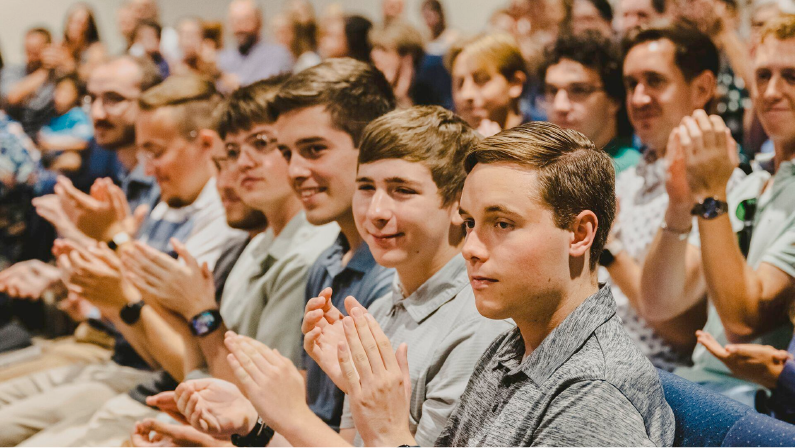
(ZENIT News / Washington, 10.30.2025).- For the first time in modern American history, young adults are more likely to be found in church pews than their parents. A new study by the Barna Group, conducted in partnership with Gloo as part of its «State of the Church» project, reveals a striking generational reversal: Millennials and members of Generation Z now attend church more frequently than Baby Boomers and the older generations who once formed the backbone of American Christianity.
The finding marks a profound cultural shift. For decades, churches across the United States relied heavily on older congregants, watching with concern as younger generations drifted away, citing secularization, disillusionment, or a simple lack of belonging. Now, the tide appears to be turning.
Barna’s data show that Gen Z Christians attend religious services an average of 1.9 weekends per month, while Millennials follow closely at 1.8. Both figures have risen steadily since the COVID-19 pandemic, marking the highest levels of young adult church attendance since Barna began tracking generational trends a quarter-century ago. In contrast, Baby Boomers now average just 1.4 attendances per month—a dramatic fall from around two per month in the year 2000. Generation X, once expected to bridge the gap between the secular and the devout, remains steady at 1.6.
“This isn’t something we typically see,” said Daniel Copeland, Barna’s vice president of research. “Historically, the older the demographic, the higher the attendance rate. What we’re witnessing now suggests that a spiritual renewal is quietly taking root among younger adults.”
The numbers may be modest, but the implications are far-reaching. For years, sociologists and church leaders alike have worried that Christianity in America was entering a phase of irreversible decline. Yet the data suggest a more complex reality. While total attendance across all age groups has stabilized rather than surged, the enthusiasm among younger adults hints at a possible turning point—one driven not by institutional loyalty, but by curiosity, authenticity, and a search for meaning in a fragmented world.
David Kinnaman, Barna’s CEO, sees in the data both promise and warning. “The decline among older generations shows that congregational life is becoming more fragile, less bound to tradition,” he said. “At the same time, the engagement of younger generations presents an extraordinary opportunity. But it’s one that must be handled with great care.”
Kinnaman cautioned that attendance alone does not necessarily translate into deeper faith. “Going to church doesn’t automatically form disciples,” he noted. “Even as participation rises among younger people, the challenge remains to shape minds and hearts that live their faith beyond Sunday morning.”
According to Barna’s analysis of more than 132,000 interviews over 25 years, the average American churchgoer—regardless of age—now attends services roughly 1.6 weekends per month, or about two Sundays out of five. That figure reveals a reality both hopeful and sobering: while engagement persists, it is still far from the weekly rhythm that once defined American religious life.
The Barna findings echo similar patterns observed abroad. In Northern Ireland, recent research from the Iona Institute found that members of Generation Z are displaying a stronger faith and greater church involvement than their parents—a “quiet resurgence,” as researchers described it, mirrored in other parts of the Western world.
Why now? Analysts suggest that the upheavals of recent years—the pandemic, social division, economic uncertainty, and digital overload—may have reignited a spiritual hunger that institutions had long struggled to address. For younger Americans, church is less about obligation and more about connection, meaning, and identity.
In a culture that often prizes individualism and self-expression, the sight of a new generation returning to communal worship carries symbolic weight. The young adults filling pews today are not repeating the faith patterns of their parents; they are reimagining them.
As Barna’s researchers put it, if the current trajectory holds, “the spiritual explorations of the next generation could redefine the very nature and vitality of Christianity.”
In other words, America’s long-predicted post-Christian future may not arrive as expected. Instead, a quieter, humbler revival—led by those once thought lost to secularism—may already be underway, one church service at a time.
Thank you for reading our content. If you would like to receive ZENIT’s daily e-mail news, you can subscribe for free through this link.

Publicaciones relacionadas:
 Germany: research reveals that young clergy are conservative and opposed to ecclesiastical progressivism
 Germany: Study Shows That Young Muslims Believe More in God Than Catholics
 The Vanishing Line Between Sin and Choice: How America’s Moral Compass Is Being Rewritten
 Beyond emotion: Spanish bishops publish a critique of the emotionalism of spiritual retreats
