

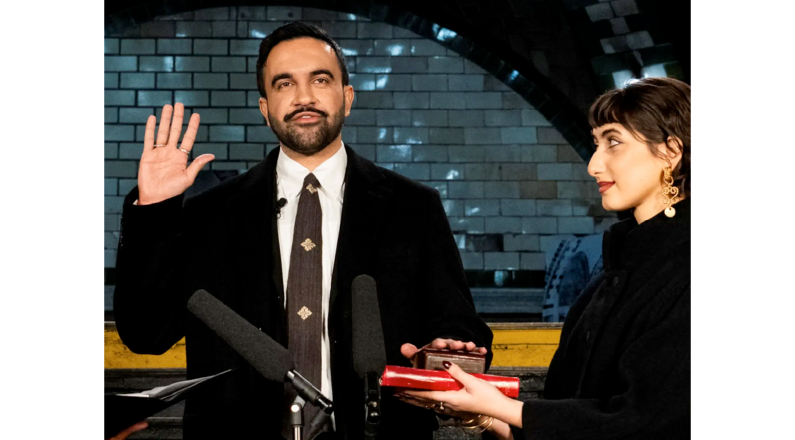
(ZENIT News / New York, 01.05.2026).- New York entered 2026 with a change of leadership that is already reshaping the city’s political and religious conversation. Zohran Mamdani, sworn in on January 1 as the city’s 112th mayor, embodies a convergence of firsts and tensions: at 34, he is among the youngest to hold the office; he is the first Muslim mayor in the city’s history; and he arrives at City Hall with a platform that openly challenges prevailing economic orthodoxies, with camouflaged communism. The result has been an unusually vivid public debate, in which faith communities have emerged both as allies and as critics.
Mamdani’s inauguration carried a symbolism that extended well beyond protocol. He took the oath of office on the Qur’an rather than the Bible, a gesture consistent with his faith but rare in the city’s civic rituals, while retaining the traditional, non-confessional invocation “so help me God.” The oath was administered by Senator Bernie Sanders, a deliberate nod to the progressive wing of the Democratic Party and to the electorate that propelled Mamdani through the primaries and into office.
In his inaugural address, Mamdani framed his mandate as a response to what he described as a city strained by inequality and social fragmentation. He spoke of uniting communities long accustomed to existing side by side rather than together, and of fostering solidarity across lines of language, origin and belief. The phrase that quickly became the most debated, however, was his pledge to replace “the coldness of rugged individualism with the warmth of collectivism,” a formulation that drew both applause and alarm.
Prominent Catholic voices were quick to react. Bishop Robert Barron of Winona–Rochester, a nationally influential figure through his Word on Fire ministry, took to social media to express sharp concern. In his view, the language of collectivism carries historical and moral weight that cannot be ignored. Barron pointed to the catastrophic human toll associated with socialist and communist systems in the twentieth century and insisted that Catholic social teaching has consistently rejected such ideologies. He contrasted Mamdani’s rhetoric with the Church’s qualified endorsement of the market economy, which it sees as grounded in personal freedom, rights and human dignity, while also insisting that economic life must be ordered to moral ends and the common good.
Barron’s intervention was notable not only for its substance but also for its origin. It did not come from New York’s archdiocese, which itself is undergoing a transition. In December, Pope Leo XIV accepted the resignation of Cardinal Timothy Dolan and appointed Bishop Ronald Hicks of Joliet, Illinois, as the new archbishop of New York. Hicks will be installed at St. Patrick’s Cathedral on February 6, an event that traditionally draws civic leaders, including the mayor. While Mamdani met with Cardinal Dolan late last year to discuss shared concerns over migration policy, a meeting with Hicks has yet to take place, though diocesan officials expect it to occur around the time of the installation.
Alongside criticism, there has also been an outpouring of support from interfaith leaders across the city. On inauguration day, a coalition of religious representatives publicly welcomed Mamdani’s commitment to equity and inclusion and called for the strengthening of an Office of Faith and Community Partnerships that would report directly to the mayor. They emphasized the longstanding contributions of religious communities to New York’s civic life and expressed readiness to collaborate with the new administration in areas ranging from social services to neighborhood cohesion.
The political tone of the inauguration was reinforced by remarks from Representative Alexandria Ocasio-Cortez, a Catholic and one of Mamdani’s most visible allies. Addressing the crowd, she cast the election as a choice for courage over fear and for broad-based prosperity over what she described as extreme income inequality. Her words captured the aspirations of many supporters who see in Mamdani’s agenda a chance to expand affordable housing, universal childcare and a cleaner, more accessible public transportation system.
The early days of Mamdani’s mayoralty thus reveal a city negotiating familiar questions in a new register. How should economic justice be pursued without undermining personal freedom? What role should religious traditions play in public life within an increasingly pluralistic society? And how can political language inspire solidarity without reopening ideological wounds?
For now, New York’s faith communities are responding in different ways: some extending a hand of cooperation, others sounding a note of warning.
Thank you for reading our content. If you would like to receive ZENIT’s daily e-mail news, you can subscribe for free through this link.

Publicaciones relacionadas:
 Almost Half a Million Catholics of India Are Putting Themselves in Imminent Schism for
 This Is the Vocational Decline in Europe in 2023
 Gays in Seminaries? In Regard to Homosexuals and the Priesthood, the Norms Have Not Changed at All
 Pope Francis yes, Church no: survey reveals that the Pope is the most trusted person in Italy
