

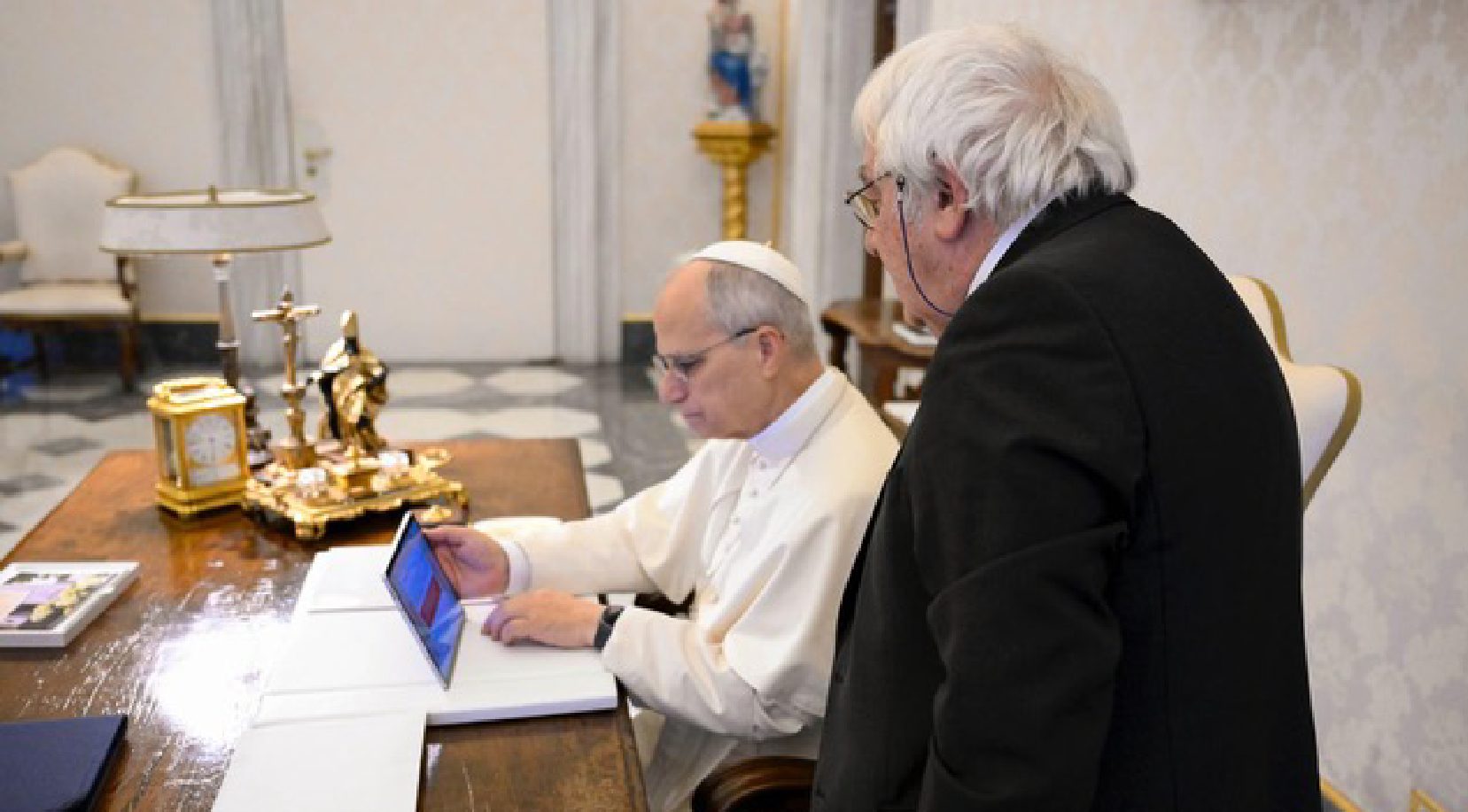
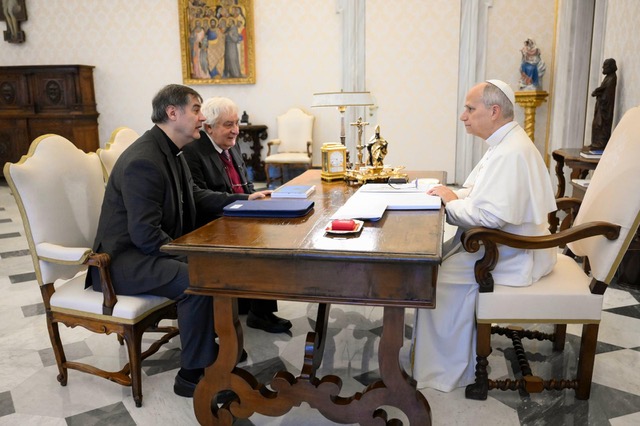
(ZENIT News / Rome, 01.11.2026).- On the morning of Friday, January 9, Pope Leo XIV stepped into an encounter with the Shroud of Turin unlike any experienced by his predecessors. Inside the Apostolic Palace, the Pontiff became the first person to explore a new digital reading of the Shroud, an initiative known as Avvolti, presented to him by Cardinal Roberto Repole, Archbishop of Turin and pontifical custodian of the relic. The moment marked a symbolic threshold: one of Christianity’s most studied and enigmatic images entering fully into the digital age.
The initiative introduces a way of engaging with the Shroud that has never before been available to the general public. For the first time, the image can be explored online through a dedicated platform, accessible via the websites avvolti.org and sindone.org. The program works on smartphones, tablets, and computers, making the Shroud available globally without geographical or logistical barriers. What once required travel to Turin and access to rare exhibitions can now be approached from anywhere in the world.
At the heart of the project lies an interactive digital reproduction that allows users to move across the surface of the Shroud as if tracing it with their own hands. Key details—the face, the marks associated with the crown of thorns, and other elements traditionally linked to the Passion—can be enlarged and examined closely. Each magnified section is accompanied by explanatory texts and direct references to Gospel passages describing the suffering and death of Jesus. The result is not a purely visual experience but a guided reading that combines image, Scripture, and interpretation.
The architects of the project have been careful to define its audience. While the texts and images are grounded in scientific rigor and serious scholarship, the aim is not to produce a tool for specialists alone. Instead, the digital reading is designed to be intelligible to a broad public, including those with little prior familiarity with the Shroud. The ambition is catechetical as much as educational: to allow the image to speak beyond academic circles and reach ordinary believers, seekers, and the curious.
This global digital experience is one component of Avvolti, a wider initiative launched by the Diocese of Turin in connection with the Jubilee of 2025. Earlier 2025 year, the project took physical form in the heart of the city. From April 28 to May 5, a large Avvolti tent was installed in Piazza Castello, offering visitors a series of proposals centered on the Shroud. Among them was a striking installation: a life-size, 1:1 reproduction of the Shroud displayed on a specially designed table measuring five meters in length. Over the course of eight days, more than 30,000 people passed through the tent, coming from 79 different countries. The scale of participation confirmed that interest in the Shroud remains both intense and international.
The digital platform now available online is an adaptation of that same experience. What visitors encountered physically on the five-meter table has been translated into a format suitable for personal screens, without losing the sense of progression and discovery. Images and texts from the experience are also being shared through social media channels, including Facebook and Instagram, extending its reach even further.
Cardinal Repole has framed the initiative within a broader pastoral vision. The release of the global digital experience, he explained, forms part of a structured “Shroud pastoral program” launched by the Diocese of Turin in 2024. Avvolti represented its core expression during the Jubilee year of 2025, but it is not intended as a one-off project. Additional initiatives are already being planned and developed, with the aim of accompanying the faithful over the coming years toward another significant horizon: the Jubilee of 2033, traditionally associated with the two-thousandth anniversary of Christ’s Redemption.
Beyond its technical innovation, the digital reading of the Shroud raises a deeper question about how ancient religious symbols function in a hyperconnected world. By allowing the Shroud to be explored in detail, patiently and personally, the project invites a slower, more contemplative form of engagement—one that contrasts with the rapid consumption typical of digital media. In this sense, Avvolti is not merely about accessibility. It represents an attempt to translate silence, mystery, and meditation into a language that contemporary audiences can understand, without stripping the relic of its complexity.
The Pope’s early encounter with the platform underscores the significance the Vatican attributes to this effort. It signals an openness to new forms of evangelization that respect tradition while embracing technology. The Shroud of Turin, an object that has survived centuries of scrutiny, debate, and devotion, is now poised to reach millions in a new way—pixel by pixel, text by text—inviting a global audience to look again, and perhaps to look deeper.
Thank you for reading our content. If you would like to receive ZENIT’s daily e-mail news, you can subscribe for free through this link.

