

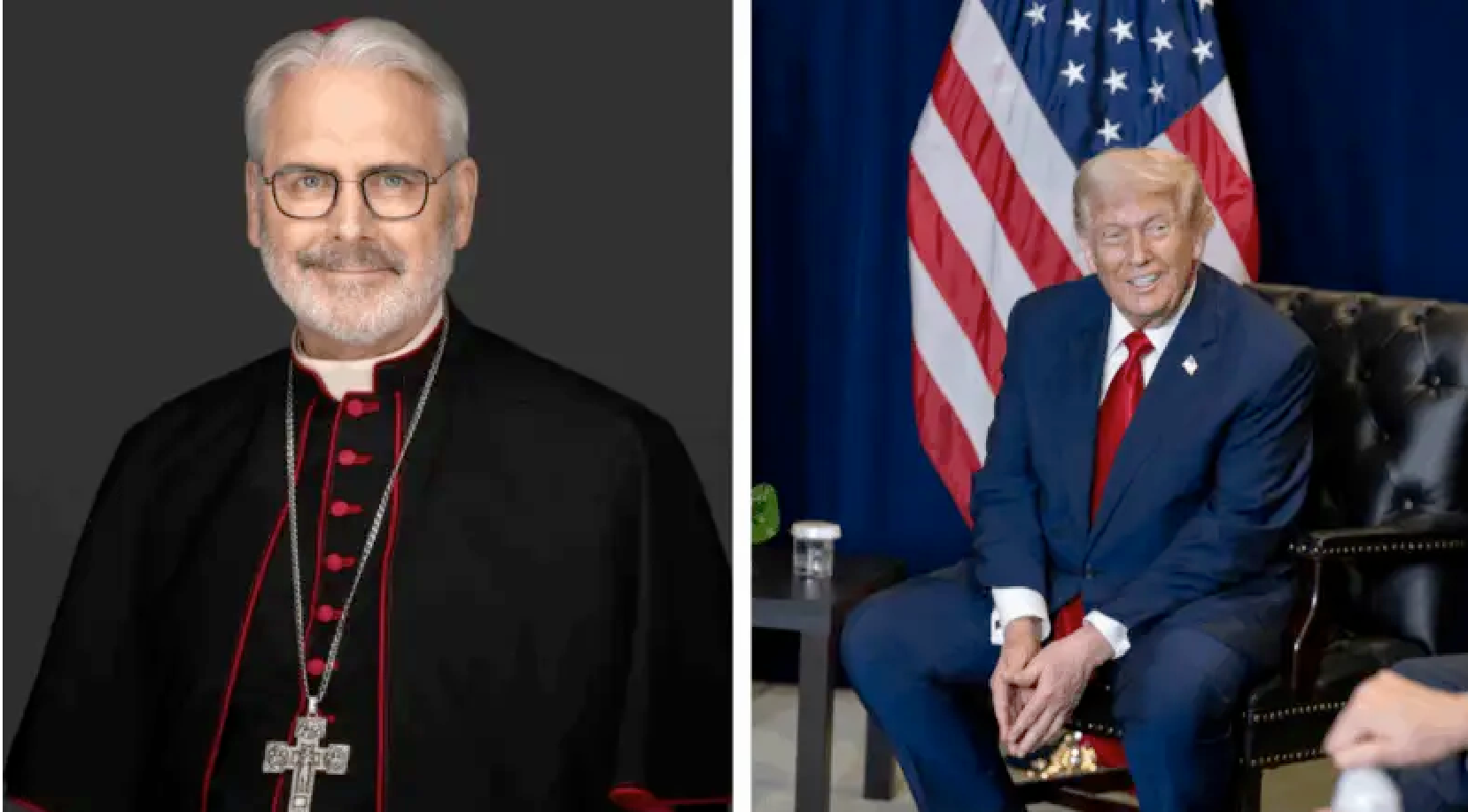
(ZENIT News / Washington, 01.13.2026).- For the first time in nearly a decade, the president of the United States Conference of Catholic Bishops sat down with a sitting U.S. president inside the White House. On Monday, January 12, Archbishop Paul Coakley of Oklahoma City met with President Donald Trump, Vice President J.D. Vance, and senior administration officials in a closed-door conversation that both sides described as an opening for sustained dialogue on issues of shared concern.
Coakley, elected president of the USCCB in November 2025, has inherited a conference navigating one of the most complex moments in its relationship with Washington in recent memory. Immigration enforcement, cultural policy, and the future of Church–state cooperation were all widely understood to be hovering over the meeting, even though no detailed agenda was made public.
According to Chieko Noguchi, spokesperson for the bishops’ conference, the encounter focused on “areas of mutual concern” and on identifying topics where further discussion would be productive. Coakley, she said, expressed gratitude for the engagement and signaled his expectation that the conversation would continue. The White House did not release its own readout, though spokesperson Karoline Leavitt indicated she would ask the president whether he wished to summarize the meeting publicly.
The symbolism of the date and the setting was hard to miss. The last comparable meeting took place in 2017, when Cardinal Daniel DiNardo, then president of the conference, met briefly with Trump ahead of the signing of an executive order on religious liberty. Since then, efforts by DiNardo’s successors—Archbishop José Gómez of Los Angeles and Archbishop Timothy Broglio of the Archdiocese for the Military Services—to secure meetings with either Trump or President Joe Biden had gone nowhere.
Coakley’s election appears to have reopened the door. As archbishop of Oklahoma City, and as ecclesiastical adviser to the Napa Institute, he is well known within conservative Catholic circles. The institute’s cofounder, Tim Busch, has publicly praised Trump’s administration as the most overtly Christian he has encountered and has highlighted the presence of prominent Catholics among the president’s senior advisers.
Yet Coakley’s posture toward the administration cannot be reduced to ideological alignment. Immigration, long one of the most sensitive fault lines between U.S. bishops and Republican administrations, remains central. In a November 2025 special message released during the bishops’ fall assembly, the conference warned against “indiscriminate mass deportation,” carefully avoiding mention of Trump by name while clearly addressing policies associated with his second term. In a video message shown at that same meeting, Coakley described immigration as a “difficult and nerve-wracking issue” but insisted it would remain a priority for the bishops.
He had already hinted at direct engagement weeks earlier. Appearing on CBS News’ Face the Nation on December 21, 2025, Coakley predicted that immigration would feature prominently in any discussion with Trump. “I think we have opportunities to work together,” he said at the time. “We have opportunities to speak frankly.”
That frankness has not always been reciprocated. In January 2025, shortly after assuming office as vice president, J.D. Vance publicly criticized the bishops’ conference for opposing a policy that expanded immigration enforcement authority in churches. He accused the conference of assisting in the resettlement of undocumented immigrants and of being motivated by financial concerns, a reference to federal funds historically received for refugee resettlement. Months later, after the Trump administration suspended the federal refugee resettlement program, the USCCB announced it would no longer partner with the government in that effort.
On other issues, the lines are less contentious. Coakley has been outspoken in his opposition to gender-affirming medical interventions and to what he calls the broader “transgender movement,” positions that closely mirror the administration’s recent executive orders restricting such care and reaffirming a binary understanding of sex. At the same time, tensions have emerged even on traditionally aligned terrain. In the first week of January 2026, Trump urged House Republicans to show “flexibility” on the Hyde Amendment, the longstanding provision barring federal funding for abortion—a policy the bishops have repeatedly defended as lifesaving and conscience-protecting.
The political choreography of January 12 extended beyond Washington. That same day, Pope Leo XIV received Venezuelan opposition leader María Corina Machado at the Vatican, underscoring how questions of sovereignty, democracy, and migration in the Americas are now being addressed simultaneously in Rome and in the White House. The pope has repeatedly insisted that migrants be treated with dignity and has urged Catholics in the United States to take seriously the guidance of their bishops on immigration, a backdrop that gives Coakley’s meeting additional weight.
Taken together, the events suggest not a sudden convergence of Church and state, but a cautious recalibration. After years of missed connections and public friction, the simple fact of a January 12 meeting marks a shift. Whether it leads to concrete policy influence or merely sustained conversation remains to be seen. What is clear is that Archbishop Coakley has positioned himself as a bridge figure at a moment when both the U.S. bishops and the Trump administration appear to recognize that silence and distance are no longer viable options.
Thank you for reading our content. If you would like to receive ZENIT’s daily e-mail news, you can subscribe for free through this link.

Publicaciones relacionadas:
 Innovative tool for priests to guide penitents to holiness in confession, help them grow in virtue, and inspire everyone to become saints
 New Reliquary Enables Public to See Saint Thomas Aquinas’ Cranium
 Bishops appeal for peace as Nigeria stands on “edge of a dangerous precipice”
 Sydney to Host 2028 International Eucharistic Congress: A Historic Return to Australia
