

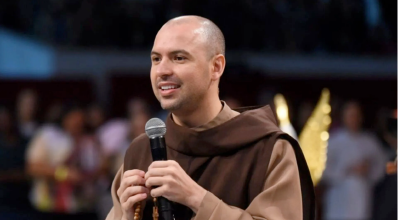
(ZENIT News / Rio de Janeiro, 01.18.2026).- While Brazil’s digital platforms are usually dominated by esports stars and sports commentators, 2025 produced an unlikely phenomenon at the very top of the streaming charts: a Catholic friar chanting the rosary before dawn. Father Gilson Pupo Azevedo, known nationwide as Frei Gilson, ended the year as Brazil’s most-watched streamer, surpassing gaming celebrities and evangelical preachers alike.
According to data compiled by Stream Charts, Frei Gilson’s content accumulated more than 153 million hours of viewing time across platforms in 2025. By comparison, Alexandre “Gaules” Barbosa, one of the country’s most prominent Counter-Strike commentators, logged around 95 million hours, while evangelical bishop Bruno Leonardo followed with nearly 68 million. In a media ecosystem built around entertainment, speed and spectacle, the numbers point to something counterintuitive: long, prayer-centered religious broadcasts attracting mass audiences.
Frei Gilson, 39, is a member of the Carmelites Messengers of the Holy Spirit and also a singer who leads a ministry called Som do Monte, or Sound of the Mountain. His public profile has grown steadily in recent years, but the decisive breakthrough came through an austere and demanding proposition: inviting people to wake up at 4 a.m. to pray the rosary with him live on YouTube.
In 2024, about 700,000 viewers joined him simultaneously for these early-morning prayers. In 2025, that number climbed past one million. The broadcasts often form part of the Lent of St. Michael, a 40-day devotion ending on September 29, the feast of the archangel, marked by fasting and daily prayer. For many Brazilians, it has become a demanding spiritual routine woven into daily life.
Visually and rhetorically, Frei Gilson defies the conventions of online celebrity clergy. He appears consistently in a brown Carmelite habit, with a shaved head, and avoids the polished aesthetics associated with television evangelism. His preaching is explicitly Catholic and unapologetically doctrinal, with frequent references to Scripture, sin, repentance and conversion. The content is not optimized for brevity or easy consumption: his YouTube videos, where he has 8.7 million subscribers, often run longer than 90 minutes.
What makes the phenomenon more striking is the absence of a conventional growth strategy. Frei Gilson has repeatedly said that his rise was not engineered. “There was never any planning,” he told Crux. “No meetings to define social media strategies, no financial investment, no concern about paying to reach a certain number of people.” He attributes the scale of his reach to what he calls “simple, genuine and faithful evangelization,” combined with a constant, daily presence in people’s lives.
Church leaders who have followed his ministry point to a deeper dynamic at work. Bishop Devair Araújo da Fonseca of Piracicaba, who has observed Frei Gilson’s impact for years, says the key lies in a blend of prayer and moral clarity. Unlike religious figures who soften difficult teachings, Gilson addresses personal sin and calls explicitly for conversion. According to the bishop, that message has tangible sacramental consequences: people arrive at confession citing examinations of conscience prompted by Gilson’s live streams, including adults who have never been confirmed and Catholics in irregular marital situations.
As his audience expanded, Frei Gilson was invited onto some of Brazil’s most influential podcasts, exposing him to listeners well beyond traditional churchgoing circles. Yet, according to Guto Azevedo, founder of the Catholic podcast Santo Flow, the message did not change. Azevedo recalls a four-hour interview in which most of the conversation focused directly on Scripture and the Church’s magisterium. “He teaches what the Church teaches,” Azevedo said. “That is the central element.”
Santo Flow itself illustrates the broader digital shift within Brazilian Catholicism. The podcast has grown to 640,000 YouTube subscribers, making it the most-watched Catholic podcast in the country. Its strategy contrasts with Frei Gilson’s long-form approach: up to 15 short clips are published daily, tailored to the viewing habits of younger audiences. For Azevedo, the pandemic revealed both the necessity and the limitations of the Church’s online presence. Many parishes learned to livestream Mass, he argues, but few developed a comprehensive digital strategy. Effective evangelization, he insists, requires planning, professional management and the sharing of best practices across dioceses.
Yet Frei Gilson’s success also challenges some assumptions about digital religion. In an era dominated by algorithms favoring brevity, his most popular content remains lengthy, repetitive and explicitly devotional. Its appeal seems rooted less in production techniques than in consistency, theological clarity and a clear spiritual demand placed on the audience.
“I think coherence and truth have led many people to find, in our content, a place where they can listen to God, recover interiorly and nourish their souls,” Frei Gilson told Crux. The 2025 streaming rankings suggest that, at least in Brazil, hundreds of millions of viewing hours indicate that a significant audience agrees.
Thank you for reading our content. If you would like to receive ZENIT’s daily e-mail news, you can subscribe for free through this link.

Publicaciones relacionadas:
 Miracle of Faith in Iraq: 1,700 Young People Take Part in Catholic Festival
 Donate 5 million euros to emblematic Parisian church: and here are the reasons why
 France Sees Historic Surge in Adult Baptisms. Young People Lead Spiritual Revival
 Monaco reaffirms its Catholic identity by halting abortion reform: Prince refuses to enact the law
