

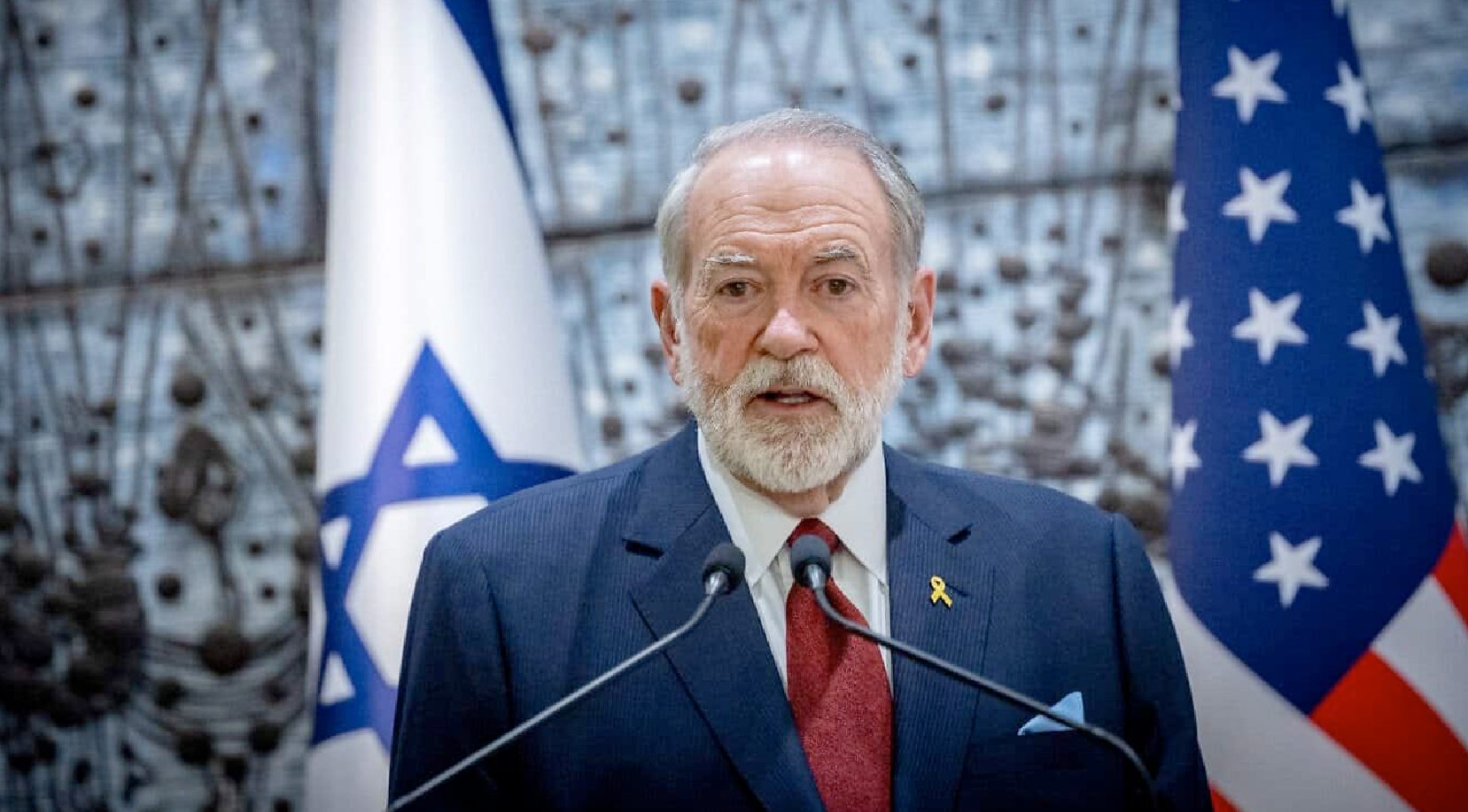
(ZENIT News / Jerusalem, 01.22.2026).- The boundaries between faith and foreign policy were tested this week in Jerusalem after the United States ambassador to Israel publicly challenged the authority of the Christian patriarchs of the Holy Land, responding directly—and unusually—to a collective letter from the region’s historic churches. The exchange has ignited debate not only about Christian Zionism, but also about how far a diplomat’s personal theology can shape, or appear to shape, official statecraft.
On Tuesday, January 20, U.S. Ambassador Mike Huckabee issued a public response to a letter released days earlier by the Patriarchs and Heads of Churches in Jerusalem. His comments, disseminated via social media, were striking both in tone and substance. Diplomats rarely intervene openly in intra-Christian theological or ecclesial disputes, especially in a region where religious authority is inseparable from fragile political and communal balances.
Huckabee, a Southern Baptist minister and prominent evangelical figure appointed ambassador in April 2025, framed his remarks as respectful but firm. While expressing personal esteem for the leaders of the ancient, liturgical churches of the Holy Land, he rejected their claim to speak for Christianity as a whole. In his words, no single group within the Christian faith should presume exclusive authority to represent Christians worldwide.
What set the statement apart, however, was its overtly theological character. Huckabee did not merely defend Israel’s right to exist in political or strategic terms; he offered an explicit endorsement of Christian Zionism, identifying himself as a committed adherent and expressing surprise that any Christian might think otherwise.
In response to the statement of non-evangelical churches in Israel, I issued the following. I hope you will read prayerfully.
I love my brothers and sisters in Christ from traditional, liturgical churches and respect their views, but I do not feel any sect of the Christian… pic.twitter.com/jqohEWk0xJ
— Ambassador Mike Huckabee (@GovMikeHuckabee) January 20, 2026
Christian Zionism, a movement rooted primarily in American evangelical Protestantism, interprets the modern State of Israel through a biblical and eschatological lens. It often views the return of the Jewish people to the land of Israel as the fulfillment of divine promises made to the patriarchs of Israel—Abraham, Isaac, and Jacob. This perspective is frequently associated with dispensationalism, a theological framework developed in the 19th century that divides history, including salvation history, into distinct eras in which God relates to humanity in different ways.
Critics, including many Catholic, Orthodox, and mainline Protestant theologians, argue that Christian Zionism risks conflating biblical Israel with the contemporary nation-state, a conflation explicitly rejected in Israel’s own foundational documents. They also warn that such theology can marginalize indigenous Christian communities in the Holy Land, many of whom are Arab and live amid the ongoing Israeli-Palestinian conflict.
Huckabee pushed back forcefully against such critiques. He argued that the label “Christian Zionist” is often used pejoratively to disparage believers from free-church traditions, who number in the millions globally. For him, being a Zionist does not entail loyalty to any particular Israeli government or policy, but rather fidelity to biblical revelation. Accepting the Jewish people’s right to live in what he described as their ancient, indigenous, and biblical homeland, he suggested, should be uncontroversial for Christians.
This theological assertion lies at the heart of the controversy. As ambassador, Huckabee’s official role is to represent and advance U.S. government policy in Israel. His statements have therefore prompted observers to ask whether his remarks reflect an official American position or his personal convictions—and where the line between the two is being drawn.
The patriarchs’ letter, released during the third weekend of January 2026, took aim at what they called the “harmful” ideology of Christian Zionism. Without naming individuals, the church leaders expressed alarm at the activities of certain local actors whom they accused of misleading the faithful, sowing confusion, and undermining the unity of Christian communities in the Holy Land. They further warned that such figures had received support at both local and international levels, intensifying their concerns.
For the patriarchs, the issue was not merely theological but pastoral and ecclesial. Their statement emphasized that interference by outside actors—especially those welcomed by political authorities—constitutes an intrusion into the internal life of the churches. It also disregards the pastoral responsibility entrusted to the patriarchs and heads of churches who, for centuries, have shepherded Christian communities in Jerusalem and beyond.
The letter reaffirmed a longstanding principle of the churches of the Holy Land: that the recognized patriarchs and heads of churches alone represent their communities in matters of religious, communal, and pastoral life. This assertion carries particular weight in Jerusalem, where historical status, legal recognition, and delicate interreligious arrangements are tightly interwoven.
The signatories reflect the extraordinary diversity of Christianity in the region. They include the Latin Patriarch of Jerusalem; the Catholic patriarchs of the Maronite, Melkite, Syriac, and Armenian traditions; the Armenian Apostolic patriarch; the Greek Orthodox patriarch; the Coptic patriarch; and the leaders of the Anglican and Lutheran churches. Together, they represent communities whose roots in the Holy Land predate the modern state system by many centuries.
By explicitly stating that his comments were a direct response to “the statement of the non-evangelical churches in Israel” and by reproducing the patriarchs’ letter in full, Huckabee underscored the confrontational nature of his intervention. What might otherwise have remained an internal ecclesial warning was elevated into an international exchange, visible to a global audience.
The episode highlights a deeper tension shaping contemporary Christianity: the growing influence of evangelical political theology on global affairs, and the unease it generates among older, territorially rooted Christian traditions. In the Holy Land, where Christian numbers are small but historically significant, that tension is amplified by the realities of occupation, migration, and demographic decline.
What is already clear is that the incident has reopened sensitive questions about representation, authority, and the role of religious belief in international diplomacy—questions that resonate far beyond Jerusalem, touching on the future relationship between American evangelicalism, the Catholic Church, and the ancient Christian communities of the Middle East.
Thank you for reading our content. If you would like to receive ZENIT’s daily e-mail news, you can subscribe for free through this link.

