

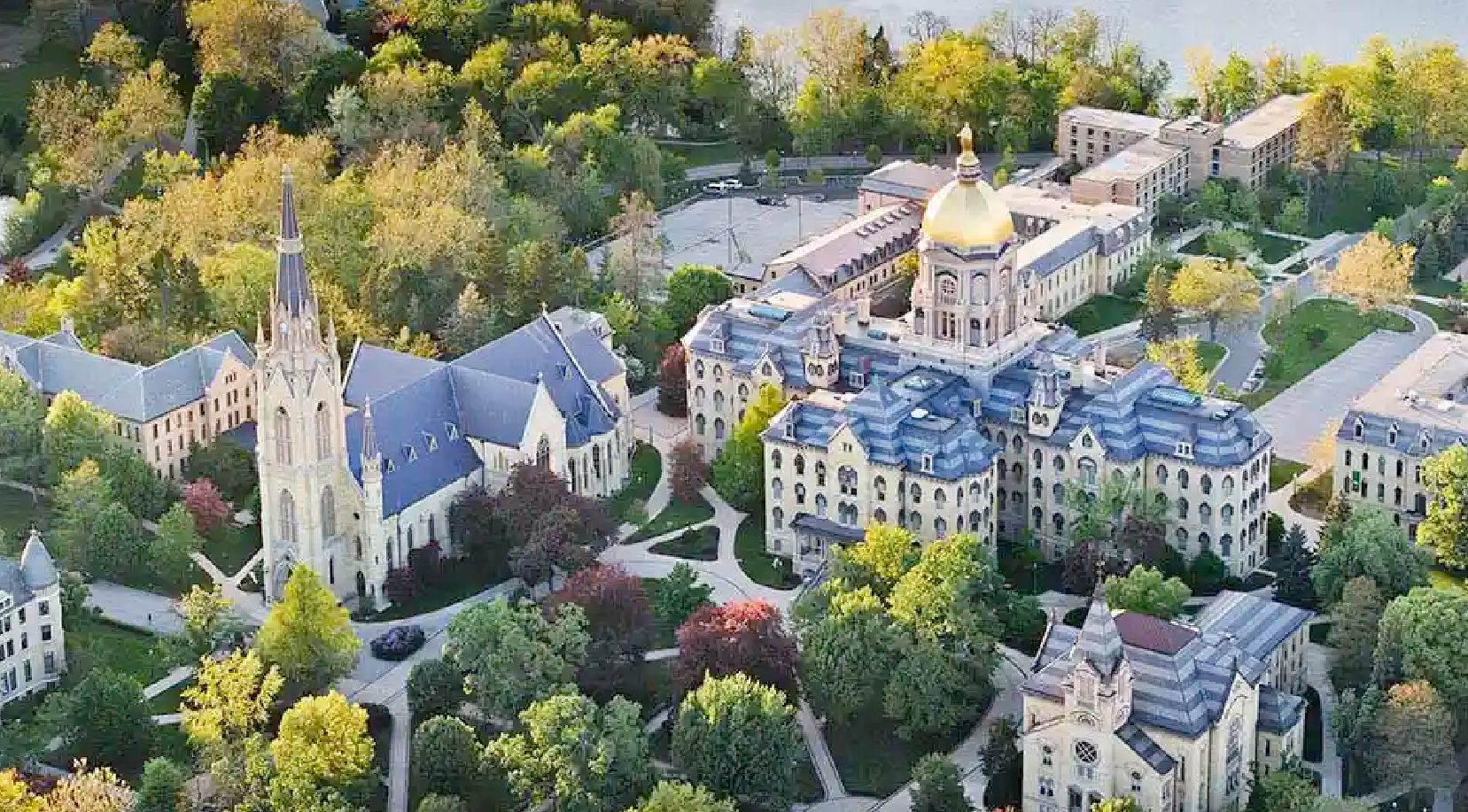
(ZENIT News / Washington, 02.12.2026).- The University of Notre Dame, long regarded as a flagship of American Catholic higher education, now finds itself navigating one of the most consequential internal disputes in its recent history. At the center of the storm is the appointment of political scientist Susan Ostermann—an outspoken advocate of abortion rights—as director of the Liu Institute for Asia and Asian Studies, a key unit within the Keough School of Global Affairs. What might have remained an internal personnel decision has escalated into a national ecclesial controversy, drawing a sharp public rebuke from the local bishop and raising fundamental questions about the meaning of Catholic identity in academic leadership.
On February 11, 2026, Bishop Kevin Rhoades of the Diocese of Fort Wayne–South Bend issued an unusually direct statement expressing “consternation” and “strong opposition” to the university’s decision. His intervention is not merely symbolic. Under the apostolic constitution Ex Corde Ecclesiae, bishops bear a specific responsibility to safeguard and strengthen the Catholic identity of universities within their jurisdiction. By invoking that document, Rhoades framed the controversy not as a political disagreement but as an issue touching the core of the Church’s mission in higher education.
The controversy began in early January 2026, when Notre Dame announced that Ostermann, a faculty member in global affairs, would assume leadership of the Liu Institute effective July 1. The institute functions as a major academic bridge between Notre Dame and Asia, engaging in research, scholarship, and dialogue across a continent where the Catholic Church is both a minority presence and, in certain regions, rapidly growing. Its mandate is explicitly tied to the promotion of “integral human development,” a term deeply rooted in modern Catholic social teaching.
Integral human development, articulated prominently in papal teaching from Paul VI through John Paul II, Benedict XVI, and Francis, refers to the flourishing of the whole person—materially, socially, morally, and spiritually. It rejects reductionist approaches that prioritize economic growth while neglecting human dignity. Pope Leo XIV, the first American-born pontiff and a native of Chicago, has recently reiterated that authentic development must encompass every dimension of the human person and must never exclude the most vulnerable.
In remarks to young political leaders cited by critics of the appointment, Leo XIV warned that no policy truly serves the people if it denies the unborn the gift of life or fails to support those in material or spiritual distress. He has also echoed Mother Teresa’s stark characterization of abortion as a profound threat to peace, calling her words “prophetic” for the present age. For many Catholics, these statements leave little room for ambiguity regarding the Church’s stance.
Ostermann’s public record, however, includes vigorous defenses of abortion access and sharp criticism of the pro-life movement, which she has linked to white supremacy and misogyny. For Bishop Rhoades, such positions do not simply reflect a diversity of political opinion. In his February 11 statement, he argued that her advocacy contradicts “a fundamental principle of justice” integral to Notre Dame’s Catholic mission. He went further, asserting that her public positions should disqualify her from administrative leadership at a Catholic institution.
The bishop also warned that leadership appointments shape the university’s public witness in a profound way. This point is not incidental. Catholic universities, especially one as prominent as Notre Dame, are not only academic institutions; they are ecclesial actors. Their administrative choices signal to students, alumni, and the broader public how they interpret and embody Catholic teaching. When those choices appear to diverge from settled doctrine—particularly on a matter the Church considers a non-negotiable defense of human life—confusion among the faithful can follow.
That confusion has already manifested internally. At least two scholars associated with the Liu Institute have resigned in protest. Robert Gimello, a retired research professor of theology and specialist in Buddhism, described continued formal association with an institute led by someone holding such views as inconceivable. Diane Desierto, a professor of law and global affairs, also severed her ties to the institute, citing the tension between the appointment and papal teaching.
Notre Dame, for its part, has defended the selection. University officials have emphasized Ostermann’s academic credentials, describing her as a highly respected political scientist and legal scholar qualified to guide the institute’s work. They have also underscored that leaders at Notre Dame are expected to exercise their responsibilities in a manner consistent with the university’s Catholic mission.
Yet the crux of the dispute lies precisely in how that mission is defined and applied. Can a scholar who publicly advances positions at odds with magisterial teaching effectively represent a Catholic institution in a leadership capacity, particularly in an institute explicitly dedicated to integral human development? Or does academic distinction suffice, provided administrative decisions remain aligned with institutional policy?
The stakes extend beyond campus boundaries. As a major interlocutor with Asian institutions, the Liu Institute plays a role in shaping perceptions of Catholic social thought abroad. In regions where questions of human dignity, religious freedom, and demographic change are pressing, the Church’s pro-life witness remains central to its moral credibility. Critics argue that appointing a prominent abortion-rights advocate risks diluting that witness at a moment when clarity is needed.
Bishop Rhoades has left open a path for resolution. Noting that Ostermann’s appointment does not take effect until July 1, he has urged university leaders to “rectify this situation,” emphasizing that there is still time to reconsider. He also expressed hope—however cautiously—that the professor might publicly retract her pro-abortion advocacy, which he sees as incompatible with Catholic leadership.
The episode places Notre Dame at a crossroads. The university has long described itself as a place where the Church engages contemporary intellectual currents at the highest level. Engagement, however, is not the same as endorsement, and Catholic institutions historically have wrestled with how to balance academic freedom with fidelity to doctrine. The present dispute sharpens that tension, focusing it on a question the Church regards as foundational: the inviolability of unborn human life.
In the coming months, Notre Dame’s response will likely reverberate well beyond Indiana. For supporters of the bishop’s stance, the matter concerns coherence between belief and governance. For defenders of the appointment, it raises questions about pluralism and the scope of Catholic intellectual life. For the broader Church, it has become a test case in how a premier Catholic university interprets its mission under the gaze of the first American pope—who has called for unity not through ambiguity, but through a shared commitment to the full dignity of every human person.
Thank you for reading our content. If you would like to receive ZENIT’s daily e-mail news, you can subscribe for free through this link.

