


(ZENIT News / Washington, 02.24.2026).- After a brief and fragile rebound, the number of babies born in the United States has begun to slide once more, reopening a debate that many Americans long considered a distant, foreign concern: whether the country is edging toward the same demographic stagnation that has reshaped large parts of Europe and East Asia.
According to provisional figures released in early February 2026 and reported by Associated Press, just over 3.6 million births were registered in the United States in 2025. That represents roughly 24,000 fewer births than in 2024. The data, compiled by the Centers for Disease Control and Prevention, are close to complete; final numbers are expected to differ by only a few thousand.
The decline confirms what many demographers suspected when births rose modestly in the immediate post-pandemic period. That uptick, which lasted roughly two years after COVID-19 restrictions eased, now appears less like the start of a sustained recovery and more like a temporary release of delayed family plans. By 2023, the downward trajectory had resumed, and 2025 seems to have cemented that reversal.
Economics, uncertainty, and delayed family life
Researchers caution that no single cause explains the decline. Still, a consistent pattern emerges from years of demographic data: people are marrying later, fewer are marrying at all, and many couples doubt their ability to provide long-term economic stability for children.
“Maternity is closely tied to economic conditions and uncertainty,” noted family demography scholar Karen Guzzo of the University of North Carolina, who said she would not expect fertility to rise in a climate marked by housing costs, healthcare expenses, and job insecurity.
These pressures intensified during the pandemic and have not fully receded. Even as employment figures improved, the structural anxieties surrounding childcare, insurance coverage, and work-life balance continue to weigh heavily on younger adults.
Below replacement, everywhere
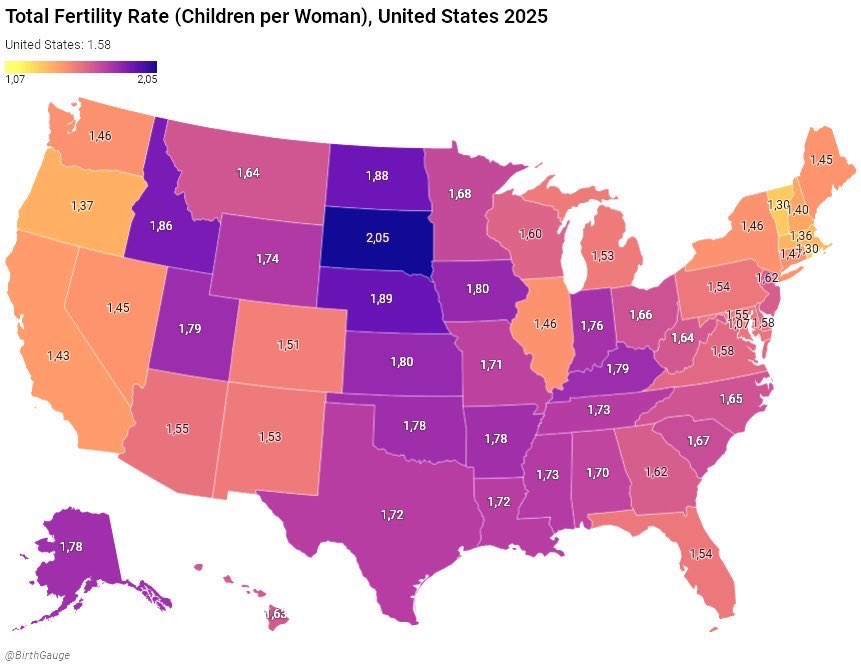
What is striking is not only the national decline but its uniformity. Data tracked by BirthGauge indicate that every U.S. state now has a fertility rate below the replacement threshold of 2.1 children per woman, the level required to maintain population size without immigration.
Historically, fertility has proven resilient even under extreme conditions—poverty, war, and famine among them. That resilience, some analysts argue, is now eroding for reasons that go beyond economics.
Long-term projections reinforce the concern. The Congressional Budget Office recently projected that by 2030 the number of deaths in the United States will exceed the number of births, a demographic milestone that would have seemed implausible just a generation ago.
Culture, relationships, and religion
For some observers, the deeper drivers are cultural rather than financial. They point to the erosion of in-person relationships in the digital age, the collapse of stable dating patterns, and the steady decline of religious affiliation—factors that historically fostered marriage and family formation.
“We have a fertility crisis because we have a marriage crisis,” argues Katy Faust, founder of the parental rights organization Them Before Us. In her view, the chain reaction is clear: fewer real-world relationships lead to fewer marriages, and fewer marriages mean fewer children. Faust calls on Christians, in particular, to model committed relationships at every stage, from friendship to lifelong covenant.
At the same time, broader social attitudes are shifting. Recent surveys by Gallup and Marist Poll show public opinion moving steadily in a more pro-choice direction on abortion over several years—a trend that intersects, directly or indirectly, with decisions about childbearing.
Policy responses and their limits
Governments have begun to respond, though with uncertain results. During 2025, the Trump administration signaled a more pronatalist stance, including an executive order aimed at expanding access to and reducing the cost of in vitro fertilization, as well as public support for so-called “baby bonuses” designed to encourage couples to have children.
Such measures echo experiments already tried across Europe and Asia, where generous subsidies, tax incentives, and parental benefits have often failed to reverse long-term declines. Critics note that international organizations, including the United Nations, frequently emphasize population stabilization or reduction, further complicating global consensus on pro-natalist policies.
A familiar future, closer than expected
For decades, demographic decline was framed in American discourse as someone else’s problem—Japan’s, Italy’s, South Korea’s. The latest U.S. figures suggest that the same structural challenges are now firmly at home.
Thank you for reading our content. If you would like to receive ZENIT’s daily e-mail news, you can subscribe for free through this link.

Publicaciones relacionadas:
 Revealing Scandal: Planned Parenthood USA Facilitates Secret Abortions to Adolescents Without Parental Consent
 International Abortion Giant Pressures USA on Abortion
 USA: Landmark Alabama Supreme Court decision protects the life of human embryos
 U.S. Abortion Numbers Top 1.1 Million in a Year, But Gaps in Data Persist, New Study Finds
