

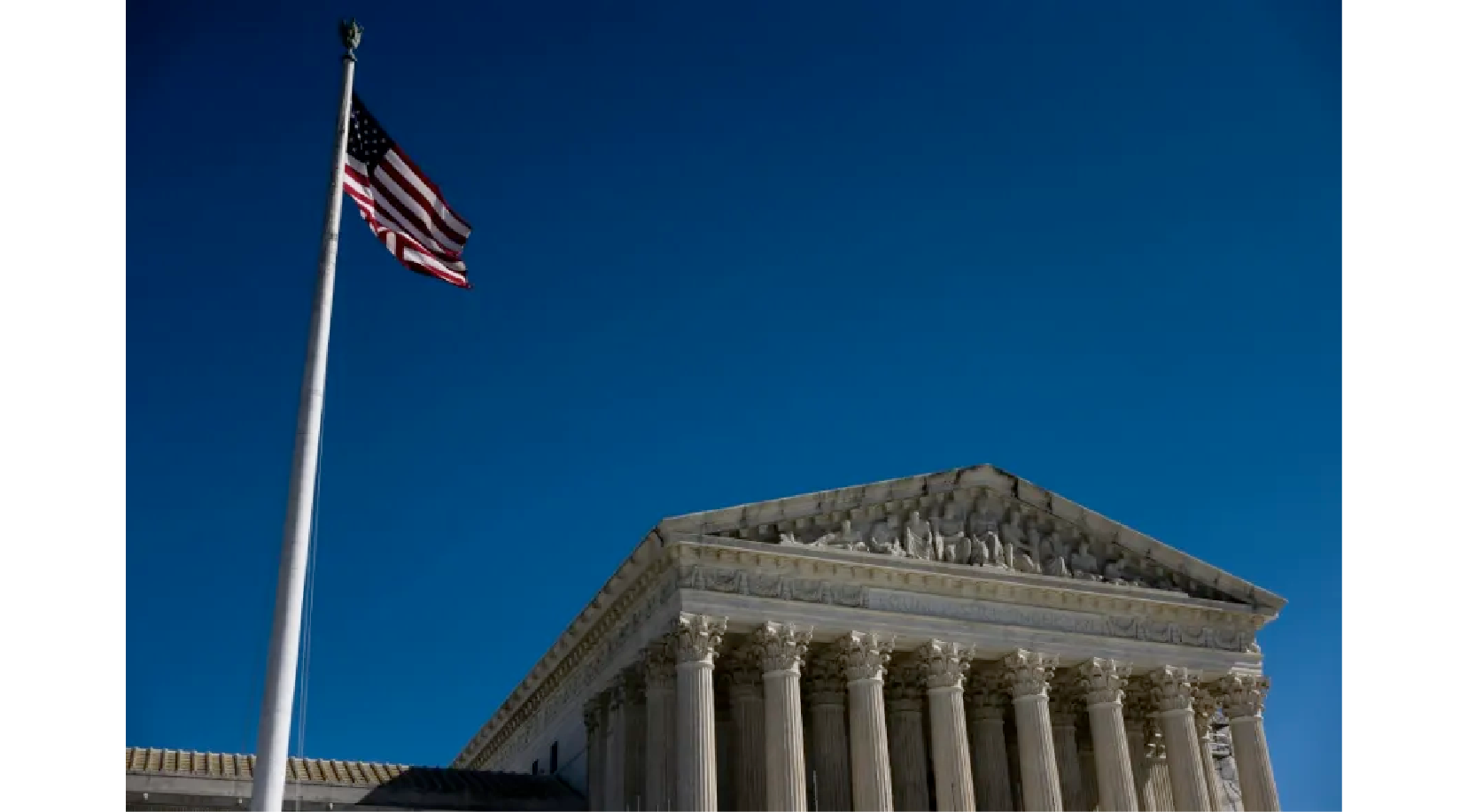
(ZENIT News / Washington, 02.01.2026).- As the United States Supreme Court prepares to hear one of the most consequential immigration-related cases in decades, the nation’s Catholic bishops have stepped squarely into the debate, urging the justices to preserve birthright citizenship and warning that abandoning it would cross not only a constitutional line but a moral one as well.
In a friend-of-the-court brief filed before the high court, the United States Conference of Catholic Bishops argued that ending the automatic conferral of citizenship to children born on U.S. soil would be “immoral,” legally unfounded, and incompatible with core principles of Catholic social teaching. The case, set for oral arguments on April 1, places the bishops in direct opposition to a controversial executive order signed by Donald Trump on his first day back in office.
That order seeks to deny U.S. citizenship at birth to children whose parents entered the country unlawfully or were living in the United States without legal status at the time of the child’s birth. Almost immediately, the measure triggered legal challenges from parents whose children were denied citizenship under the new policy. Those lawsuits contend that birthright citizenship is not a discretionary policy but a constitutional guarantee rooted in the Fourteenth Amendment.
The dispute has now reached the Supreme Court of the United States, which must decide whether the executive branch has the authority to narrow a principle that has shaped American citizenship law for more than a century. The bishops’ intervention reframes the issue, insisting that the case cannot be reduced to technical questions of jurisdiction or statutory interpretation.
According to the brief, the Fourteenth Amendment’s citizenship clause—adopted in 1868 in the aftermath of the Civil War—was designed precisely to prevent the creation of hereditary classes excluded from full membership in society. “All persons born or naturalized in the United States, and subject to the jurisdiction thereof,” the amendment declares, “are citizens of the United States.” For the bishops, dismantling that protection would resurrect the very injustices the amendment sought to erase.
The bishops also point to Western legal tradition and Catholic moral theology to support their argument. They contend that denying citizenship to children based on their parents’ legal status undermines the inherent dignity of the child and weakens the family, both of which occupy a central place in Catholic teaching. In their words, laws that harm innocent children or reduce them to a secondary legal status demand moral resistance, particularly when they echo historical patterns of exclusion.
The legal history surrounding birthright citizenship adds further complexity. In 1898, the Supreme Court ruled broadly in favor of birthright citizenship, recognizing only narrow exceptions. Yet the Court has never directly decided a case involving children born to parents residing in the country unlawfully. That gap has allowed the current administration to argue that the constitutional text leaves room for reinterpretation, an argument the bishops firmly reject.
Joining the bishops in the brief is the Catholic Legal Immigration Network, which emphasized the practical consequences of stripping citizenship from children who have known no other country. Together, the organizations argue that legal uncertainty would follow such children throughout their lives, affecting access to education, employment, and civic participation.
Not all Catholic voices agree. The filing has sparked a public backlash among some Catholic scholars and conservative commentators, who accuse the bishops of conflating prudential policy judgments with binding moral doctrine. Philosopher Joshua Hochschild of Mount St. Mary’s University suggested that a counter–amicus brief could articulate what he described as a more nuanced Catholic approach, one that recognizes legitimate diversity in interpreting the Fourteenth Amendment while remaining faithful to Church teaching.
Kevin Roberts, president of the Heritage Foundation, went further, dismissing the bishops’ argument as political advocacy rather than theology. He pointed to the Catechism of the Catholic Church, which affirms both the duty of prosperous nations to welcome migrants and the right of states to regulate immigration and expect respect for their laws. For critics like Roberts, the bishops’ emphasis on human dignity appears, in their view, selectively applied.
Legal analysts outside ecclesial debates also caution against assuming an inevitable outcome. Andrew Arthur, a former immigration judge and now a policy fellow at the Center for Immigration Studies, has noted that unrestricted birthright citizenship is relatively rare worldwide. According to World Population Review, only 36 countries, including the United States, maintain it without conditions, while many others impose restrictions. Arthur observes that even the Holy See does not practice birthright citizenship and that several European nations have moved away from it in recent years.
Still, Arthur concedes that the administration faces significant hurdles. He suggests the Court could choose a narrow path, limiting rather than abolishing birthright citizenship, or rule that only Congress—not the president—has authority to alter such a foundational rule. Any of those outcomes would leave the broader political and moral debate unresolved.
What distinguishes this case is not merely its legal novelty but the way it exposes competing visions of nationhood, responsibility, and belonging. By casting birthright citizenship as a test of how a society treats its most vulnerable members, the U.S. bishops have deliberately elevated the stakes. When the justices hear arguments in Trump v. Barbara next month, they will be asked not only to interpret constitutional text, but to weigh how law defines who fully belongs in the American community.
Thank you for reading our content. If you would like to receive ZENIT’s daily e-mail news, you can subscribe for free through this link.

Publicaciones relacionadas:
 Victory for children: Court says NY can’t shut down adoption provider for its Christian beliefs
 USA: 20 Prosecutors Against the FBI for Harassment and Prejudice Against Catholics
 Mozambique: Famine, disease and thirst predicted due to Islamist terrorism
 Archdiocese of Washington to lay off employees to address financial crisis stemming (in part) from McCarrick case
