

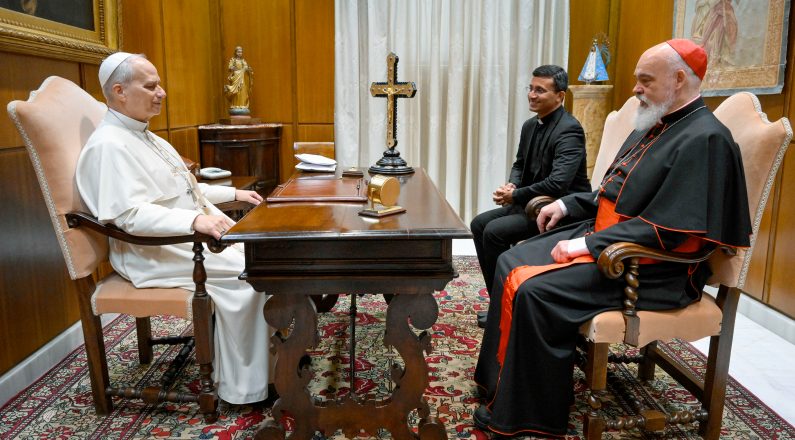
(ZENIT News / Vatican City, 03.12.2026).- As the Middle East faces a new phase of instability following military strikes on Iran, the head of the Catholic Church in the country has surfaced in Rome after days of uncertainty. On March 11, Pope Leo XIV received in a private audience Cardinal Dominique Mathieu, the Belgian-born archbishop of Tehran-Isfahan, who had been evacuated days earlier from the Iranian capital amid escalating conflict.
Mathieu arrived in Rome on March 8 after leaving Iran as part of the evacuation of the Italian diplomatic mission. His residence, the archdiocesan offices and the small Latin Catholic cathedral in Tehran are all located within the grounds of the Italian embassy, making his departure effectively unavoidable once the embassy suspended operations.
The evacuation followed the dramatic events that began on February 28, when the United States and Israel launched coordinated military strikes against Iran. The attacks killed Iran’s supreme leader, Ali Khamenei, along with several senior officials, triggering retaliatory actions by Tehran against U.S. forces, Israel and allied targets in the Gulf region. The conflict has since widened, raising fears of a broader regional war.
For several days after the strikes, the whereabouts of the Iranian archbishop were unknown publicly, fueling concern among those following the situation of the tiny Catholic community in the country.
A Church linked to the diplomatic presence
Mathieu, a member of the Order of Friars Minor Conventual and a native of Belgium, has led the Archdiocese of Tehran-Isfahan since 2021. The 62-year-old prelate, who joined the Franciscan order in 1983 and speaks five languages including Arabic, was elevated to the College of Cardinals in 2024 by Pope Francis.
His archdiocese represents one of the smallest Catholic jurisdictions in the world. Estimates suggest that the Latin-rite Catholic community numbers only a few thousand faithful, most of them foreign expatriates working or living temporarily in Iran.
When the conflict began, many of those expatriates quickly left the country. According to Vatican sources, this mass departure also influenced the decision for the archbishop to evacuate.
Iran’s total Catholic population—counting Latin, Chaldean and Armenian Catholics—is believed to be around 20,000 people in a nation of more than 80 million inhabitants, the overwhelming majority of whom are Muslim.
Unlike in countries such as Iraq or Syria, where local bishops often remain with their communities during wartime, the particular structure of the Catholic presence in Iran makes such decisions more complex. Because so many Latin Catholics are foreigners, the life of the archdiocese is closely tied to diplomatic and international networks.
Embassy closure triggers evacuation
The Italian government announced on March 5 that it would temporarily close its embassy in Tehran. According to Italian Foreign Minister Antonio Tajani, roughly 50 Italian citizens were evacuated through neighboring Azerbaijan, with embassy personnel relocating to Baku while maintaining diplomatic channels with Tehran.
Since the archdiocese’s headquarters—including the Cathedral of the Consolata, the archbishop’s residence and administrative offices—are located inside the embassy compound, Mathieu departed with the diplomatic convoy.
After crossing into Azerbaijan, he eventually traveled on to Rome.
The Vatican has also recalled the Holy See’s diplomatic representative in Iran, the Indian priest Sebastian Febin, who had been serving as chargé d’affaires of the Apostolic Nunciature in the absence of a nuncio. According to Vatican sources, he returned to Rome to brief officials and is expected to go back to Tehran once conditions allow.
Papal appeal for peace
The private meeting between Leo XIV and the Iranian cardinal took place on the same day the pope used his weekly general audience in St. Peter’s Square to address the worsening crisis in the region.
Before thousands of pilgrims gathered in the Vatican, the pontiff renewed his appeal for peace and asked the faithful to pray particularly for civilians caught in the violence.
“Let us continue to pray for peace in Iran and throughout the Middle East, especially for the many civilian victims, including numerous innocent children,” the pope said.
Leo XIV also drew attention to another tragic episode linked to the conflict’s expansion beyond Iran.
A priest killed in Lebanon
On March 9, artillery fire in southern Lebanon killed Father Pierre al-Rahi, a Maronite Catholic priest serving in a Christian village near the border.
During his remarks, the pope paid tribute to the priest’s final act of pastoral dedication.
The pontiff noted that the surname “al-Rahi” means “shepherd” in Arabic, describing the priest as a true pastor who remained close to his community. According to the account presented during the audience, he had rushed to assist parishioners wounded in a bombardment and was killed while trying to help them.
Leo XIV prayed that the blood shed by the priest might become “a seed of peace” for Lebanon, expressing solidarity with the Lebanese people as villages in the south once again experience the hardships of war.
Warnings against “peace through force”
The developments echo concerns that Cardinal Mathieu himself expressed months earlier about the region’s trajectory.
In a July interview reflecting on earlier clashes between Israel and Iran, the archbishop warned about the growing appeal of nationalist rhetoric and the idea that stability could be achieved through military superiority.
Thank you for reading our content. If you would like to receive ZENIT’s daily e-mail news, you can subscribe for free through this link.

Publicaciones relacionadas:
 What Does Pope Leo XIV’s Letter to the President of Ukraine Say? Full Text
 Cardinals will return to Rome for a new Consistory in June 2026 requested by Pope Leo XIV
 Trump invited the Vatican to the new “Peace Board.” The Holy See confirms that Leo XIV is considering accepting
 An Italian: this is the Pope’s new ambassador “to” Donald Trump
