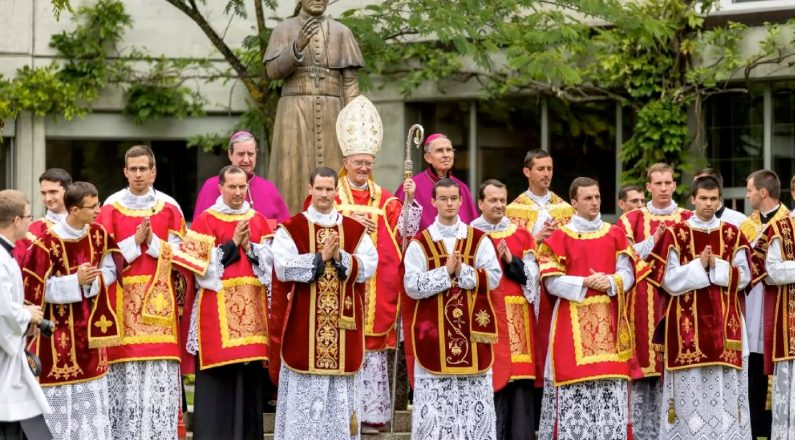
(ZENIT News / Rome, 03.18.2026).- The Society of Saint Pius X, better known as Lefebvrians, has sent a newly published volume to every residential bishop in the country, outlining in systematic form the theological and canonical rationale behind its intention to proceed with new episcopal consecrations.
The book, titled “Al servizio della Chiesa” and released by the Fraternity’s Italian publishing arm, is more than a doctrinal essay. It is a strategic document—part explanation, part justification, and part appeal—aimed directly at the hierarchy of the Church in Italy. Accompanied by a cover letter from Gabriele D’Avino, the initiative invites bishops to revisit what the Fraternity describes as an ongoing “crisis” within Catholicism and to consider the need for what it calls a process of “restoration.”
At the heart of the volume lies a concept deeply embedded in the history of the movement: the idea of an “operation survival,” first articulated in 1988 by Marcel Lefebvre. That year marked a decisive rupture with Rome, when Lefebvre consecrated bishops without papal mandate—an act that triggered canonical sanctions but also ensured the continuity of the Fraternity’s episcopal structure.
The current publication revisits that moment not as an isolated event, but as a precedent. It argues that, under certain conditions, extraordinary measures are justified to preserve what the Fraternity understands as the integrity of Catholic Tradition. The text draws heavily on Scripture to frame its argument, opening with a passage from the Letter to the Galatians that warns against any deviation from the original Gospel—even if proclaimed by authoritative figures.
This biblical citation is not incidental. It underpins one of the book’s most controversial claims: that the crisis the Fraternity perceives is not external to the Church, but originates, at least in part, within its own leadership. From this perspective, the authors advance the notion of a “right of resistance to authority,” a principle they consider applicable when doctrinal integrity is believed to be at stake.
Such arguments place the initiative within a long-standing tension between the SSPX and the Holy See. Although relations have fluctuated over the decades—with periods of cautious rapprochement, particularly under recent pontificates—the Fraternity’s canonical status remains irregular. Its clergy exercise ministry in a context that the Vatican has sought to regularize in specific cases, but without a full juridical resolution.
The decision to address Italian bishops collectively suggests a calculated shift in tone. Rather than acting unilaterally, as in 1988, the Fraternity is framing its intentions as part of a broader ecclesial conversation. D’Avino’s accompanying letter explicitly presents the book as an invitation to dialogue—proposing a “shared path of reflection, study and engagement” centered on what he describes as the good of souls and the glory of God.
Yet the underlying message is unmistakable: the SSPX is preparing the ground for decisions that could once again test the boundaries of ecclesiastical authority. Episcopal consecrations, by their nature, touch the core of apostolic succession and the unity of the Church. Any move in this direction without papal approval would inevitably carry significant canonical and symbolic consequences.
The Italian context adds further weight to the initiative. As the historical and institutional heartland of the Catholic Church, Italy’s episcopate occupies a unique position. Engaging directly with its bishops can be seen as an attempt to situate the Fraternity’s arguments at the center of ecclesial discourse, rather than at its margins.
Whether the book will achieve its intended effect remains uncertain. It may be read as a gesture of openness—or as a prelude to confrontation. What is clear is that the SSPX is not merely revisiting its past; it is actively shaping its future, seeking to justify in advance decisions that could once again redefine its relationship with Rome.
Thank you for reading our content. If you would like to receive ZENIT’s daily e-mail news, you can subscribe for free through this link.