

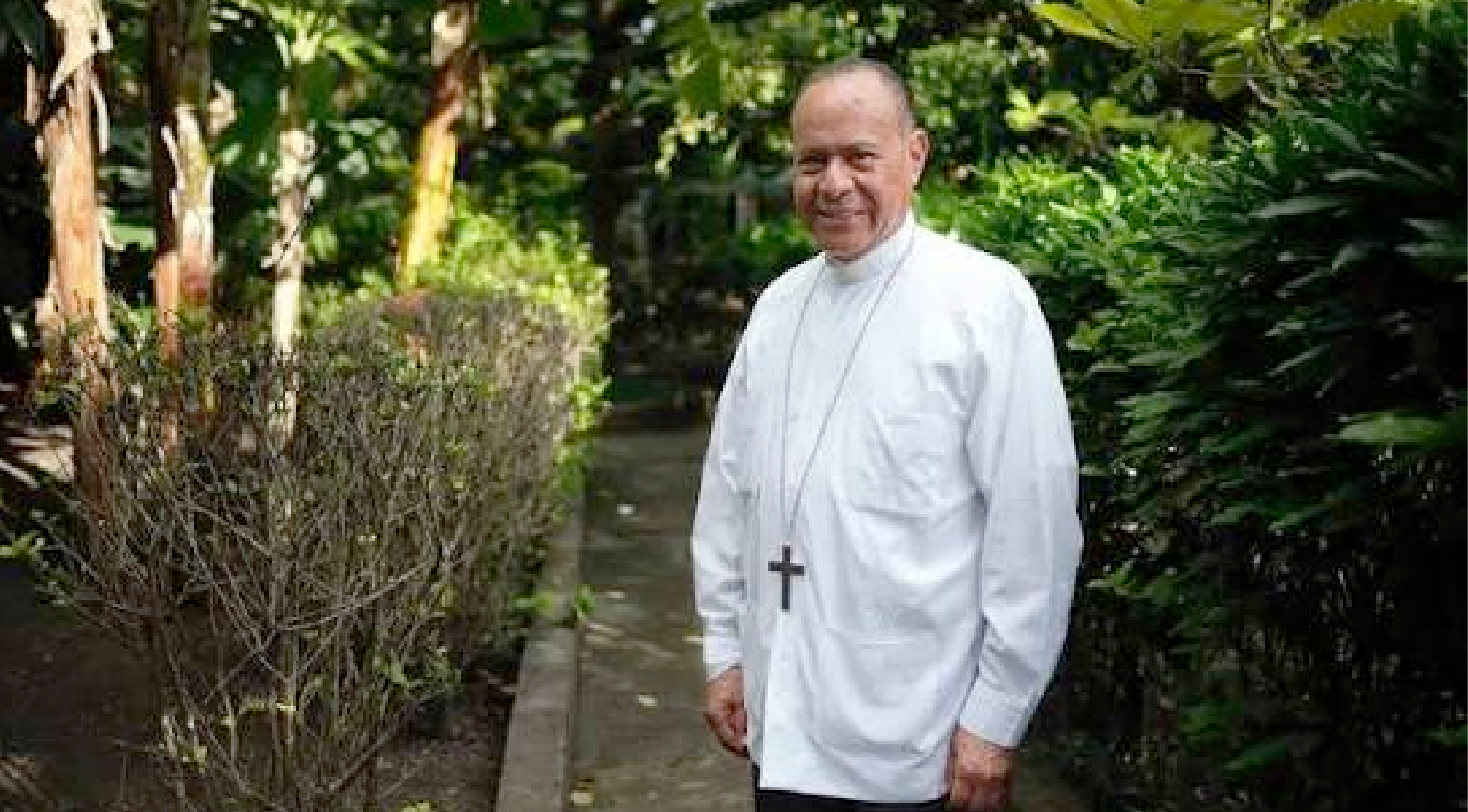
(ZENIT News / Managua, 07.06.2026).- The disappearance from public view of Bishop Juan Abelardo Mata has become the latest flashpoint in the long-running confrontation between Nicaragua’s government and the Catholic Church. Days after the 80-year-old bishop was reportedly detained following a Mass in which he prayed for the country’s persecuted Church, conflicting accounts of his whereabouts have only intensified concern both inside Nicaragua and abroad.
According to reports from independent journalists and Church-linked sources, the retired Bishop of Estelí was taken into police custody on June 29, one day after celebrating a Mass at the Church of the Holy Cross of Calvary in Estelí. During the liturgy, he reportedly invited the faithful to pray for Catholics facing persecution and remembered exiled clergy, including Bishop Rolando Álvarez and Father Frutos Valle.
The episode quickly attracted international attention because of Mata’s long-standing reputation as one of the most outspoken critics of the government led by President Daniel Ortega and Vice President Rosario Murillo. For years, the bishop has publicly denounced restrictions on civil liberties and what he considers the country’s growing authoritarianism.
Initial reports indicated that Mata was transferred to the Evaristo Vásquez Sánchez Police Complex in Managua, commonly known as “El Nuevo Chipote,” a detention center that has become synonymous with the imprisonment of political opponents. Although some sources later stated that he had been returned to his residence in Tisma, uncertainty soon emerged regarding his true situation.
The Nicaraguan Interior Ministry subsequently released a statement claiming that the bishop had merely been questioned as part of an investigation concerning alleged irregularities related to property and family connections. Authorities insisted that he had returned home in good health and had been treated respectfully throughout the process.
Yet that official version has been challenged by independent media outlets and religious freedom advocates. Several Nicaraguan news organizations operating from exile reported that they had been unable to establish direct contact with the bishop or independently verify that he was free to move about without restrictions. No recent photographs, videos, or public appearances have emerged to confirm the government’s account.
Martha Patricia Molina, a researcher who has extensively documented attacks against the Catholic Church in Nicaragua since 2018, publicly disputed official claims, asserting that the bishop’s situation remains unclear. Her concerns have been echoed by numerous observers who note that Mata requires periodic medical supervision because he has a pacemaker.
The uncertainty surrounding the bishop’s condition prompted a diplomatic reaction from Washington. The U.S. State Department called for his “immediate and unconditional” release, describing his detention as arbitrary and condemning what it characterized as the continued repression of religious freedom in Nicaragua. American officials also emphasized the bishop’s advanced age and fragile health.
The case has revived international scrutiny of the relationship between the Sandinista government and the Catholic Church, a relationship that has deteriorated dramatically over recent years. Since the anti-government protests of 2018, bishops, priests, seminarians and religious communities have faced increasing pressure. Processions have been prohibited, Catholic institutions closed, and numerous clergy expelled or forced into exile.
Among the most prominent cases is that of Bishop Rolando Álvarez. After spending months under house arrest and nearly a year in prison, he was eventually expelled from the country and sent to Rome in January 2024. His imprisonment became one of the most visible symbols of the conflict between the Church and the government.
The broader scale of the crisis is reflected in reports by human rights organizations. According to the NGO Colectivo Nicaragua Nunca Más, at least 261 religious figures, including bishops and priests, have been expelled from the country. Diplomatic relations between the Holy See and Nicaragua remain suspended, and tensions have persisted since Pope Francis famously described the Nicaraguan government as a dictatorship in 2023.
For many Nicaraguan Catholics, the uncertainty surrounding Bishop Mata carries significance beyond the fate of a single prelate. The retired bishop has long been regarded as a respected moral voice willing to challenge those in power. Whether he is free, under house arrest, or subject to further restrictions remains impossible to verify independently. What is certain, however, is that his case has become another powerful illustration of the climate of mistrust and fear that continues to surround religious life in Nicaragua.
Thank you for reading our content. If you would like to receive ZENIT’s daily e-mail news, you can subscribe for free through this link.

Publicaciones relacionadas:
 Traditional Congregation Accused of “Brain Washing”: Superior Faces Prison
 Preserving Christianity in Iraq 10 years after Daesh invasion
 Chinese Bishop Is Arrested for Celebrating Mass, Marking the Beginning of the Jubilee Year, Without the Permission of the Communist Government
 Nicaragua: A Holy Week with Many Restrictions, But More Faith from Local Catholics
