(ZENIT News / Rome, 07.12.2026).- Answered by Legionary of Christ Father Edward McNamara, professor of liturgy and sacramental theology at the Pontifical Regina Apostolorum university.
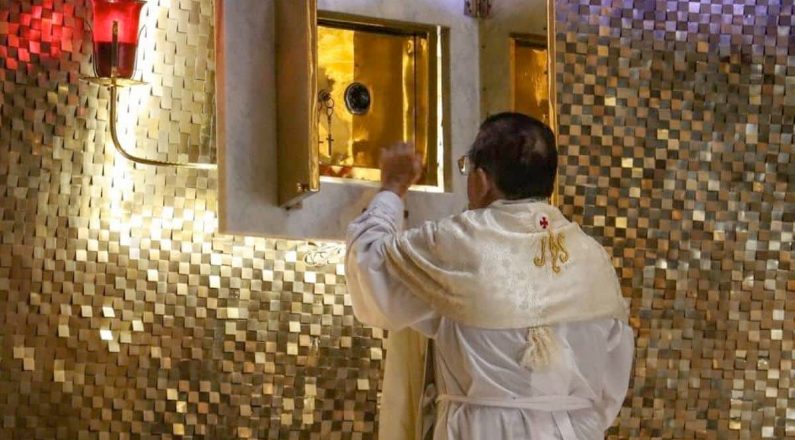
Q1: When it is communion time, my pastor proceeds to the side tabernacle to retrieve the consecrated hosts with great dignity. All acolytes are instructed to turn, face the tabernacle, bow at the opening of the tabernacle, and the priest carries the ciborium at the highest elevation, both hands above his head. I fear he will trip, and I wonder about the protocol? — P.F., Toronto, Canada
Q2: I see in some parishes that, when communion is completed and the hosts left over are transferred to the tabernacle, a certain number of the faithful stand up. If they have received communion, does it make sense to stand up when they have Christ within them? Is this gesture proper? — G.O., Santo Domingo, Dominican Republic
A: I will address these questions together as they both refer to the attention given to the reserved hosts during the context of the Eucharistic celebration.
While veneration for the Real Presence and the tabernacle is highly commendable, the context of the Eucharistic celebration, the central act of our Catholic faith, means that the rites proper to the celebration and its attendant symbolism have a priority during the celebration itself.
For example, the general rule of genuflecting toward the tabernacle is not followed during the course of the celebration of Mass. Hence, the General Instruction of the Roman Missal (GIRM) says:
“274. A genuflection, made by bending the right knee to the ground, signifies adoration, and therefore it is reserved for the Most Blessed Sacrament, as well as for the Holy Cross from the solemn adoration during the liturgical celebration on Good Friday until the beginning of the Easter Vigil.
“During Mass, three genuflections are made by the Priest Celebrant: namely, after the elevation of the host, after the elevation of the chalice, and before Communion. Certain specific features to be observed in a concelebrated Mass are noted in their proper place (cf. nos. 210-251).
“If, however, the tabernacle with the Most Blessed Sacrament is situated in the sanctuary, the Priest, the Deacon, and the other ministers genuflect when they approach the altar and when they depart from it, but not during the celebration of Mass itself.
“Otherwise, all who pass before the Most Blessed Sacrament genuflect, unless they are moving in procession. Ministers carrying the processional cross or candles bow their heads instead of genuflecting.”
In describing the Rite of Communion, the GIRM states:
«84. The Priest prepares himself by a prayer, said quietly, so that he may fruitfully receive the Body and Blood of Christ. The faithful do the same, praying silently. Then the Priest shows the faithful the Eucharistic Bread, holding it over the paten or over the chalice, and invites them to the banquet of Christ; and along with the faithful, he then makes an act of humility, using the prescribed words from the Gospels.
«85. It is most desirable that the faithful, just as the Priest himself is bound to do, receive the Lord’s Body from hosts consecrated at the same Mass and that, in the cases where this is foreseen, they partake of the chalice (cf. no. 283), so that even by means of the signs Communion may stand out more clearly as a participation in the sacrifice actually being celebrated.
“86. While the Priest is receiving the Sacrament, the Communion Chant is begun, its purpose being to express the spiritual union of the communicants by means of the unity of their voices, to show gladness of heart, and to bring out more clearly the ‘communitarian’ character of the procession to receive the Eucharist. The singing is prolonged for as long as the Sacrament is being administered to the faithful. However, if there is to be a hymn after Communion, the Communion Chant should be ended in a timely manner.”
Later, in describing the rites of purification after the communion, the document says:
«163. When the distribution of Communion is over, the Priest himself immediately and completely consumes at the altar any consecrated wine that happens to remain; as for any consecrated hosts that are left, he either consumes them at the altar or carries them to the place designated for the reservation of the Eucharist.
“Upon returning to the altar, the Priest collects the fragments, should any remain, and he stands at the altar or at the credence table and purifies the paten or ciborium over the chalice, and after this purifies the chalice, saying quietly the formula Quod ore sumpsimus, Domine (What has passed our lips), and dries the chalice with a purificator. If the vessels are purified at the altar, they are carried to the credence table by a minister. Nevertheless, it is also permitted to leave vessels needing to be purified, especially if there are several, on a corporal, suitably covered, either on the altar or on the credence table, and to purify them immediately after Mass, after the Dismissal of the people.”
To this we may add this note from the instruction Redemptionis Sacramentum which says:
“88. The faithful should normally receive sacramental Communion of the Eucharist during Mass itself, at the moment laid down by the rite of celebration, that is to say, just after the Priest celebrant’s Communion. It is the Priest celebrant’s responsibility to minister Communion, perhaps assisted by other Priests or Deacons; and he should not resume the Mass until after the Communion of the faithful is concluded. Only when there is a necessity may extraordinary ministers assist the Priest celebrant in accordance with the norm of law.”
The Missal, and indeed all the liturgical books, are silent with respect to what if any gestures of respect toward the tabernacle correspond to either taking the hosts from the tabernacle or reserving them after administrating Communion.
In liturgy, this silence is not a license to invent new rituals but rather an indication that no special rites are envisioned that would draw attention away from the central act of our salvation which is the celebration of the sacrifice of the Mass in which the symbolic center of attention is the altar of sacrifice. This remains true as long as the sacrifice of the Mass has not yet concluded.
With respect to the concrete questions of our correspondents:
I would say first that, in line with the above liturgical laws, the ideal is that the hosts reserved in the tabernacle are not used at Mass at all. Rather, everybody should have the opportunity to receive hosts consecrated in the same Mass in which they participate.
It is not liturgical best practice to habitually use the hosts reserved in the tabernacle especially if this means that very few hosts are consecrated during the Mass. An effort should be made to consecrate sufficient hosts for the majority of the faithful present and that the number of hosts reserved in the tabernacle be sufficient for an emergency but not excessive.
The use of large ciboria with many hosts hails back to an earlier liturgical practice in which Communion was frequently distributed immediately after rather than during the Mass.
Likewise, even if it is necessary to take hosts from the tabernacle to the altar, this is usually done before the priest’s communion, usually by a deacon or concelebrant during the “Lamb of God” or even after the Our Father if the tabernacle is at some distance.
It makes no sense at all to add a ceremony for the reserved hosts while the Sacred Host and the Precious Blood are still on the altar. Even if a lone priest has to go to the tabernacle after taking Communion, he treats the ciboria in the tabernacle in the same manner as those he has consecrated during the Mass, and hence with no special elevations or ceremonies.
The same can be said with respect to returning the hosts after communion. GIRM 163 places everything within the context of the practical gestures following communion and before the purification of the sacred vessels. Again, the ideal is that so few hosts remain that they may be consumed immediately. If it is necessary to return them to the tabernacle, this is done without any ceremonial emphasis.
It would not be best liturgical practice for everybody, or even just the servers, to stop what they are doing and turn toward the tabernacle at this moment as we are still within the celebration of the sacrifice of the Mass, and the center of attention at this moment is giving thanks for the gift of the Communion that has been received.
It would probably be acceptable for the minister who returns the hosts to the tabernacle to genuflect before closing the door as is the usual practice for when the Blessed Sacrament is reserved (although the obligation of this genuflection would be open to debate).
However, the servers and other ministers should not genuflect at this moment in accordance with GIRM 274 above.
The missal does not address these situations for one simple reason. If Mass is celebrated in accordance with the norms, then, ideally, these situations should not arise.
* * *
Readers may send questions to zenit.liturgy@gmail.com. Please put the word «Liturgy» in the subject field. The text should include your initials, your city and your state, province or country. Father McNamara can only answer a small selection of the great number of questions that arrive.
Thank you for reading our content. If you would like to receive ZENIT’s daily e-mail news, you can subscribe for free through this link.