

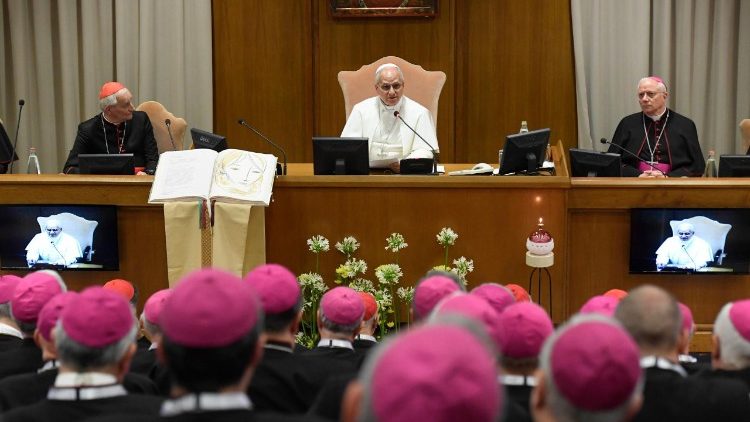
(ZENIT News / Mexico City, 07.24.2026).- One of the current Pope’s priorities is unity. This is not merely a statement of intent but involves concrete steps taken to foster communion within the Church. The state of the Catholic Church when Leo XIV assumed the papacy made this need evident; social polarization was mirrored by polarization within the Church itself. A recent example of this, in one specific sense, is the ordination of Bishops by the Society of Saint Pius X without a papal mandate. Yet, in a different vein, there are also the many individual gestures made by various figures holding ecclesiastical office, including some Bishops.
It is useful to present the facts, examine their possible interpretations, and look to the unchanging doctrine as a beacon that illuminates inconsistencies. It is also important to highlight the disservice that certain decisions do to the cause of reconciliation.
The Bishop of Ávila, Spain, forbade a chaplain associated with a group favoring the Latin Mass from celebrating it for a group of American pilgrims. Father João Silveira, a missionary priest who gathers communities worldwide for the Latin Mass, posted on X on June 15 that a group of American pilgrims had requested to reserve a chapel in the city of Ávila. When they informed the Episcopal Curia that the Mass would be in Latin, they were told that the Bishop’s authorization was required, as «that Mass is prohibited in this diocese.» The order came from Bishop Jesús Rico García, who was appointed by Pope Francis in 2023.
A similar incident occurred involving Bishop F. William Medley of Owensboro, Kentucky, who on May 18 forbade Father David Kennedy from celebrating the Traditional Latin Mass (using the 1962 Roman Missal), citing instructions previously received from the Holy See.
These cases are taking place across various countries and regions. It is worth recalling that Pope Benedict XVI’s 2007 Motu Proprio, Summorum Pontificum, recognized the 1962 Roman Missal as an «extraordinary form» of the Roman Rite and granted every priest the freedom to celebrate it without needing special permission from his Bishop. The document framed the traditional liturgy not as a relic of the past, but as a living expression of the Church’s worship, capable of enriching the entire Catholic world.
Pope Francis’s 2021 Motu Proprio Traditionis Custodes, shifted this approach, declaring the liturgy reformed by Paul VI after Vatican Council II to be the «unique expression» of the Roman Rite and placing the celebration of the older form under strict episcopal control (requiring explicit authorization, often restricted to non-parish settings).
There are two ecclesiological visions present in these documents: one of liturgical pluralism within unity, and another of liturgical uniformity as a condition for ecclesial communion. Pluralism was established by the Vatican Council II through the call for adaptation in the document Sacrosanctum Concilium (specifically in sections 28 through 40). Furthermore, on May 27, the Pope called for a balance between preserving tradition and fostering renewal.
Continuing with a review of events: on June 5, when the Archbishop of Detroit praised the new mosque built in the city, he stated, «There is no place where I feel greater goodness.» Edward Weisenburger’s statement was considered scandalous by some because he suggested that, within a Muslim place of worship, one could «very fully sense the presence of the Divine.»
Many were struck by the fact that Archbishop Edward Weisenburger attended the inauguration of a mosque and the headquarters of the Islamic Institute of America. But what about the assertion that Muslims and Catholics worship the same God? The Conciliar Declaration Nostra Aetate, approved by the Vatican Bishops and promulgated by Paul VI on October 28, 1965, noted that «the Church also regards with esteem the Muslims who worship the one, living, and subsistent God, merciful and almighty, Creator of heaven and earth, who has spoken to mankind (…). Although they do not acknowledge Jesus as God, they venerate Him as a prophet; they honor His Virgin Mother, Mary, and sometimes even invoke her with devotion.»
Muslims do not accept the Trinity, nor do they consider Jesus Christ to be God. Yet, they do worship the one God; this serves as a bond that fosters closeness in the cultivation of faith in God and in the practice of charity, a virtue strongly emphasized among Muslims, as the Church and Islam work together within the secularized world that surrounds us all. However, without explanation, this gives rise to confusion.
The secularization of sacred spaces was evident in the television screens set up to watch World Cup soccer matches inside the Church of San Antonio in Madrid, Spain, or in the gathering of people at the Cathedral of Innsbruck, Austria, to eat pasta and socialize at a long table facing the altar.
A similar situation arose with a group of pilgrims traveling with a priest from the Priestly Fraternity of St. Peter; he was denied permission to celebrate the Latin Mass in three different Italian cities, forcing the group to attend Mass in a hotel basement in San Giovanni Rotondo. Priests of the Priestly Fraternity of St. Peter enjoy the explicit recognition of the Holy See.
Would Christ enter the temple today and smash the television sets? Or would He accept the situation because the tabernacle had been covered by a red curtain at the San Antonio parish in Madrid?
The line separating the sacred from the secular calls for a stronger Christian witness within the worldly realm. Pope Leo XIV recalled a historic quote from Saint John Paul II from 1975: «Nothing is more necessary for an increasingly secularized world than the witness of this spiritual renewal.» Indeed, the goal of drawing those distant from the Gospel closer to it does not seem to be achieved by desacralizing places of worship.
The Church’s outreach to the LGBTI community led Cardinal Robert McElroy to state, during a homily at Georgetown University on June 20, that the papacy of Leo XIV offers signs of «great hope» for the Church’s ministry to LGBTI Catholics, as exemplified by the «Outreach» ministry founded by Jesuit Father James Martin. Some critics viewed this statement as contrary to Church doctrine and as projecting certain expectations onto the Pope.
It appeared that the Archbishop of Washington downplayed Pope Leo’s stance on sexual morality by recommending a Vatican report that advocates a more pastoral approach toward believers experiencing same-sex attraction. The Archbishop stated: «In a Church that has so often wounded the LGBT community through judgment and exclusion, we should find great hope in two important developments that have taken place during the pontificate of Pope Leo and that constitute fertile seeds for the advancement of the Gospel in the years to come.»
In the same vein — reflecting a perceived weakening of resolve regarding the immorality of homosexuality — attention has been drawn to an initiative by the Archdiocese of Florence, Italy: a housing project for young adults identifying as LGBTI, funded by the portion of Italian tax revenue allocated to the Catholic Church. Caritas Florence offers «Casa Andrea» as a residential and counseling service for LGBTI adults aged 18 to 35.
Father Andrea Bigalli described the initiative as follows: «Our goal is to offer dialogue, a listening ear, and concrete support so that LGBTI young people can build their own life paths peacefully, avoiding isolation and discrimination.» This statement can be viewed as pastoral support for homosexuals or judged as an attack on the Church’s moral doctrine, depending on one’s interpretation of the shelter. Regardless, it represents a highly selective way of providing support using funds contributed by all Catholics.
Pope Leo XIV was clear in stating that he foresees no changes to the Catholic Church’s official stance regarding LGBTI individuals: «Francis stated it very clearly when he said: ‘Everyone, everyone, everyone’ […]. I find it highly unlikely, at least in the near future, that Church doctrine regarding its teachings on sexuality and marriage will change.» (…) «The family is composed of a father, a mother, and children,» he declared in an interview with American journalist Elise Ann Allen in July 2025.
Regarding the role of women in the Church, attention has been drawn to a proposal by Italian Archbishop Erio Castellucci. He invoked the testimony of Saint Mary Magdalene concerning the Resurrection of Jesus to justify women proclaiming the Gospel and preaching during Mass.
According to the May 24 bulletin of the Diocese of Modena-Nonantola, the Archbishop proposed, during a conference in Carpi organized by the feminist group Centro Italiano Femminile, that women «co-preside» over the Liturgy of the Word while priests preside over the Eucharistic consecration.
Pope Leo’s position is also evident in an interview with journalist Elise Ann Allen, in which he remarked that the issue of women in positions of power within the Church must adhere to Church doctrine. Regarding the possibility of female deacons, he stated: «I have no intention of changing the Church’s teaching.»
In light of events such as the remarks made by Monsignor Würtz, the most recent German Bishop appointed by the Pope, who asked, «What would we lose if we abolished mandatory celibacy, and what would we gain?» It seems that the debate over mandatory priestly celibacy is active within the Church. The German prelate maintained that any potential modification to this discipline requires careful consideration of both what might be lost and the possible benefits of such a change.
In face of the controversy, Pope Leo expressed in two addresses – one to Italian seminarians and another to more than 400 Bishops and Cardinals gathered at the Vatican during the Holy Year for the Clergy –stating that «celibacy constitutes a charism that must be recognized, protected, and nurtured.»
Why is there so much controversy surrounding key aspects of the Church’s internal life? Is the Church divided and in conflict, or is there simply more noise than peace? Is the Pope leaning toward one faction while sidelining the other? Answering these questions requires three clarifications to understand what is happening in the Church today.
First, the media tends to broadcast radical or fringe events that grab attention, even if they represent only a minority, while remaining silent on the actual positions held by the leadership guiding the entire Church and by the vast majority of the faithful.
Second, there have always been, and always will be, individuals or small groups promoting unfounded ideas; these proposals do not represent the universality of the Catholic Church and stand out only because of their novelty, yet they tend to disappear shortly thereafter. Novelty is short-lived.
And third, there is the matter of information selection, which colors certain events or incidents while omitting other constructive details. Consequently, controversies involving a handful of Bishops are amplified, while we never hear about the thousands working in African jungles, remote mountainous corners of South America, or the plains of Asia. Nor do we recognize the efforts of priests and laypeople who serve twenty chapels of a parish in Canada’s forests or care for the sick and incarcerated in small European towns. The Church does a vast amount of good that goes unnoticed, and it is a joy for us to acknowledge it.
However, it is evident that gestures and words open to misinterpretation do little to foster the unity Pope Leo seeks; instead, they fuel those on the opposite side of the polarization divide who perpetuate the conflict by highlighting these very incidents and statements.

Publicaciones relacionadas:
 Trump and Vance prolong the conflict with Leon XIV as Russia and Brazil join the controversy
 Major Canadian newspaper acknowledges the falsehood of the allegations regarding mass graves of infants that were leveled against the Catholic Church and led to the burning of churches across the country
 How ‘Rare’ Are Sex-Trait Modification Surgeries on Children?
 The British and their attunement to Christian religious heritage
