

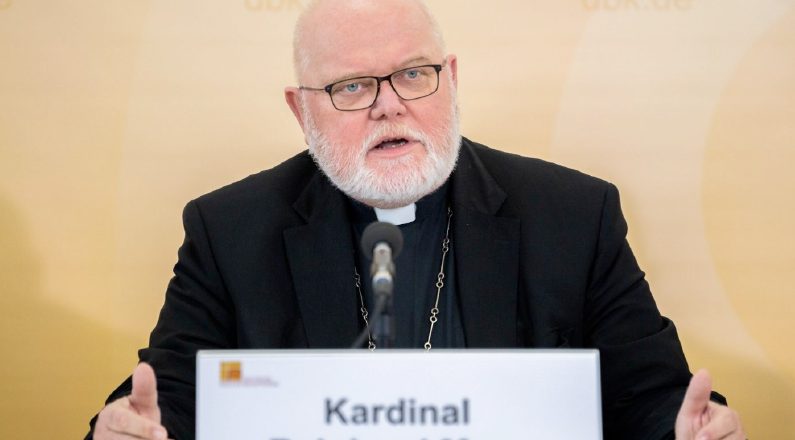
(ZENIT News / Munich, 07.24.2026).- A dispute that began as a question about the limits of pastoral practice has now become something more fundamental in the Archdiocese of Munich and Freising: a question of ecclesial authority, conscience and the meaning of unity.
Twenty-six priests have written to Cardinal Reinhard Marx challenging his recommendation that Germany’s national guidelines for blessing couples in irregular situations, including same-sex couples, be implemented in the archdiocese. If the cardinal’s response does not resolve their concerns, the priests say they may ask the Holy See for an official clarification.
The immediate dispute concerns a document published in April 2025 under the title “A Blessing Gives Love Strength.” It emerged from the German Synodal Way’s demand for blessing ceremonies for couples in parishes across the country. The document was presented as a recommendation rather than a canonically binding norm, but its practical consequences have proved anything but theoretical.
Marx has proposed a one-year trial period for applying the guidelines in the archdiocese. He has also said that they do not constitute binding canonical law and that, once the experimental period ends, priests would be invited to discuss their experience.
For the 26 signatories, however, the problem is not simply whether a document is technically binding. It is whether a diocesan recommendation can ask priests to implement a practice they believe conflicts with the teaching and directives of the universal Church.
That question has acquired greater weight because the Vatican itself has intervened.
The priests argue that the German guidelines go beyond the limits established by Fiducia supplicans, the 2023 declaration of the Dicastery for the Doctrine of the Faith. That document allowed brief, spontaneous blessings for people in irregular situations, while excluding formalized ceremonies that could resemble a wedding celebration.
The German guidelines, the priests contend, describe a more structured approach, including detailed pastoral and liturgical considerations. They therefore ask Cardinal Marx a question that goes to the heart of the controversy: does the Vatican document still apply in Munich and Freising?
Their concern is not merely theoretical. They say they have been placed in a conflict between obedience to their diocesan archbishop and fidelity to the teaching of the universal Church. They also question whether they can be required to refer people requesting such a blessing to another priest or dean if they themselves cannot preside over it in conscience.
The dispute became more difficult to dismiss after the publication in May 2026 of a letter sent by the Dicastery for the Doctrine of the Faith to the German bishops in November 2024. The letter raised objections to the draft national guidelines.
The issue was also put directly to Pope Leo XIV during the press conference on his flight home from Africa. The Pope said that the Holy See did not support the formalized blessing of couples, whether same-sex couples or couples in irregular situations, beyond what had been specifically permitted by Fiducia supplicans.
He emphasized the distinction between welcoming every person and creating a formal blessing rite for a couple. Everyone, he said, is welcome in the Church and invited to follow Christ and seek conversion. Going beyond the existing framework, he warned, could produce “more disunity than unity.”
That distinction is central to the German debate. The dispute is not over whether people may enter a church, pray, receive a general blessing or seek pastoral accompaniment. The contested issue is whether the Church can establish a recognizable blessing ceremony for a relationship in a way that might appear to confer an ecclesial affirmation upon that relationship.
The German bishops’ conference and Cardinal Marx did not publicly respond to the Pope’s remarks.
Germany, meanwhile, remains divided in practice. The dioceses of Limburg, Osnabrück and Aachen have published the guidelines in their official bulletins. Cologne, Augsburg, Eichstätt, Passau and Regensburg have rejected them, considering them incompatible with the limits established by Fiducia supplicans.
The controversy has also exposed a striking problem of communication. In September 2025, Bishop Georg Bätzing, then president of the German Bishops’ Conference, said that the guidelines had been developed transparently with the Dicastery for the Doctrine of the Faith. But Cardinal Víctor Manuel Fernández, the dicastery’s prefect, later said that his department had not endorsed the document.
The disagreement is therefore no longer only between conservatives and progressives within the German Church. It involves competing interpretations of the relationship between a national episcopal conference, an individual diocesan bishop, the Pope and the Roman dicastery responsible for doctrine.
That is why the letter from the 26 priests could become more important than its numbers might suggest. The Archdiocese of Munich and Freising had more than 900 priests in 2023, according to Catholic-Hierarchy.org. The signatories therefore represent a minority, but one that has chosen to make a question of conscience public rather than simply absorb the disagreement privately.
Their letter is carefully framed as a request for dialogue. They say they want an authentic conversation with their archbishop about whether the Church’s teaching is to continue being taught and lived in the archdiocese in unity with the universal Church. They also warn that confusion among priests will inevitably produce confusion among the faithful.
“For the love of the Church,” they write, “we cannot reconcile this with our conscience.”
The next step could determine whether the dispute remains a German ecclesial conflict or becomes a formal question for Rome. If Marx’s explanation does not satisfy them, the priests are considering asking the Holy See for clarification.
The deeper issue is not simply whether Germany will permit a particular form of blessing. It is whether a decentralized Church can maintain genuine diversity in pastoral practice without creating contradictory answers to the same doctrinal question.
For Pope Leo XIV, the answer appears to be that unity cannot be built merely by allowing every local experiment to continue indefinitely. For the 26 priests, the question is whether unity requires them to follow a local directive that they believe conflicts with the universal Church.
Thank you for reading our content. If you would like to receive ZENIT’s daily e-mail news, you can subscribe for free through this link.

Publicaciones relacionadas:
 Bishop Accepts and Backs First Transgender “Man” (Biologically a Woman) in Catholic Hermitic Life
 Woman Wins Lawsuit Against Two Bishops in Belgium for Refusing to Accept Her for Diaconal Formation
 Prefect of Dicastery for Doctrine of the Faith criticizes gender ideology in speech to German theologians
 “Not in my name”: German bishop turns his back on document full of gender ideology from his country’s episcopate
