

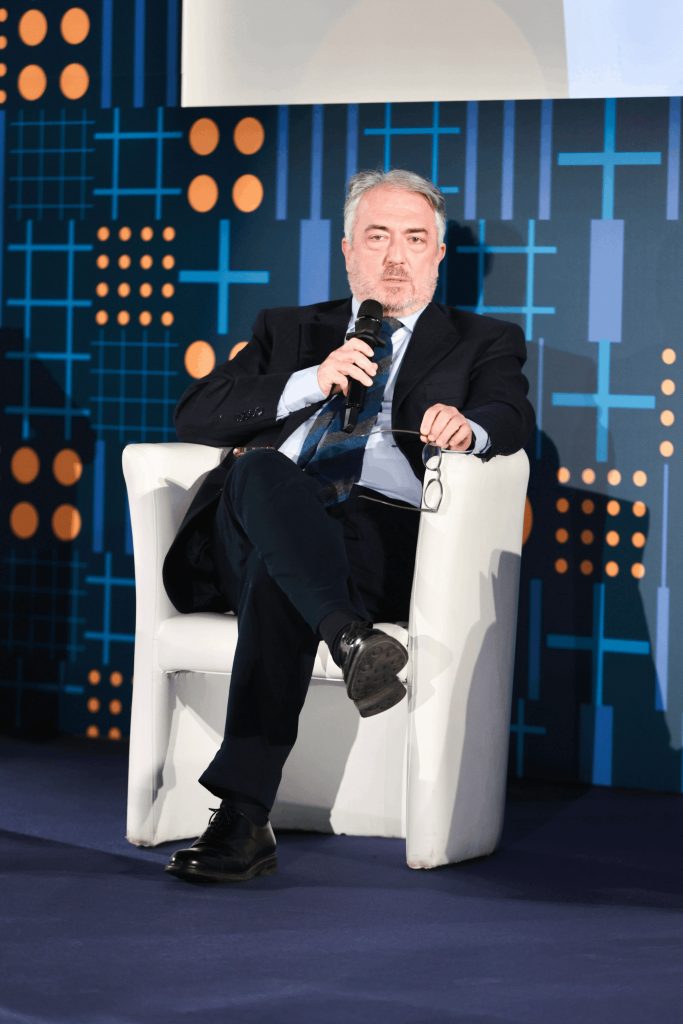
(ZENIT News / Rome, 08.14.2026).- Pope Leo XIV’s decision to appoint three historians to the Pontifical Committee for Historical Sciences would ordinarily have been a routine academic appointment. Instead, the selection of Italian medievalist Umberto Longo has opened an uncomfortable question for the Vatican: how should a pontifical institution respond when one of its newly appointed members is identified in documentary records produced by Masonic organizations as a senior figure within the Scottish Rite?
The Holy See announced on August 13 that Leo XIV had appointed Longo, director of the Italian Historical Institute for the Middle Ages and a professor of medieval history at Sapienza University of Rome, alongside Francesco Cesareo, emeritus president of Assumption University in Worcester, Massachusetts, and Anna Barańska, an associate professor at the John Paul II Catholic University of Lublin.
The committee is not a ceremonial body. Founded by Pope Pius XII in 1954, it inherited the tradition of the Cardinal Commission for Historical Studies established by Leo XIII in 1883. Among its principal responsibilities is the study and promotion of the Church’s archival heritage, particularly the Vatican Archives, and throughout its history it has pressed successive popes to expand scholarly access to the Holy See’s documentary collections. It is currently headed by Jesuit Father Marek Inglot, with Pierantonio Piatti as secretary.
It is precisely this institutional setting that makes the controversy significant.
The question is not whether a historian may study Freemasonry. Obviously he may. Nor is participation in a public conference organized by a Masonic body, by itself, proof of membership. Academic historians routinely study political, religious and intellectual movements with which they have no personal affiliation.
The documentation concerning Longo, however, goes considerably further than conference attendance.
Records published by Italian Masonic organizations identify a person named Umberto Longo as a “Brother,” assign him specific Scottish Rite degrees and describe him holding an internal office. In a 2013 issue of the Scottish Rite publication Logos, the Roman lodge of Perfection known as Giano lists “Brother Orator Umberto Longo, fourth degree” among its officeholders. The same publication carries ritual papers attributed to him in that capacity.
The following year, the evidence becomes even more consequential. The Grand Orient of Italy announced a conference by Umberto Longo on the Scottish Rite’s tradition and ritual. The same presentation subsequently appeared in the Scottish Rite publication under the name “Brother U. Longo, ninth degree.” The publication also identifies Longo as the lodge’s orator.
A later text, published in 2015, is particularly difficult to interpret as the work of a detached academic observer: Longo reportedly writes in the first person about “we as Masons and Scottish” and discusses initiation and the internal symbolism of the rite. The documentation therefore presents a substantially different picture from that of a professor who merely accepts invitations to speak at Masonic cultural events.
Nor does the trail end in 2014 or 2015.
In 2019, the Grand Orient of Italy again listed Longo as a speaker at a conference organized by one of its lodges. In December 2022, he participated in an event devoted to Hugo Pratt and the initiatory world associated with the character Corto Maltese. The event was sponsored by a Scottish Rite-linked cultural foundation, and the person presiding over the rite’s supreme council publicly addressed the speaker as “Brother Professor Longo.” The source material identifies the academic Longo and the individual described in the Masonic documentation as the same professor from Sapienza.
Taken together, the chronology is striking: an internal Masonic office in 2013, documentation identifying a ninth-degree Scottish Rite member in 2014, further first-person Masonic references in 2015, a Grand Orient conference in 2019 and another Scottish Rite-sponsored appearance in 2022.
That does not automatically establish every allegation that might now circulate about Longo, and prudence requires distinguishing documented facts from interpretations. The material provided does not contain a public declaration from Longo explaining whether he remains a Freemason today, nor does it document a resignation or formal break with the organization. That unanswered question matters.
But there is another question, and it belongs to the Vatican.
The Catholic Church’s position on Freemasonry is unusually clear. In 1983, the Congregation for the Doctrine of the Faith, under Cardinal Joseph Ratzinger and with the approval of Pope John Paul II, stated that the Church’s negative judgment regarding Masonic associations remained unchanged because their principles were considered incompatible with Catholic doctrine. The declaration also stated that Catholics who join Masonic associations may not receive Holy Communion.
The Vatican reaffirmed that position four decades later, in 2023, when the Dicastery for the Doctrine of the Faith again emphasized the incompatibility between Catholic doctrine and active membership in Freemasonry.
There is, however, an important distinction that should not be lost amid the controversy. The available material does not establish that Longo is Catholic. Consequently, the canonical penalties applicable to Catholic members of Masonic organizations cannot simply be transferred to him. Nor does membership in a pontifical academic committee require that every member be Catholic.
The issue is instead one of institutional judgment.
The Pontifical Committee for Historical Sciences exists within the Holy See and deals with precisely those historical questions in which the Church’s own history, institutions and documentary heritage are at stake. Its work includes the Vatican Archives, whose collections contain records central to understanding the Church’s political, intellectual and religious history.
A scholar’s academic competence and his ideological or organizational affiliations are not necessarily the same thing. A historian can possess extraordinary expertise while holding convictions with which the Church disagrees. But when documentary evidence appears to indicate sustained participation at a senior level in an organization that the Catholic Church explicitly regards as doctrinally incompatible with Catholicism, transparency becomes especially important when that person is appointed to a pontifical body.
The Vatican therefore faces a relatively simple question, even if the answer may not be simple: was this documentation known and considered before the appointment?
If it was, the Holy See may have a reasoned explanation for why it concluded that Longo’s scholarly qualifications outweighed concerns about his associations. If it was not, the controversy exposes a potentially serious gap in the vetting process for appointments to pontifical institutions.
There is also a broader historical irony. Freemasonry and the Catholic Church have intersected — and frequently collided — throughout modern European history, particularly during the nineteenth-century struggles surrounding the Papal States, Italian unification and the changing relationship between political authority and the Church. The very period that historians of medieval and modern Italy study is therefore not an abstract subject when the institutions involved are themselves part of the historical record.
For that reason, the controversy should not be reduced either to an accusation against Longo or to an attempt to discredit the Vatican’s historical committee. The other two appointments announced on August 13 — those of Francesco Cesareo and Anna Barańska — are not implicated in the dispute, and the committee’s longstanding scholarly mission remains important.
But the question surrounding Longo deserves a precise answer.
The documentary trail presented by the Masonic organizations themselves is extensive enough that simply describing the matter as a case of an academic who once appeared at Masonic conferences would fail to capture what the records say. At the same time, any responsible account should leave room for the possibility of a subsequent change in status that has not been publicly documented.
That is why the most important next step is transparency rather than speculation.
The appointment of a historian to a Vatican committee should ultimately be judged by his scholarship. Yet a pontifical appointment also carries an institutional responsibility: the Holy See should be able to explain how it evaluates affiliations that its own doctrine has explicitly judged incompatible with Catholicism.
In this case, the historical record may be only the beginning of the story. The Vatican’s explanation of the appointment could prove equally important.
Thank you for reading our content. If you would like to receive ZENIT’s daily e-mail news, you can subscribe for free through this link.

Publicaciones relacionadas:
 Controversial Antwerp bishop expands on his idea of ordaining married men and shares his thoughts on women
 A diplomatic storm denied: Vatican and Washington push back against claims of Pentagon pressure on the Holy See
 Trump and Vance prolong the conflict with Leon XIV as Russia and Brazil join the controversy
 Trump takes another swipe at the Pope following the audience granted by Leo XIV to the mayor of Chicago
