

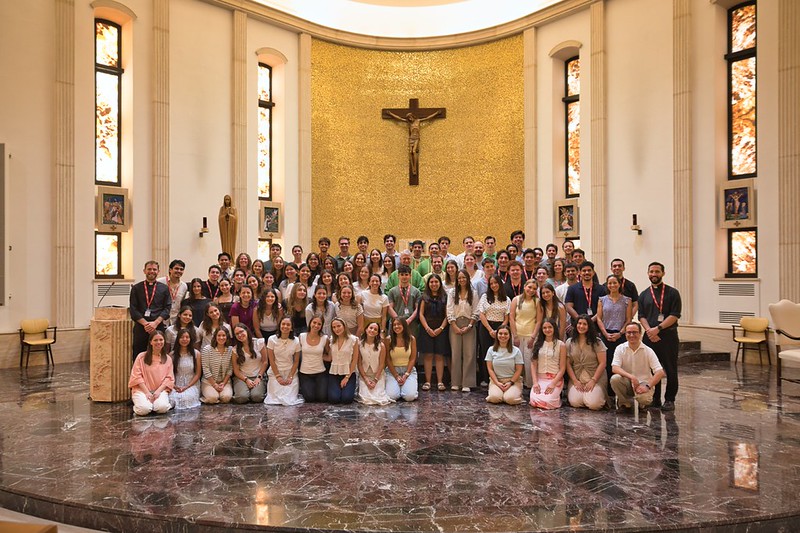
(ZENIT News / Los Ángeles, 08.25.2026).- For years, the American university campus has often been portrayed as difficult terrain for organized religion. Yet a different picture is emerging from Catholic ministry centers across the country: young adults are not merely showing curiosity about the Church, but are entering it, returning to it and, in some places, filling its churches.
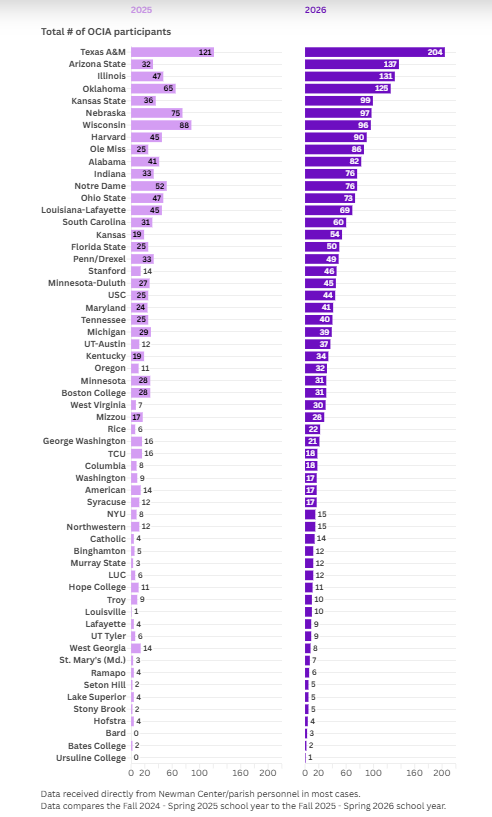
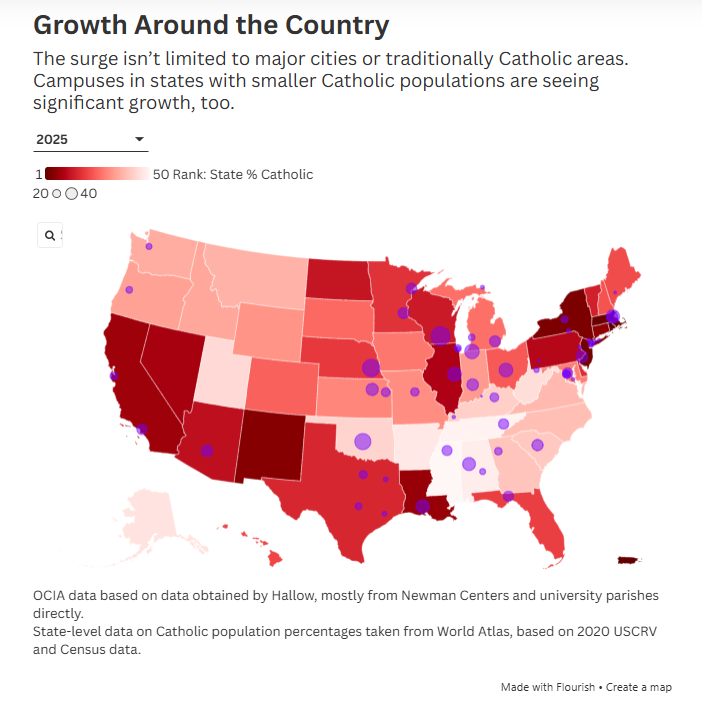
The clearest evidence comes from the Order of Christian Initiation of Adults, or OCIA, the process through which adults prepare to enter the Catholic Church. Data gathered from nearly 60 universities and higher-education institutions show a striking expansion during the 2025-26 academic year. Across the institutions reporting to Hallow, participation in OCIA increased by 87.6 percent when the combined number of candidates and catechumens was compared with the previous academic year. On an institution-by-institution basis, the average increase was even higher, at 115 percent.
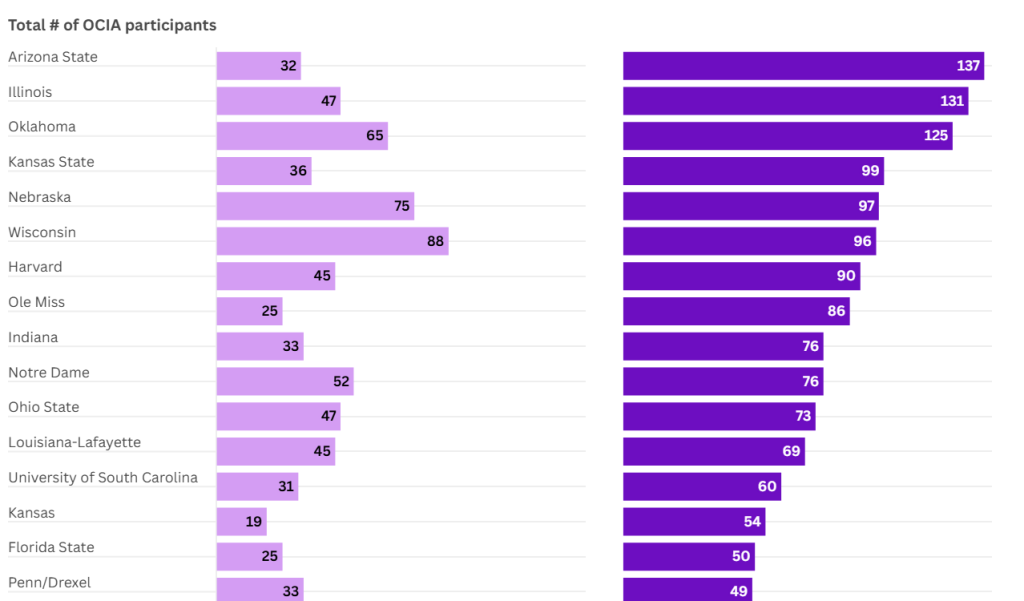
The distinction matters: the two figures measure the same phenomenon in different ways. The 87.6 percent figure compares the total participants across the reporting institutions, while 115 percent represents the average growth rate among individual schools.
Either way, the direction is unmistakable.
Texas A&M recorded the largest number of OCIA participants in the dataset, rising from 121 in 2024-25 to 204 in 2025-26. Arizona State reported 137, the University of Illinois 131, Oklahoma 125, Kansas State 99, Nebraska 97, Wisconsin 96 and Harvard 90. Some institutions that had recorded virtually no activity the previous year also began to see students enter the process: Louisville increased from one participant to 10, while Ursuline College and Bard College reported their first participants in the period covered.
But the most revealing evidence may be found beyond the conversion figures.
At the University of Southern California, diocesan-style statistics have acquired a very personal face. Deacon Paul Pesqueira, who has directed the campus OCIA program for 14 years, saw participation rise from 18 students in 2023-24 to 25 the following year, and then to 44 in 2025-26. He had hoped merely to reach 26. The increase came without advertising: according to Pesqueira, students found the program primarily through word of mouth.
That pattern is significant. A religious revival sustained largely by personal invitation suggests something different from a successful institutional marketing campaign. Students appear to be talking to one another about faith and bringing friends into communities they have discovered themselves.
The phenomenon is also visible in places not traditionally associated with Catholic strongholds. Stanford tripled its OCIA numbers during 2025-26. More strikingly, Father Bart Hutcherson reported 16 adult baptisms at Easter, compared with an historical average of about four per year, with almost all of the newly baptized coming from the university. New York University recorded an 88 percent increase in OCIA participation, alongside a tripling of daily Mass attendance. Loyola University Chicago also doubled its OCIA participation.
The numbers become even harder to dismiss when sacramental life is considered alongside them.
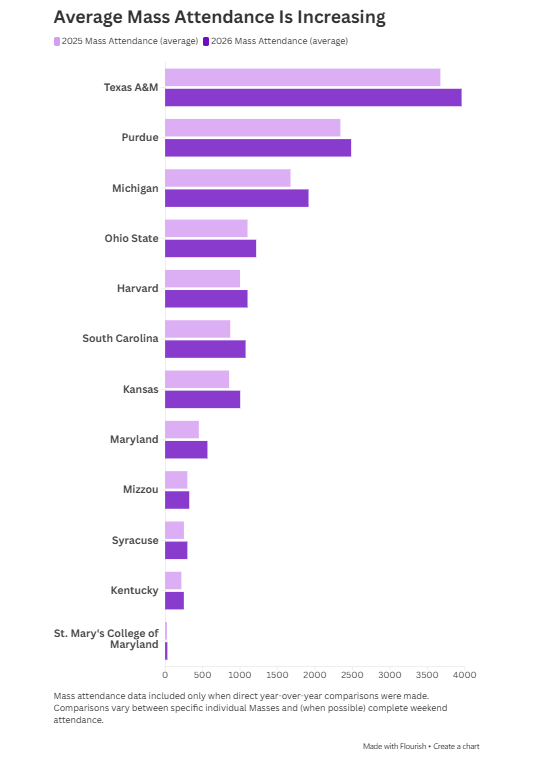
At St. Thomas More on the University of South Carolina campus, daily Mass attendance rose from about 45 to 80 people. An autumn retreat that attracted 23 students in 2023 drew 122 in 2025. Perhaps the most dramatic comparison came on Ash Wednesday: attendance grew from 500 students in 2021 to 2,537 the following year cited in the report.
Campus Catholic centers elsewhere report the same pattern: fuller retreats, increased demand for confession, greater participation in Eucharistic adoration and crowded Sunday liturgies. At Northwestern University, additional opportunities for confession and adoration have been introduced as participation has grown. At some campuses, Eucharistic vigils have attracted students willing to remain for many hours.
What is driving it?
The available data do not establish a single cause, and it would be premature to turn a collection of encouraging reports into a definitive explanation of American religious life. Yet the testimony of students and campus ministers points toward a common theme: exhaustion with a culture that often promises identity, connection and fulfillment through digital life, social approval and constant self-presentation.
Sophia Carrenza, a student at Texas Christian University who entered the Church through OCIA and now serves in campus ministry, described young people as increasingly willing to question whether the pressures surrounding them actually provide meaning. At TCU, nine students had already registered for OCIA for Easter 2027, while the campus ministry was considering two Confirmation classes to accommodate demand. Sunday Mass there averages about 450 students, from an undergraduate population of roughly 11,000.
There is another dimension that deserves attention. The revival is not confined to conversions.
Carrenza observed that many students raised Catholic but subsequently detached from religious practice are also returning. That makes the trend more than a story about converts. It may also represent a rediscovery of Catholic identity among young adults who inherited the faith but never fully embraced it.
The broader comparison is equally noteworthy. Hallow reported a 38 percent increase in OCIA candidates and catechumens across dioceses in 2025-26. Growth among university ministries and Newman Centers therefore appears substantially stronger than the diocesan increase. The available figures do not prove that every Catholic campus is experiencing a revival, nor do they establish a nationwide reversal of long-term religious trends. But they do suggest that college-age Americans may currently be responding to Catholicism at a faster rate than the wider population.
And perhaps that is why the most telling statistic is not a statistic at all.
At the University of Utah, Father Gabriel T. Mosher, OP, has watched Mass attendance triple during his four years at the Newman Center. He believes the community’s liturgical life helps people remain once they arrive. Yet his explanation ultimately moves beyond strategy and demographics: the Church’s task, he argues, is to be ready to receive those who are seeking.
That is a useful lesson for Catholic institutions confronting declining practice elsewhere. Programs, communication and capable ministry matter, but they cannot manufacture a conversion of heart. The striking feature of these campuses is not simply that more young people are signing up for OCIA. It is that, in an increasingly secular university environment, many appear to be asking questions that the culture around them has failed to answer—and are finding in Catholicism a faith substantial enough to keep searching.
Thank you for reading our content. If you would like to receive ZENIT’s daily e-mail news, you can subscribe for free through this link.

Publicaciones relacionadas:
 How ‘Rare’ Are Sex-Trait Modification Surgeries on Children?
 Surprising research data among French clergy: the younger they are, the more conservative… and happy they are
 This is the first country to legally ban social media for children, and this is what studies say about it
 Masculinity Reconciled with Religion: Study Shows Increase in Faith Among Young Men
