


(ZENIT News / Rome, 04.16.2026).- After decades in which young women consistently reported higher levels of religiosity than their male counterparts, new data suggest that the pattern has not only eroded but reversed. Young men are now emerging as the most dynamic segment in a broader environment otherwise marked by religious decline.
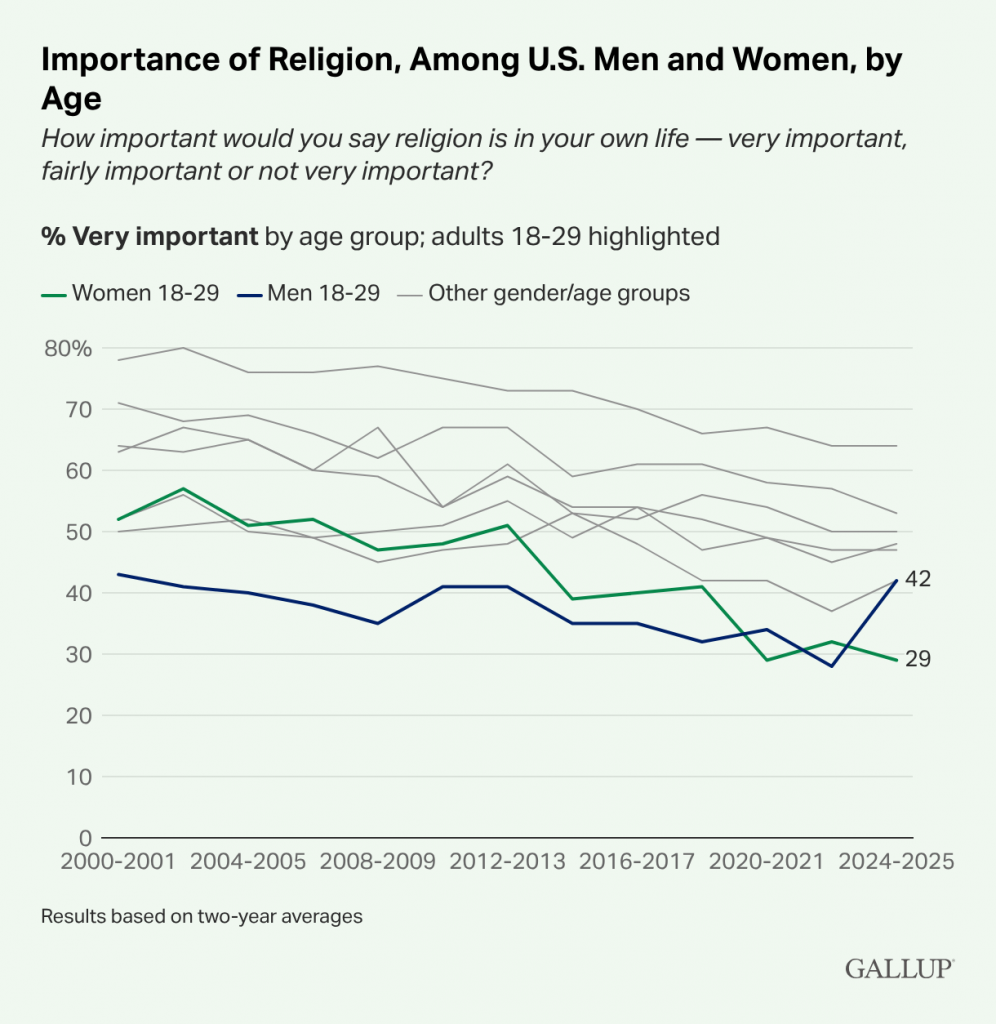
According to the latest aggregated findings from Gallup for the 2024–2025 period, 42% of men aged 18 to 29 say religion is “very important” in their lives. This marks a sharp increase from 28% just two years earlier, effectively returning this group to levels last seen at the turn of the millennium. By contrast, young women have remained largely static, with around 30% expressing the same level of religious importance. The result is a statistically significant inversion of a gender gap that, for years, had tilted decisively in the opposite direction.
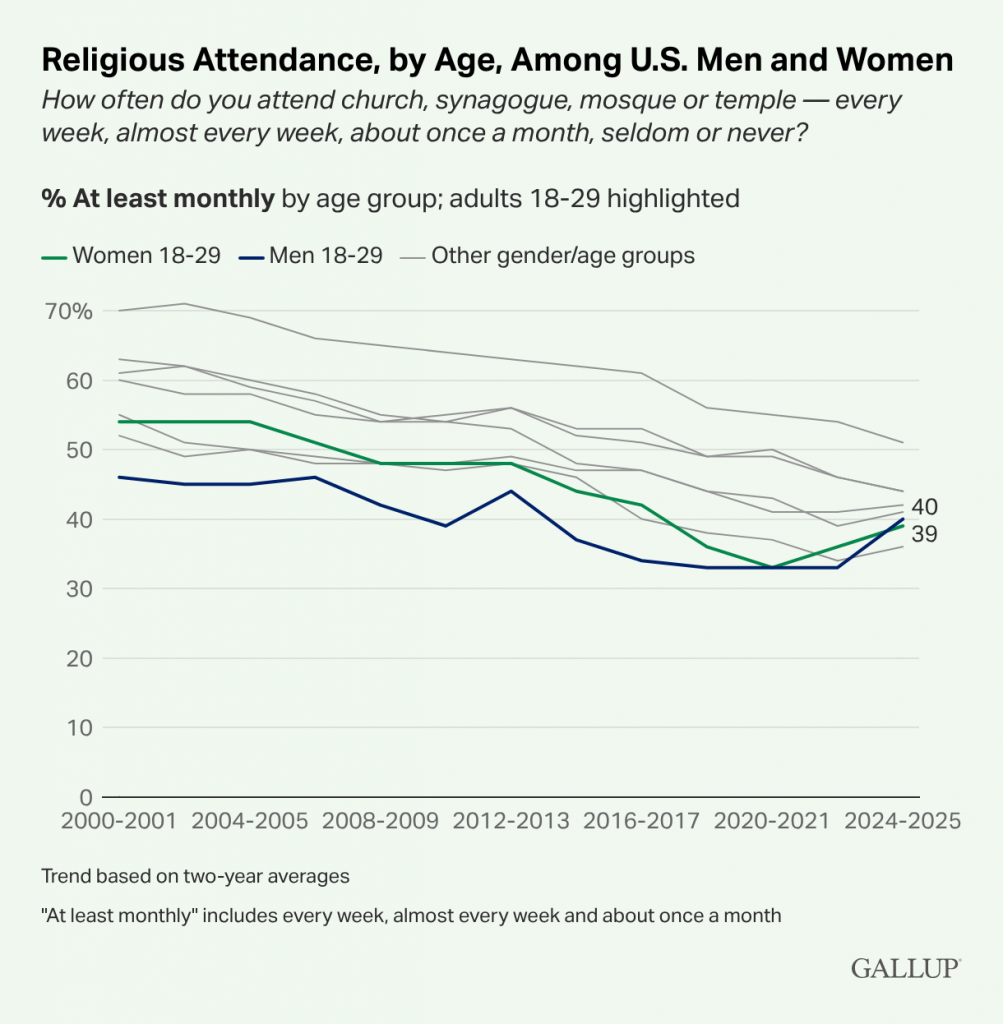
At the beginning of the 2000s, young women outpaced young men in religious commitment by nine percentage points, a gap that widened to as much as 16 points in the following years. Over time, however, that difference gradually narrowed, reaching near parity by the early 2020s. The latest figures do more than confirm convergence; they signal a turning point.
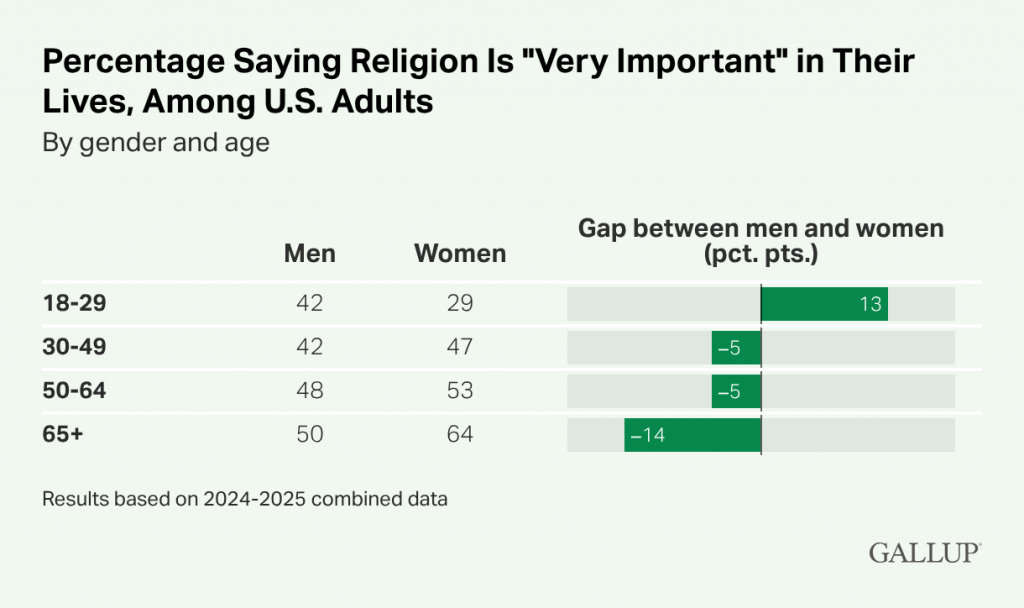
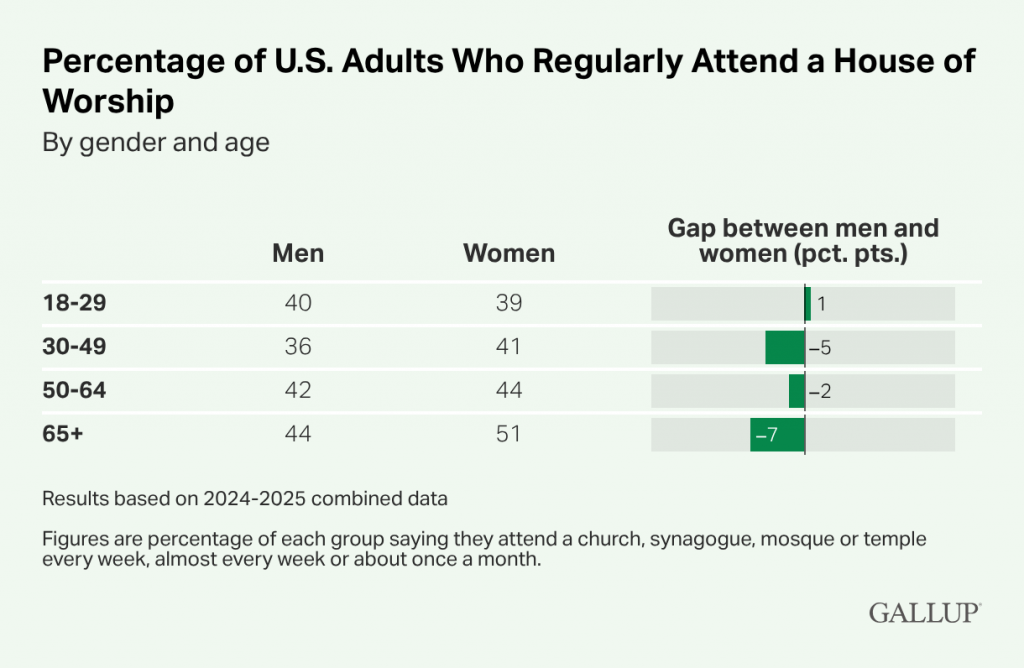
This reversal is tightly concentrated within the youngest adult cohort. Among Americans aged 30 and above, women continue to report higher religiosity than men, maintaining the traditional pattern. What distinguishes the current moment is not a universal resurgence of faith, but rather a generational anomaly: young men are moving against the prevailing current.
The same dynamic appears in patterns of religious practice. Forty percent of young men now report attending religious services at least monthly, a seven-point increase since 2022–2023 and the highest level recorded for this group since 2012–2013. Young women have also registered a modest uptick, rising to 39%, but their participation remains well below early-2000s benchmarks. Notably, young men’s attendance now closely resembles that of older men, while young women stand increasingly apart—not only from men, but from older women as well.
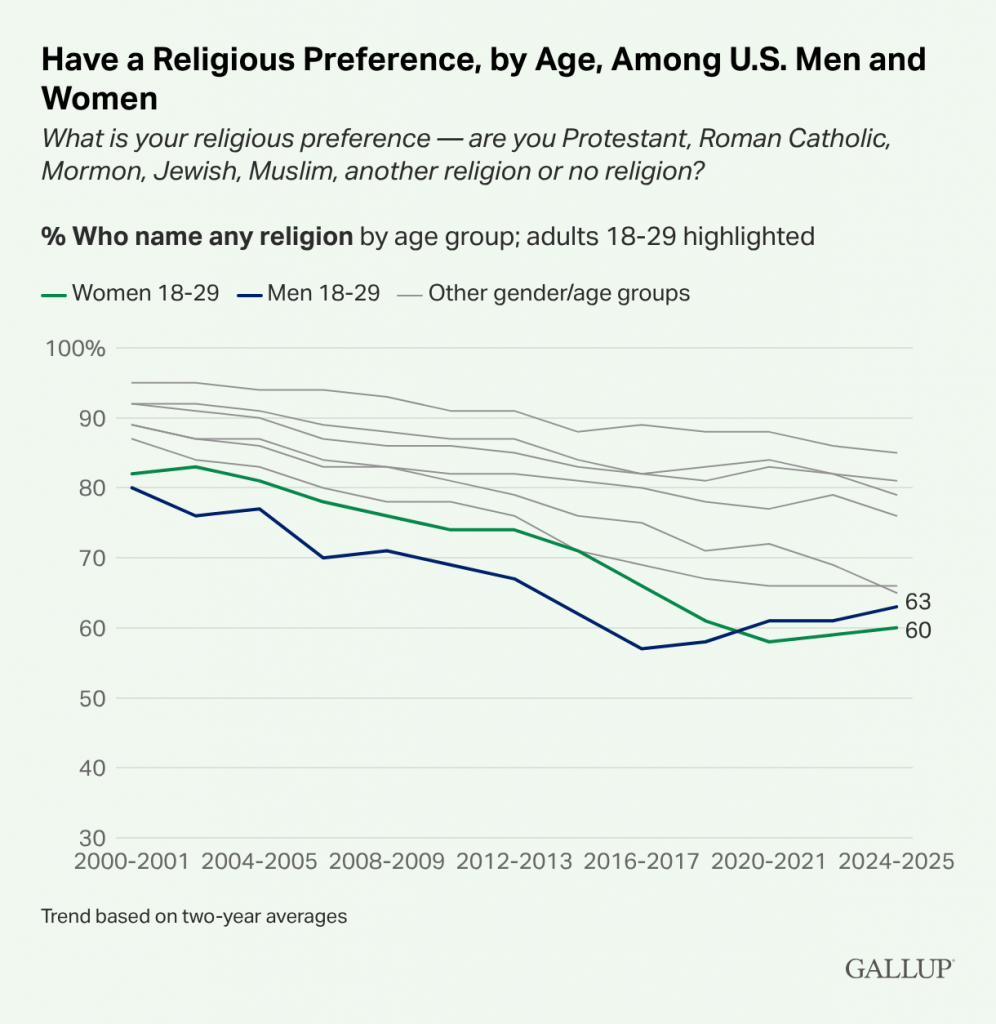
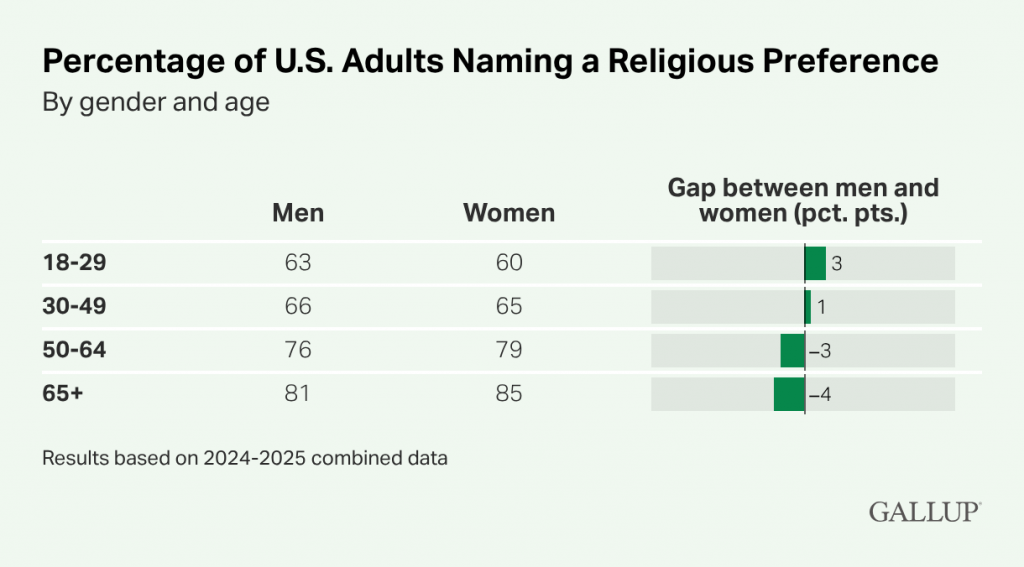
Religious identity, however, tells a more nuanced story. While 63% of young men identify with a specific faith tradition—virtually unchanged from recent years—this figure represents a recovery from a low point of 57% in 2016–2017. Among young women, identification has declined to 60%, continuing a gradual downward trend. The gap here is modest but persistent, with young men holding a slight edge since 2020–2021.
Across the broader population, the trajectory remains one of erosion. Older men and women alike report historically low or near-low levels of religious importance, affiliation, and attendance. In that context, the resurgence among young men stands out less as a revival than as an exception.
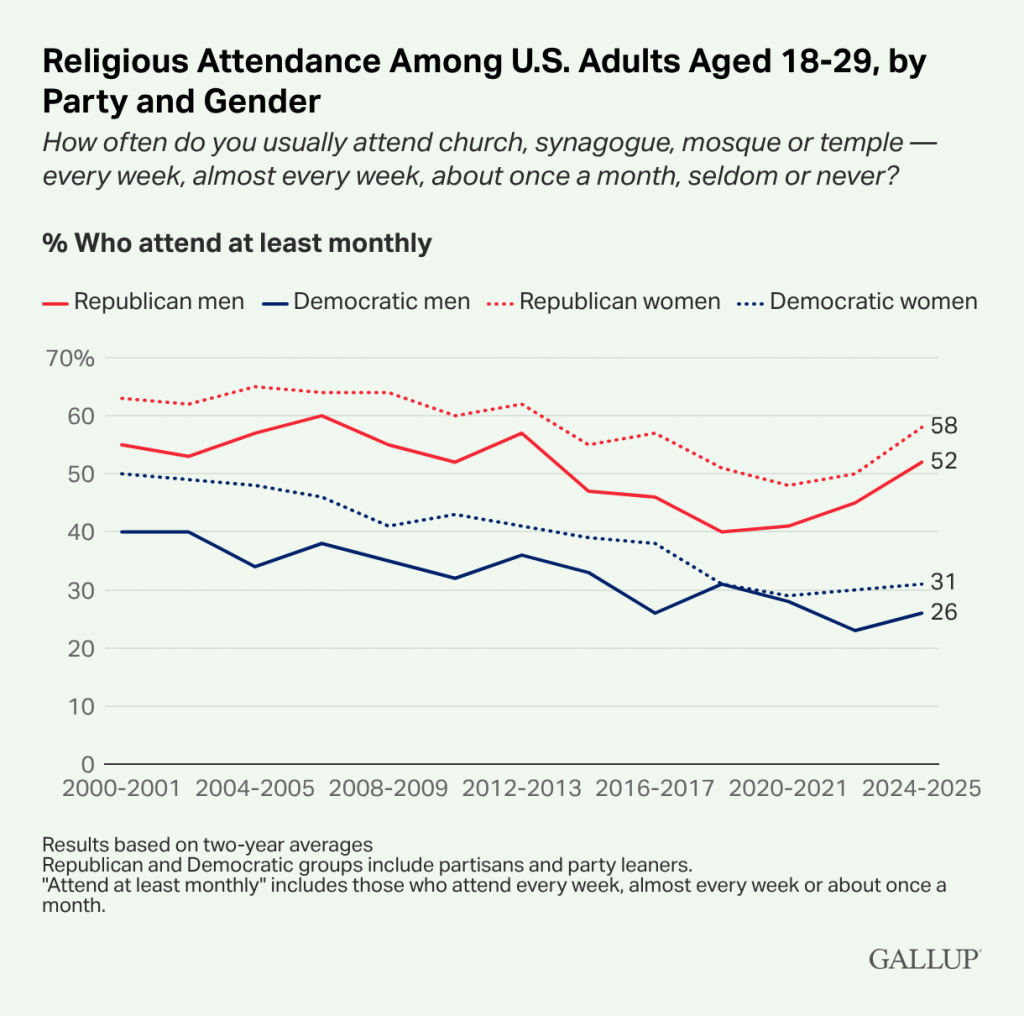
The data point to an important explanatory variable: political alignment. When religious attendance is analyzed through a partisan lens, the recent increase appears closely tied to young Americans who identify with or lean toward the Republican Party. Since 2022–2023, attendance has risen by seven points among young Republican men and eight points among young Republican women, compared with a more modest three-point increase among young Democratic men and little change among young Democratic women.
These shifts are amplified by the differing political compositions of young men and women. Nearly half of young men—48%—identify as or lean Republican, compared with 41% who align with Democrats. Among young women, the pattern is reversed: 60% lean Democratic, while only 27% identify with or lean Republican. As a result, the religious resurgence among Republican-leaning youth has a much greater influence on the overall trajectory of young men than on that of young women.
What emerges is a complex interplay between religion, gender, and political identity. The increase in religiosity among young men does not appear to stem from a broad-based cultural shift affecting all demographics equally. Rather, it reflects the growing weight of a subgroup whose religious engagement has been intensifying over several years, particularly since the late 2010s.
Whether this development represents a temporary fluctuation or the beginning of a more durable realignment remains uncertain. Gallup’s long-term data series, spanning from 2000–2001 to the present, underscores the volatility of religious indicators across generations. Yet if current patterns persist, they could reshape one of the most stable sociological observations in American religion: the consistent tendency of women to report higher levels of faith than men.
For now, the evidence suggests that the narrative of religious decline in the United States, while broadly accurate, is no longer uniform. Within it, a countercurrent is forming—led not by institutions or older believers, but by a segment of young men whose renewed engagement is beginning to redraw the map.
Thank you for reading our content. If you would like to receive ZENIT’s daily e-mail news, you can subscribe for free through this link.

Publicaciones relacionadas:
 How ‘Rare’ Are Sex-Trait Modification Surgeries on Children?
 Transgender Identification Surges Among Young Adults: A Generational Shift or a Social Phenomenon?
 Australia: data suggest that more and more people are seeking God
 This is the first country to legally ban social media for children, and this is what studies say about it
