

(ZENIT News / Madrid, 09.01.2026).- A centuries-old Marian image has become the most visible symbol of a much larger dispute. At the center is Torreciudad, the sanctuary associated with Opus Dei, and a bishop who now says he would rather surrender his office than accept a settlement that permanently separates his diocese from the image it has venerated for generations.
The confrontation reached a new level on Aug. 31, when Ángel Javier Pérez Pueyo, bishop of Barbastro-Monzón, publicly declared that he would place his position at the disposal of the Holy See if an eventual agreement required him to accept the definitive removal of the original image of Our Lady of Torreciudad from its historic hermitage.
His declaration puts the spotlight not only on a disputed statue, but also on Pope Leo XIV, who inherited the unresolved case from Pope Francis. The question now facing Rome is how to settle a conflict involving a diocese, a personal prelature of the Catholic Church’s and a sanctuary that has acquired an international spiritual importance without allowing the dispute itself to overshadow the religious purpose of the site.
The immediate issue is deceptively simple: where should the original image remain?
The answer is anything but simple.
For more than a thousand years, according to the bishop’s account, the image was associated with the small hermitage at Torreciudad. More than five decades ago it was moved to the modern sanctuary promoted by Saint Josemaría Escrivá, founder of Opus Dei, which opened in 1975. The new complex subsequently became a major center of Marian devotion and pilgrimage.
On Sept. 5, however, the image is scheduled to return temporarily to the old hermitage during the 47th pilgrimage of the Virgins of Ribagorza and Sobrarbe. Pérez Pueyo has presented the occasion as more than a ceremonial homecoming. For him, it is a test of whether an ancient local religious tradition can survive an institutional dispute that has developed far beyond the scale of the original transfer.
The bishop insists that Barbastro-Monzón is not seeking control of the modern sanctuary. He says the diocese has renounced any financial compensation and is not demanding control of the new temple, its assets, its accounts or the companies and foundations connected with its administration.
Instead, he has proposed a solution that would radically change the institutional framework: Torreciudad could become an international sanctuary under the direct responsibility of the Holy See, with Rome overseeing its pastoral and financial affairs.
That proposal is significant because it attempts to separate two questions that have become entangled: who should administer Torreciudad, and where the historic image should be permanently located.
Pérez Pueyo says the diocese can accept the first question being resolved in favor of a structure involving the Holy See and Opus Dei. The second, he argues, is non-negotiable.
At the heart of that position is a historical claim that remains contested. The bishop says diocesan and cathedral archives do not contain documentation establishing that the image was definitively surrendered by the local Church when it was moved. Opus Dei, however, maintains that documentary evidence exists showing that the relevant rights were transferred in perpetuity.
The dispute therefore has a legal dimension as well as an ecclesial one. The competing interpretations of documents from the early 1960s could ultimately determine whether the image’s relocation constituted a legitimate transfer of rights or merely an authorized movement whose original ownership and connection to the diocese remained intact.
That unresolved question helps explain why an apparently local Marian controversy has reached the Vatican.
Francis intervened directly in the wider Torreciudad dispute in October 2024 by appointing Archbishop Alejandro Arellano Cedillo, dean of the Roman Rota, as a plenipotentiary pontifical commissioner for the complex. The intervention did not amount to placing the Diocese of Barbastro-Monzón itself under a commissioner; the bishop has stressed that distinction.
What began as a Vatican mechanism intended to resolve the dispute has now become another source of disagreement. Pérez Pueyo says the commission has increasingly resembled mediation between the parties rather than an instrument for determining what he regards as the diocese’s rights.
The history of the confrontation also explains why the bishop has repeatedly invoked Francis.
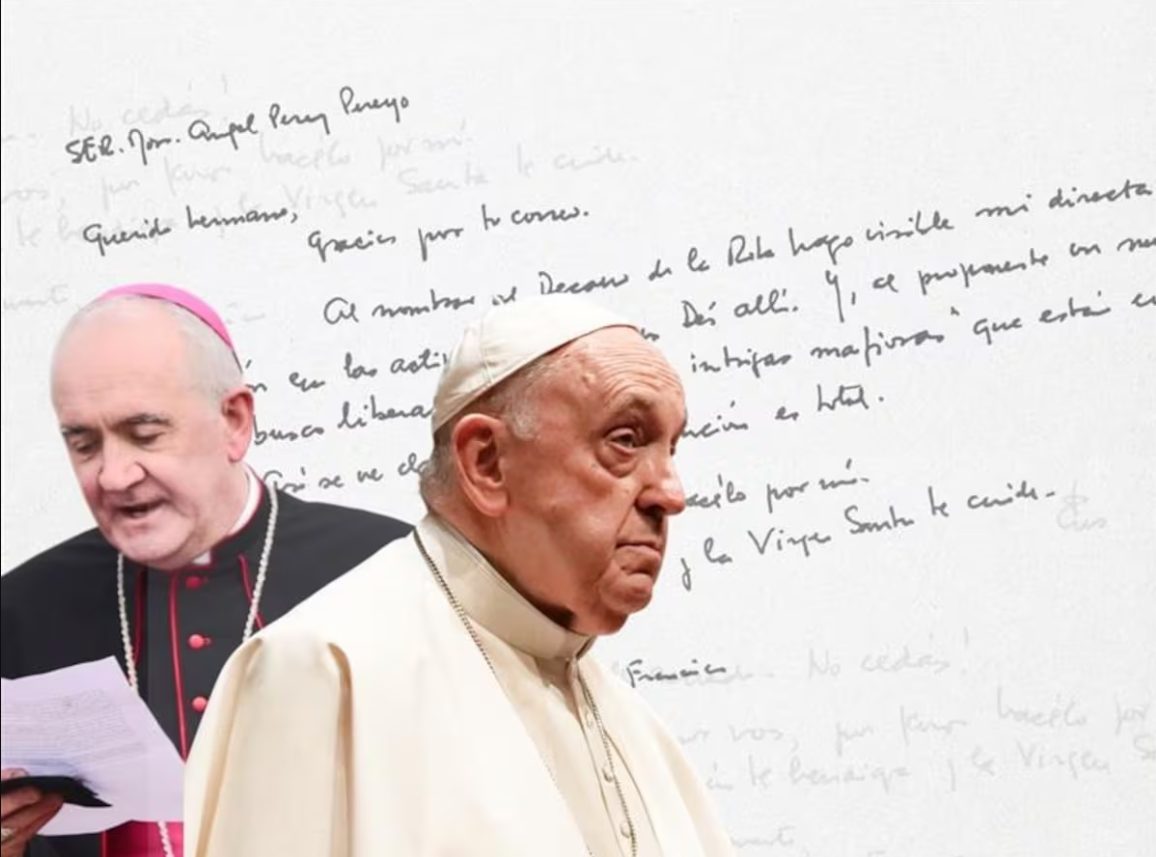
According to Pérez Pueyo, Francis first heard his concerns during the bishop’s visit to Rome in December 2021. Meanwhile, the anticlerical newspaper El País has published the contents of several letters from the late Pope Francis to the bishop of Barbastro. According to those letters, Francis sides with Pérez Pueyo. In July 2023, the late pope allegedly sent him a handwritten message urging him not to give way. In September 2024, according to the bishop, Francis again asked him personally about whether the Madonna had been brought down from the sanctuary. A further handwritten communication later that year referred to what Francis described as intrigues surrounding the affair.
Those private exchanges have acquired new significance after Francis’ death because they reveal the degree to which the former pope personally followed a dispute that had already become a difficult issue within the Church’s relationship with Opus Dei.
Francis had previously altered the institutional position of Opus Dei within the Church’s structures, placing it under the Dicastery for the Clergy and changing the status of its prelate. The Torreciudad intervention formed part of the same period of heightened scrutiny.
Leo XIV must now deal with the unfinished business without simply inheriting the political dynamics of his predecessor.
There is another complication. The present pope has not yet approved Opus Dei’s revised statutes, and in March 2026 he received author Gareth Gore, whose published investigation had sharply criticized aspects of the organization. The meeting does not by itself establish the Pope’s position on Torreciudad, but it has inevitably attracted attention because of the broader dispute over the institution.
For Pérez Pueyo, however, the controversy is ultimately not about Opus Dei’s right to carry out its mission at Torreciudad. In his letter, he explicitly acknowledges the spiritual work accomplished there over fifty years, citing conversions, confessions, families, vocations and Marian devotion. He says he wants Opus Dei to continue its mission and wants the sanctuary to become a major center of Marian evangelization.
That distinction may be crucial to any eventual settlement.
The bishop is not presenting the dispute as a contest between Opus Dei and the diocese over who can claim Torreciudad. He is framing it as a question of whether the modern sanctuary can flourish without severing its relationship with the older religious tradition from which the site emerged.
Thank you for reading our content. If you would like to receive ZENIT’s daily e-mail news, you can subscribe for free through this link.

Publicaciones relacionadas:
 Pope Francis sends a «golden rose» to Our Lady of Peace and Good Voyage in the Philippines
 Pope Francis yes, Church no: survey reveals that the Pope is the most trusted person in Italy
 “Deportation hurts the dignity of many men»: Pope Francis in letter to U.S. bishops
 Pope Francis Warns of AI’s Role in Enabling Abuse, Calls for Ethical Responsibility
