

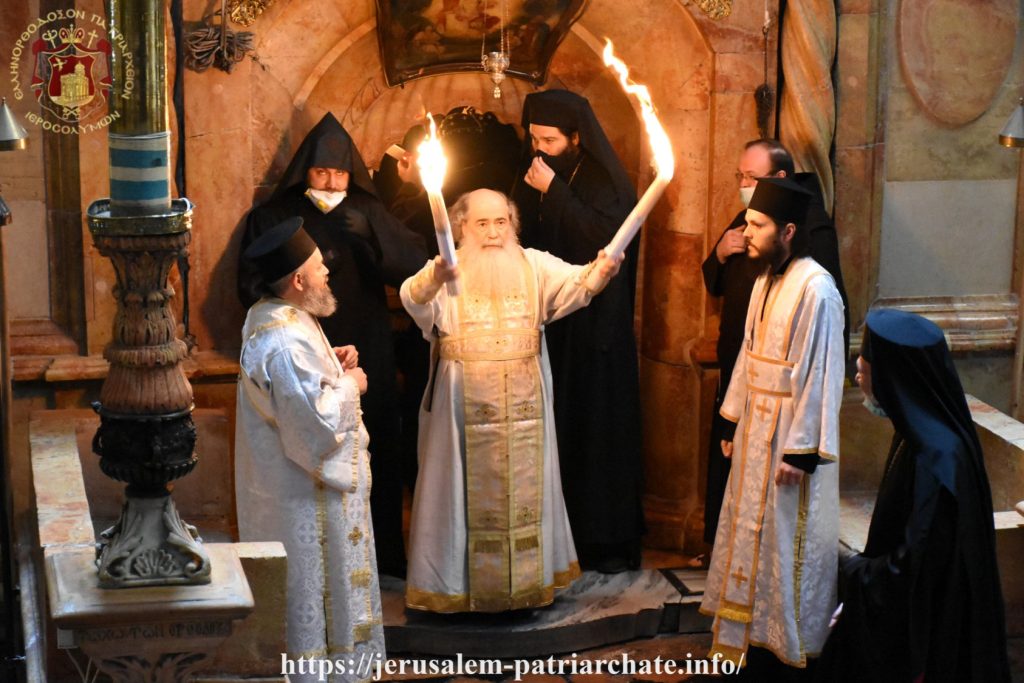
(ZENIT News / Atenas, 09.07.2026).- For centuries, one of the most emotionally powerful ceremonies of Orthodox Christianity has unfolded every Holy Saturday inside Jerusalem’s Church of the Holy Sepulchre. Thousands of pilgrims gather to await the appearance of the Holy Fire, a flame traditionally associated with the Resurrection and carried from Jerusalem to Orthodox communities across the world.
But a recent court ruling in Athens has brought an old controversy into sharp new focus, concluding—on the basis of testimony and evidence examined during litigation—that the flame is lit through human intervention rather than appearing through a supernatural event.
The judgment does not, and could not, rule on whether God is capable of performing miracles. What it addressed was a more concrete question: whether journalist Dimitris Alikakos had falsely reported testimony concerning the way the Holy Fire ceremony is conducted. The answer reached by the Athens court has given the controversy consequences far beyond a dispute between a journalist and an Orthodox hierarch.
The ruling, issued on February 26, 2026, by the Single-Member Court of First Instance of Athens, found that the evidence supported the conclusion that the flame is lit by human means, including with a lighter or matches. The case became final on June 23 after no appeal was filed within the required period.
A ceremony revered across the Orthodox world
The Holy Fire ceremony remains one of the most important annual religious events for many Orthodox Christians. After prayers at the Church of the Holy Sepulchre, the flame is distributed among the faithful and transported to countries with significant Orthodox populations, including Greece, Bulgaria, Romania, Serbia, Cyprus, Georgia, Lebanon, Egypt, North Macedonia, Ukraine and Russia.
For many believers, its importance has never been merely technical. The ceremony is a powerful symbol of Easter, light overcoming darkness and the Resurrection of Christ.
Yet that symbolic and devotional significance is precisely what makes the question of its alleged miraculous origin so sensitive.
For years, descriptions associated with the Greek Orthodox Patriarchate of Jerusalem explicitly referred to the event as a “true miracle.” Catholic Franciscans responsible for the Holy Land, however, have historically shown greater reserve regarding claims that the flame is supernaturally produced.
The controversy intensified after investigations by Alikakos, the son of an Orthodox priest and author of the 2019 book Redemption: On the Holy Fire. Beginning his investigation in 2018, he published testimonies and recordings involving figures connected with the Patriarchate of Jerusalem.
One of those disputes eventually reached the Greek courts.
Testimony from inside the Patriarchate
Among the evidence cited in connection with the case was sworn testimony from Archbishop Nikiforos of Ascalon, who had served for decades in the Patriarchate of Jerusalem.
Between 1984 and 1988, he held the position of skeuophylax, an ancient ecclesiastical office involving responsibility for sacred objects and preparations connected with the church.
According to his sworn account, there was no supernatural ignition of the Holy Fire. He stated that the perpetual lamp was prepared and kept burning so that the Patriarch would find the flame during the ceremony, adding that this was known among the Patriarchate’s hierarchs.
Another cleric, Archbishop Theophanes of Gerasa, offered a distinction that may be crucial for understanding the entire controversy. According to his testimony, the flame itself was natural, while its religious significance came through the Patriarch’s prayers and the liturgical ceremony surrounding it.
That distinction challenges the popular understanding of the event without necessarily denying the spiritual value that believers attach to it.
A liturgy does not become meaningless simply because every physical element within it can be explained. The problem arises when devotional symbolism is presented as an objective supernatural fact without sufficient grounds.
The Patriarchate quietly changed its language
Another development has added weight to the controversy.
Following the revelations published by Alikakos in 2018, the wording describing the Holy Fire as a “true miracle” disappeared from the Patriarchate’s online material. The page was modified in June 2018, and the specific entry dedicated to the Holy Fire was later removed.
The historical record also appears more complicated than the popular story suggests.
The fourth-century pilgrim Egeria described a lamp burning continuously in the Church of the Holy Sepulchre but did not describe a miraculous annual ignition. Explicit accounts presenting the appearance of the flame as supernatural emerged considerably later, apparently no earlier than the eighth or ninth century.
This does not diminish the antiquity of Christian devotion at the Holy Sepulchre. On the contrary, it highlights the importance of distinguishing between the ancient Christian veneration of the place where Christ was buried and later traditions that developed around particular ceremonies.
Faith does not need manufactured miracles
The Athens ruling should not be used as a weapon against Orthodox Christianity or against the sincere faith of the pilgrims who travel to Jerusalem every Easter.
The Holy Fire ceremony can retain profound religious meaning as a celebration of Christ, the Light of the World, even if the flame itself is lit by human hands.
Christian faith has never required believers to accept every popular tradition or devotional claim as a miracle. Indeed, the Church’s credibility is strengthened, not weakened, when religious institutions distinguish clearly between established supernatural events, symbolic ceremonies and traditions whose origins may be less extraordinary than generations of believers have assumed.
The court in Athens did not pronounce on heaven. It examined evidence about what happens on earth.
Thank you for reading our content. If you would like to receive ZENIT’s daily e-mail news, you can subscribe for free through this link.

Publicaciones relacionadas:
 Israeli embassy attacks Catholic leaders in the Holy Land for comments on Gaza massacre
 Catholic Church in Italy announces funding for new hospital in Gaza
 Netanyahu at the UN: Palestinian Christians Denounce a Lie
 Archaeologists Identify the Site Where Jesus Exorcised the Legion of Demons and the Herd of Pigs
