

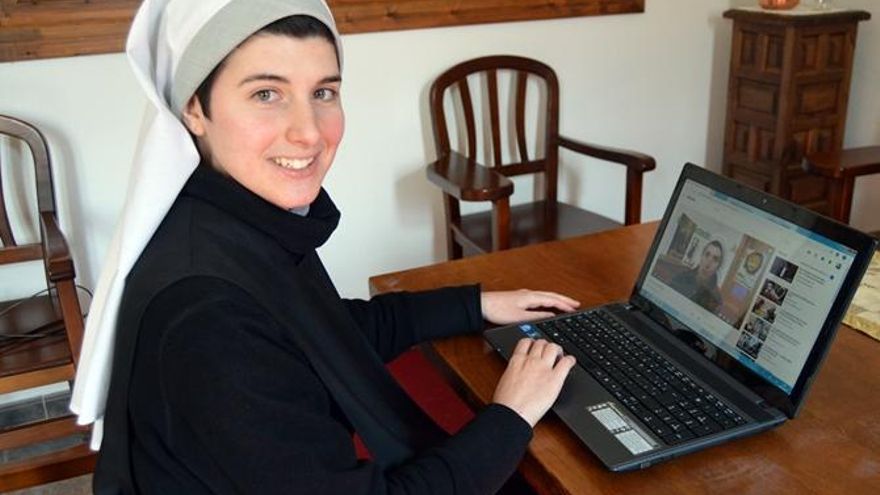
(ZENIT News / Guadalajara, 09.14.2026).- Certain women religious are not necessarily abandoning the traditional “ora et labora”; rather, they are bringing the ancient Benedictine principle — «pray and work» –into the 21st century. They are engaging in online stores, social media, marketing, sustainable agriculture, artisanal products, and business management, yet with a purpose distinct from that of conventional business: sustaining a community, preserving a heritage, and continuing a mission.
In this century, there are women religious who might be considered true «entrepreneurial nuns» — though it may be more accurate to call them entrepreneurial women religious or social entrepreneurs — because their goal is typically not personal enrichment, but rather sustaining the community, preserving convents, and funding apostolic and social works.
In Spain, Benedictine Sister Marta González, from the Convent of Santa Cruz de Sahagún in León, combines a contemplative life with a very modern «business venture.» At her convent, they produce artisanal sweets, soaps, lip balms, and creams, which they sell — even internationally — through their online store. Sister Marta also uses YouTube and TikTok to share daily life at the convent, having built a community of nearly 200,000 followers.
It is a magnificent example of how a cloistered nun can utilize e-commerce and social media without abandoning her contemplative identity.
One of the most surprising cases is that of Sister Doris Engelhard, a Franciscan religious Sister at Mallersdorf Abbey in Bavaria.
She is a master brewer who has produced beer for the convent for decades; L’Osservatore Romano noted that she reached an annual production of approximately 3,000 hectoliters. For her, working and brewing beer can also be a way of serving God. Her case is particularly interesting because it breaks the stereotype that a nun must limit herself to activities traditionally considered «religious.»
The nuns of Maredret Abbey developed a craft beer as a way to raise funds for the convent’s preservation efforts.
Yet, they did not stop at merely selling a product; they turned the abbey’s history and identity into part of the brand. The recipes incorporate plants associated with the convent garden, such as juniper, coriander, and sage.
This highlights a very modern concept: entrepreneurship as a tool for preserving religious heritage.
Entrepreneurial Religious Women in Africa
This phenomenon is even more striking in Africa. The «Sisters Blended Value Project» is training Catholic women religious from various African countries in business management, financing, market access, and social entrepreneurship.
There are agricultural projects, including farms, food production, and workshops. One specific case in Kenya began with the manufacture of school uniforms; after receiving business training, the group secured a university contract to produce graduation gowns.
Here, the concept of the «religious entrepreneur» takes on a new dimension: the business generates revenue while simultaneously creating jobs and aiding vulnerable communities. Italian monasteries are also involved in cosmetics, agriculture, and food production.
We find very interesting examples in Italy as well. The Trappist nuns of Vitorchiano run a cosmetics workshop and engage in agricultural activities, while other communities produce bread, olive oil, cereals, and other goods.
Some communities have even created shared brands so that products from different convents can reach the market under a unified identity.
A Growing Phenomenon
These are not merely isolated cases. In Spain, for instance, various communities of nuns are seeking new sources of income because convent maintenance costs have risen while the number of religious vocations has declined.
An Inspiring Irish Success Story
On the banks of the River Moy in County Mayo lies one of Ireland’s most remarkable industrial success stories. The Foxford Woollen Mill, now known simply as FOXFORD, has survived over 130 years of economic turbulence, shifting fashion trends, technological transformation, and even the threat of closure. At the heart of this story is an extraordinary woman: Mother Agnes Morrogh-Bernard, a Catholic nun who believed that the solution to poverty lay not merely in charity, but in dignified employment.
Agnes Morrogh was born in Cheltenham on February 24, 1842, the eldest of ten children in a wealthy Catholic family — the Morroghs of Glanmire, near the city of Cork. On July 2, 1863, driven by her Catholic faith and the poverty she had witnessed in Kerry, she traded a life of privilege for one of personal sacrifice by entering the novitiate of the Sisters of Charity, an Order founded in 1815 by the Cork-born Mary Aikenhead.
Agnes professed her vows as Sister Mary Joseph Arsenius on January 16, 1866. Her first assignment was as a teacher at the Stanhope Street National School in Dublin. In 1877, she was sent to Ballaghaderreen, in County Mayo, to serve as Superior of a new convent. There, she founded a national school, a technical school offering training in various agricultural methods, a bakery, a laundry, a pharmacy, and a public library. Notably, she established a textile business where local young women received training in spinning, weaving, knitting, garment making, lacemaking, and crochet.
By the time she arrived in Foxford in December 1890, she had already established a reputation as an energetic and practical organizer.
Foxford was a small, impoverished community in the west of Ireland that had never fully recovered from the effects of the Great Famine. Mother Agnes was determined to take practical action to alleviate the poverty she encountered. Her ambition was summed up in the phrase that defined her vision for the town: «Brighter homes, better jobs, and greater happiness.»
A Mill as a Response to Poverty
She recognized that Foxford possessed two important resources. The first was the River Moy, whose waters could provide energy for an industrial enterprise. The second was the abundant wool produced by local sheep farmers. She was already familiar with a small-scale spinning and weaving operation.
She did not view the proposed wool factory merely as a commercial enterprise; it was a social project. Her aim was to create stable employment so that local residents could earn a decent living without having to leave Mayo. The factory would also provide opportunities for women to acquire useful skills and for families to build more secure lives.
However, the idea was far easier to conceive than to execute. A nun with little experience in conventional business needed technical expertise, funding, and someone who understood the wool industry.
The Protestant Owner of the Tyrone Mill
John Charles Smith, owner of the Caledon Mill in County Tyrone, was suggested as a contact. Smith was an unlikely ally. He was a Protestant and a Freemason, whereas Mother Agnes was a Catholic nun in an Ireland where religious divisions remained deeply entrenched. According to the account of their first meeting, Smith himself pointed out the apparent incongruity, responding to her approach with these words: «Madam, do you realize you have written to a Protestant and a member of the Orange Order?»
Mother Agnes was undeterred. Religious differences did not matter to her when the goal was the well-being of the people of Foxford.
Financial support followed. The Congested Districts Board, established to combat poverty and underdevelopment in certain parts of Ireland, recognized the project’s potential and provided grants and loans. In 1892, the Providence Woolen Factory, as it was initially known, began operations.
From Local Business to National Name
The factory grew rapidly. Its early products included rugs, blankets, woven fabrics, tweeds, and other wool items. Training was a key part of the business, ensuring the workforce acquired the skills needed to produce quality textiles. In little more than a decade, the factory employed over 100 people, and by the mid-20th century, its workforce exceeded 200.
Foxford’s products earned a reputation that extended beyond the borders of Mayo. By 1905, they were sold in major Dublin retail chains such as Brown Thomas and Arnotts. At its peak, the factory became a major textile supplier for all of Ireland; according to Foxford’s records, its looms even produced fabric for the Garda (Irish police) uniforms.
The factory was never isolated from life in Foxford. Mother Agnes viewed economic development as part of a much broader program of community improvement. She supported schools, agricultural and domestic training, music, and sports; she helped found a music band and managed housing for the factory workers. Later, roads were built and other improvements were made. Her goal was not simply for people to earn a wage, but to create a healthier, more self-confident community.
Mother Agnes continued to oversee and develop the enterprise until her death in 1932. However, her legacy belonged as much to Foxford as it did to the factory. The crisis of the 1980s, combined with changing consumer habits, posed a major challenge decades after Mother Agnes’s passing. The very products that had made Foxford famous became vulnerable to shifts in consumer behavior. The rise of synthetic fibers and, in particular, the popularity of duvets undermined the market for traditional wool blankets.
In 1987, the factory went into receivership and closed its doors. For a town that had depended on the factory for generations, the prospect was devastating. The Sisters of Charity had increasingly focused on their religious and educational work, while the industrial operation required new commercial leadership.
Joe Queenan, a young accountant from Mayo, was involved in the receivership; initially, he was expected to assist with the closure. However, he understood what the loss of the factory would mean for Foxford. When no buyers emerged, Queenan gathered investors and acquired the business, determined to preserve its skills, jobs, and heritage.
The recovery was neither immediate nor easy. The workforce was drastically reduced, machinery had to be modernized, and the company had to figure out how to operate as a traditional wool mill in a world that no longer needed millions of conventional blankets. Yet the looms survived, and so did the name.
FOXFORD Today
The transformation since the 1980s has been profound. Rather than attempting to compete with mass-produced textiles, FOXFORD has increasingly positioned itself as a high-end Irish design and lifestyle brand. The company continues to weave blankets, shawls, and scarves at its Mayo factory, using materials such as lambswool, merino, mohair, and cashmere, while collaborating with designers and suppliers to produce bedding, homeware, and apparel.
A collaboration with designer Helen McAlinden in the early 2000s helped establish a more contemporary design language, drawing inspiration from the colors and textures of the landscape in the west of Ireland. Subsequent collaborations have enabled the brand to blend its traditional weaving techniques with modern design.
The historic factory now serves as both a manufacturing enterprise and a tourist destination. Its café, shops, and historical experience welcome visitors, who can learn about the company’s history and observe aspects of the weaving process. It typically attracts over 130,000 visitors annually, making it the second most important tourist attraction in Mayo, after Westport House. Both the shop and the café are often bustling with visitors of diverse nationalities.
Mother Agnes founded Foxford to harness local resources and human skills, aiming to provide a future for the people. More than a century later, the company remains a business deeply rooted in the local area, craftsmanship, and employment.
Behind every product made, every project undertaken, and every sale completed lies much more than mere economic activity. There are women religious around the world who, without forsaking their contemplative vocation, seek new ways to sustain the mission they have received. Their work enables them to continue serving God and others while helping to preserve monasteries—institutions that, in some cases, have supported their local convents for centuries.
It is not a matter of leaving the contemplative life behind to enter the business world, but rather of placing creativity, organizational skills, and new resources at the service of a vocation that remains intact. For them, entrepreneurship becomes a means to foster prayer, community life, and service to God and their brothers and sisters.

Publicaciones relacionadas:
 The Papal Foundation Awards $800,000 in Scholarships to 110 Priests, Brothers, Sisters, and Lay Faithful
 Sister Paulina Melite: The «David vs. Goliath» of the Pro-Life Movement in India and Her Impressive Work
 FEATURE: Making Word of God More Beloved & Known by People of God– Archbishop Fisichella Tells ZENIT the Motivation Behind the Sunday of the Word of God
 Mel Gibson’s “The Passion of the Christ” sequel to begin filming in August 2025
