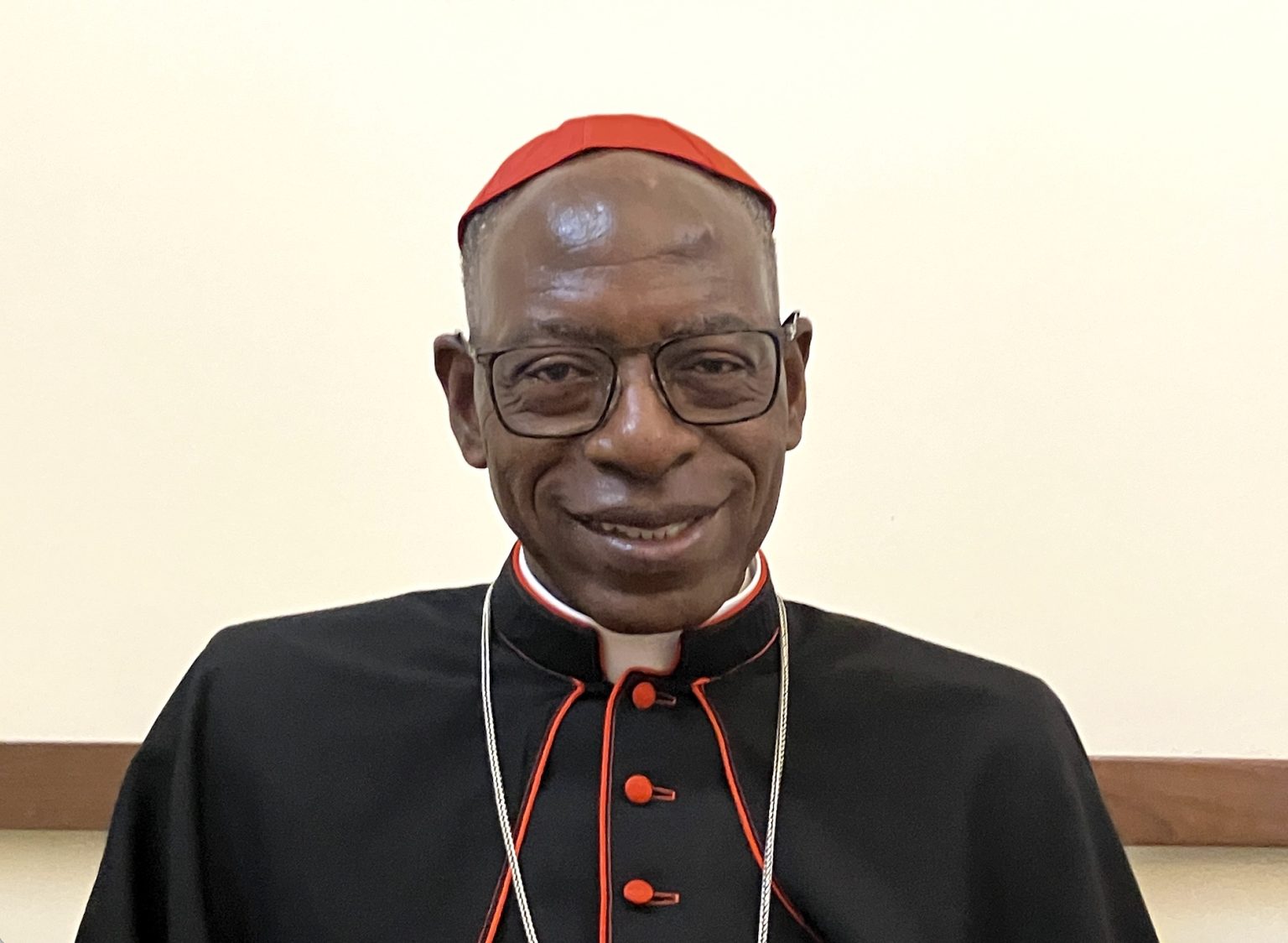
(ZENIT News / Rome, 09.16.2026).- Cardinal Ignace Bessi Dogbo was appointed Archbishop of Abidjan, Côte d’Ivoire, in May 2024, having previously served as Bishop of Katiola and Korhogo in the north of the country. After actively participating in the 2023 and 2024 Synod sessions, he was created a Cardinal by Pope Francis in December 2024, prior to participating in his first Conclave in May 2025. His six years at the helm of the Episcopal Conference of Côte d’Ivoire (CECCI) also gave him a unique perspective on the Church in his country and, more broadly, on the reality of the Church in Africa. ZENIT met in Rome with a shepherd deeply concerned with communion, who seeks to develop a pastoral vision based on a synodal «Church-Family of God» — one that is financially autonomous and at the service of all.
ZENIT: Your Eminence, what have been your main pastoral priorities since your appointment as Archbishop of Abidjan?
Cardinal Ignace Bessi Dogbo: I could say that everything is a priority for me! But my top priority is to be in full communion with the universal Church through the implementation of synodality. For this reason, I have strived to develop a vision for the Archdiocese of Abidjan: to cultivate a synodal «Church-Family of God» that is financially self-sufficient and at the service of all. A Church that lives out communion, and not only among Christians. A Church that seeks to be the model our society needs.
Of course, this vision is inspired by the Synod on Synodality, but also by the vision of the Church in Africa which, since the Apostolic Exhortation Ecclesia in Africa has viewed itself as an «ecclesial family of God.» More recently, the Symposium of Episcopal Conferences of Africa and Madagascar also sought to engage our Church with the theme of hope, looking toward the year 2035: seeing Jesus as the hope of the «ecclesial family of God» in Africa.
ZENIT: Synodality, financial autonomy, service to all, how is this being implemented in your diocese?
Cardinal Bessi Dogbo: Together with the Pastoral Council team, we reflect on how to implement this synodality by establishing structures for communion. In our diocese, and indeed across Africa, there is a tendency among the clergy to think that the faithful lack the maturity to participate fully in the life of the Church. Sometimes, structures fail to function or take a long time to implement; and even when they are implemented, it is as if they did not exist.
Therefore, the synodal approach will help us experience communion among the laity, priests, and consecrated persons. Today, we ensure that the various components of the Church are represented in all diocesan structures. When there is so much talent in the Church, there is no reason not to make use of it; and there is no reason why a layperson should not do what they are capable of doing. In economic matters, we strive to ensure that parishes are managed fairly and equitably, and that priests can work with the financial resources provided by the community.
This aspect of equalization, or financial redistribution, is my top priority. We are also working on this at the national level so that the money within the Church, and the Church’s funds, benefit everyone. How can we use a portion of what we receive in our churches — tithes or offerings — for empowerment?
In the Old Testament, tithes were allocated to the priests, as well as to widows, orphans, and foreigners. Therefore, we have decided to do the same for the poor in our community and society. Ultimately, serving everyone is undoubtedly the supreme goal of our work: serving by proclaiming the Gospel and sharing the faith. This proclamation must be accompanied by acts of charity and calls for everyone to participate in serving others. This is my all-encompassing priority!
ZENIT: More broadly, you served as President of the Bishops’ Conference of Ivory Coast for six years. What are the main areas of concern that need to be addressed within the Church in your country?
Cardinal Bessi Dogbo: When I was elected President in 2017, I spontaneously proposed to my fellow Bishops that we meet to draft an action plan for the Church in Ivory Coast. The Bishops responded positively, and we conducted a survey to analyze our Church, viewing it as a Church of communion, autonomous and at the service of all, and one that truly bears fruit in missionary and pastoral terms. This also aligned with the vision Pope Francis had been expressing since 2015: he wanted the Church to be a synodal Church — a Church of communion, participation, and mission.
There is great religious diversity in Ivory Coast. This can be dangerous if not managed properly. The natural tendency is toward conflict, something we have largely avoided in our country. Regarding interfaith dialogue, we have Muslims, Christians, and traditional religions. We have created an interfaith forum where virtually everyone is represented, and a religious alliance for peace bringing together Christians and Muslims is also being established. We also strive to be proactive regarding social events, such as elections.
We encourage everyone to prevent religion from interfering in politics, and vice versa, so as to avoid internal conflicts. Religious leaders maintain good relations and strive not to instrumentalize religion for political ends, in order to prevent social division. Another major challenge is unity in truth, for we have experienced crises in Africa fueled by lies. Regardless of our religious beliefs, we must not build upon falsehood. That is fundamental. Jesus said in the Gospel that at the first gust of wind, the house shakes. And Psalm 85 tells us: «Love and truth meet; justice and peace embrace.»
ZENIT: We also observe strong growth in the number of newly baptized Christians and great vitality in the practice of the faith in Africa. What is your perspective on this?
Cardinal Bessi Dogbo: It is true that we are experiencing a time of great spiritual and vocational fervor in Africa, much like what France experienced in the 19th and 20th centuries, when missionaries were sent across the globe to evangelize. For instance, this past Pentecost, we confirmed nearly 2,000 children in our Diocese, and we also have a large number of priests and seminarians: close to 400 priests in the Archdiocese of Abidjan and around 2,000 throughout the Ivory Coast.
However, we must also humbly acknowledge that this fervor does not automatically equate to spiritual strength. This intense religiosity can sometimes prove fleeting when it comes to the concrete commitment of the baptized. A transformation of life cannot be taken for granted; the fact that churches are full does not mean that people are readily prepared to bear witness to their faith. Consequently, we face the challenge of revisiting the formation of catechumens, especially young people, and helping them become steadfast Christians in our changing society. We have therefore adapted our resources to foster long-term Christian formation.
ZENIT: In your opinion, what can Africa contribute to the universal Church, and what can it receive from her?
Cardinal Bessi Dogbo: I believe the Catholic Church in Africa needs to deepen this sense of family life — where we care for one another — and that communion among all helps the universal Church, in turn, to reveal this same face.
This concept of the Church-as-Family should not be the exclusive prerogative of Africa or a Third World country, but rather of Christian communities throughout the world. Therefore, we have intellectual, pastoral, and liturgical work to do so that the values of solidarity are purified through prayer and study, and so that they serve the universal good. Yet an exchange of gifts is also necessary. Africa looks to the universal Church for help. We need to be heard and evangelized, and we must free ourselves from whatever hinders us from drawing closer to Christ, I am thinking, in particular, of polygamy. Of course, the African Church must also strive to inculturate the faith, something that has nothing to do with mere folklore. And no one else can do this for us.

Publicaciones relacionadas:
 This Is the Legal Situation of the Bishop Arrested in Nicaragua as Told by His Lawyer
 Pope’s Secretary of State visits Brazilian President and presides over opening of Brazilian Episcopate Assembly
 New Zealand Cardinal acquitted by Vatican and Police in unproven abuse case
 Bishop announces resignation if Vatican does not rule in his favor in dispute with Opus Dei