

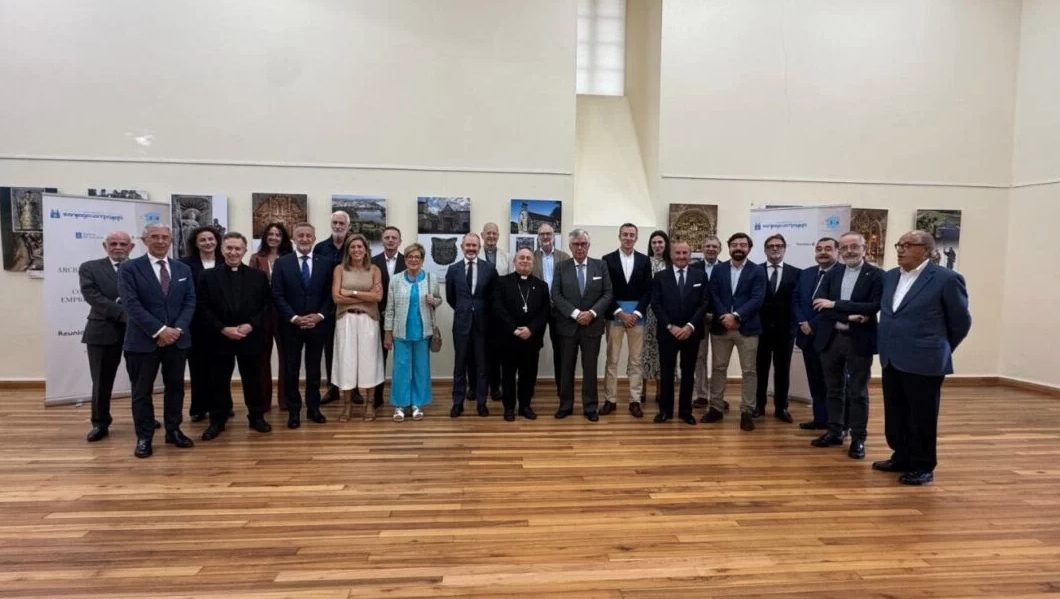
(ZENIT News / Santiago de Compostela, 09.17.2026).- The Archbishop of Santiago de Compostela, Msgr. Francisco José Prieto Fernández, presented the main outlines of the program the Compostela Church is preparing for the 2027 Holy Year to business leaders and representatives of the economic sector. The meeting took place on Monday, September 14, during a breakfast in the Pilgrims’ Hall at the San Martín Pinario Hostel.
Participants in the event included the President of the Confederation of Businessmen of Galicia (CEG), Juan Vieites; the Manager of Tourism of Galicia and Xacobeo 27, Antonio Casas; the Diocesan Treasurer, Fernando Barros; members of the 2027 Holy Year Commission; and numerous business leaders convened by the CEG.
A Heritage Belonging to All of Society
The Archbishop began by thanking those present and explained that the Compostelan Holy Year — while rooted in Christian tradition — has, over the centuries, become a shared heritage capable of bringing together people from diverse backgrounds, cultures, and sensibilities.
He also touched upon the various reasons that lead people to undertake the Camino. While some make the pilgrimage driven by faith, others seek answers, silence, connection, or a different kind of time in their lives. All of them have helped shape an experience that begins as a geographical and historical journey but often evolves into an inner journey.
The Prelate recalled that the Jacobean tradition weathered difficult times during the 20th century and highlighted the figure of Elías Valiña, the parish priest of O Cebreiro and Commissioner for the 1982 Holy Year. His yellow arrows helped revive routes that were beginning to fade into obscurity and once again marked Compostela as a destination for thousands of pilgrims.
This revival was later bolstered by the support of public institutions, most notably the Xunta de Galicia, starting in the 1990s. This collaboration enabled the religious observance to be complemented by the Xacobeo initiative and an extensive program of cultural, social, and tourism-related activities. «Major events only achieve their full transformative potential when many different wills manage to unite around a shared project,» the Archbishop stated.
An Invitation to Join the Project
Monsignor Francisco Prieto noted that the Holy Year and the Xacobeo have put the city of Compostela and Galicia on the global map, while also linking the region to values such as welcoming others, human connection, perseverance, hospitality, the quest for meaning, and hope.
From this perspective, he explained that the Church of Compostela wishes to experience the 2027 Holy Year with a spirit of participation, pooling the efforts of institutions, civil society, and businesses.
The Archbishop explained that sponsoring the program can mean far more than simply associating a company with a high-profile event. It entails helping to preserve a heritage handed down over centuries, promoting culture and beauty, improving services for pilgrims, and linking corporate social responsibility with a celebration that showcases Galicia and Spain to the world.
He also highlighted the social contribution of the business community, which, beyond creating jobs and wealth, generates innovation, fosters relationships, builds corporate culture, and strengthens commitment to the local region. For this reason, he encouraged every company to consider what it can contribute — drawing on its own unique identity, capabilities, and creativity — to ensure the Holy Year leaves a lasting legacy.
Heritage, Music, and Spaces for Reflection
The proposed initiatives include the renovation of the Diocesan Museum and the creation of the «Orixes» exhibition space at the Monastery of San Martín Pinario. The project also encompasses the development of exhibition areas within the corridors and the creation of «Compostela”, a permanent exhibition designed to introduce pilgrims and visitors to the religious and cultural heritage of Santiago.
Music will also play a significant role in the program. Plans include composing a Holy Year Hymn, holding a major commemorative concert, and organizing sacred and classical music performances in various churches. The schedule will also feature performances by Abraham Cupeiro, a musician and musicologist specializing in the revival of ancient instruments, as well as concerts in churches located along the Camino.
The Archbishop also addressed the dialogue between the Church and the business world, which will be structured around two major gatherings. The first will take place in 2026 and will focus on the theme of «Western Civilization”. The second, scheduled for 2027, will be dedicated to «The Caminos» and will bring together some of the principal pilgrimage routes, spanning both the Catholic tradition and other cultures. It will be an opportunity to reflect on the role these paths have played in shaping peoples and on the contributions they can still make to contemporary society.
The Holy Door as An Invitation to Begin Anew
The opening and closing of the Holy Door will frame the celebration of the 2027 Holy Year. Monsignor Prieto recalled its profound Christian significance but noted that it also offers an image that resonates with those coming from different perspectives: «A door that opens, a threshold inviting one to set out on a journey, the possibility of starting over.» The Archbishop used this image to summarize the essence of the event: «That is what the 2027 Holy Year will be, in large measure: an open door.»
The detailed presentation of the program was given by the Diocesan Treasurer, Fernando Barros. Meanwhile, Juan Vieites, President of the Confederation of Entrepreneurs of Galicia (CEG), encouraged the business leaders present to consider participating in the various initiatives, while Antonio Casas, Manager of Tourism of Galicia and Xacobeo 27, explained the tax benefits legally available to sponsoring companies.
“The 2027 Holy Year has yet to be written,» the Archbishop noted, before encouraging the business community to contribute their own pages to a story in which the Church and public authorities will also assume their respective responsibilities.
With information from Archicompostela.

Publicaciones relacionadas:
 Bishops Release North American Final Document to Conclude Continental Stage of the 2021-2024 Synod
 Archdiocese of Los Angeles Reaches $880 Million Settlement Over Child Abuse Claims
 China in the Heart of Notre Dame Cathedral in Paris
 Clergy Arrests, ICE Raids, and a City on Edge as Minnesota’s Churches Confront America’s Immigration Crackdown
