

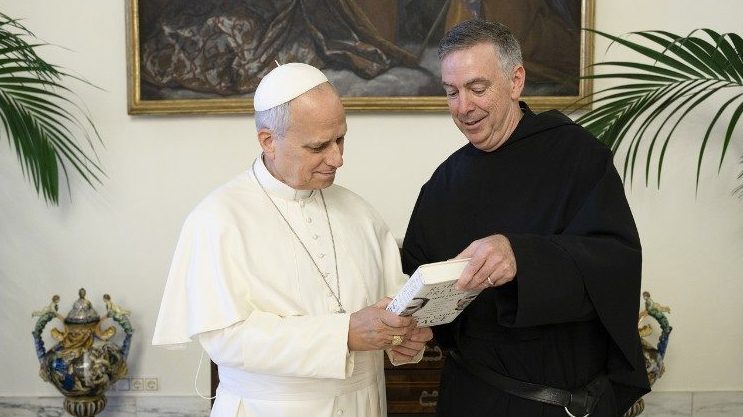
(ZENIT News / Rome, 09.18.2026).- What does Pope Leo XIV sound like when he is not speaking as Pope?
The question acquires particular interest with the publication in English of “Freedom Under Grace: Reflections on the Spiritual Tradition That Formed Me”, a collection drawn from the writings, homilies, speeches and letters of Robert Francis Prevost during the twelve years in which he served as Prior General of the Order of St. Augustine, from 2001 to 2013. Published in the United States on September 15 by Image Books, part of Penguin Random House Christian Publishing Group, the volume is also being released in the United Kingdom and across the English-speaking world.
The book is not a manifesto written to explain the pontificate of Leo XIV. It is something potentially more revealing: a record of the spiritual vocabulary he was using long before anyone knew he would one day be elected Pope.
The more than 400 pages are arranged chronologically rather than thematically, allowing the reader to follow a man still immersed in religious life as he addressed the Church, his fellow Augustinians and the societies in which they were serving. The texts were originally delivered in different languages and were largely intended as spoken rather than academic works. That matters. These are not retrospective reflections composed after his election, but pastoral words produced in the midst of ministry.
And across that period, several ideas return with striking consistency: interiority, unity, renewal, service, human dignity and the relationship between love of God and love of one’s neighbor.
At the heart of Prevost’s thought is an Augustinian conviction that the path toward God passes through a truthful encounter with oneself. In his homily to the Augustinian General Chapter in 2001, he connected self-knowledge with knowledge of God and then with love of both God and neighbor. It is a sequence that helps explain why his spirituality is not primarily concerned with private devotion detached from the world. The interior life is meant to become a form of charity.
That movement from contemplation toward relationship may be one of the most useful keys to reading Leo XIV today.
His Augustinian inheritance is unmistakable. St. Augustine appears repeatedly throughout the collection, not simply as the historical founder associated with the Pope’s religious family, but as a model for Christian life. In a reflection delivered in Iquitos, Peru, Prevost linked respect for human dignity, sensitivity to what is genuinely human, dialogue between cultures and recognition of legitimate human autonomy with an authentic Christian spirituality.
The emphasis is significant. Christianity, in this account, does not begin by withdrawing from human experience. It enters into conversation with it while retaining a clear reference to truth and faith.
That same balance appears in his reflections on Augustine himself. Speaking in Slovakia, Prevost presented the saint as a man whose generosity became service to the Church and to others, joining unity and truth to charity. The pattern is repeated throughout the book: truth is not detached from love, and unity is not reduced to institutional agreement.
This may also explain why “unity” occupies such an important place in the book’s presentation of the Augustinian charism. The collection’s editor identifies unity, renewal and continued progress in spiritual life as recurring themes, while the publisher describes community, solidarity and service to marginalized people as important elements of Prevost’s vision.
There is another thread running beneath these reflections: the conviction that Christian identity cannot be measured by possessions, knowledge or status. “Man is not defined by what he possesses or what he knows, but by what he loves,” Prevost writes. It is perhaps the simplest sentence in the collection, but also one of the most revealing.
It places love—not sentimentality, but the Christian act of willing and seeking the good of another—at the center of his understanding of the human person.
That perspective gives particular weight to his insistence on human dignity. In the texts gathered here, dialogue with different cultures does not require abandoning Christian convictions, just as recognizing legitimate human autonomy does not mean indifference toward the deeper questions of human existence. Instead, faith is presented as something capable of entering the complexity of modern life without losing its spiritual center.
The collection also shows a future Pope addressing a world already marked by the tensions that would later become familiar features of his pontificate: the consequences of September 11, political ideologies, poverty, conflict and questions surrounding human rights. The publisher presents these writings as an opportunity to see the reasoning behind some of Prevost’s contemplative responses to those challenges.
For readers trying to understand Leo XIV, that historical distance is precisely what makes the book valuable. It offers no polished retrospective account of the papacy because the papacy did not yet exist. Instead, it allows patterns to emerge without requiring the reader to assume that every sentence written decades earlier was a prediction of what was to come.
The distinction is important. A Pope’s earlier writings do not constitute a secret blueprint for a pontificate. Circumstances change, responsibilities change and the office itself changes the scale at which a person’s words are heard. But earlier texts can reveal intellectual and spiritual foundations that later responsibilities draw upon.
In Leo XIV’s case, those foundations appear remarkably consistent: a search for unity without sacrificing truth, an insistence that spiritual renewal begins within the person, a conception of faith expressed through service, and a sustained attention to human dignity.
Even the book’s title points toward another characteristic of his thought. Freedom is not presented as independence from every obligation, but as something understood within grace. The Christian is free precisely in relationship with God and others rather than through isolation from them.
That helps explain why the collection repeatedly moves from the individual to the community. Prevost’s Christian ideal is not the isolated believer seeking private spiritual fulfillment. Faith becomes credible when it is lived together, when other people can encounter something of God’s presence through the way Christians share their lives.
The book’s final message captures the tone of that spirituality: work with hope, recognizing that grace is what gives life. It is less a programme than a disposition—a Christian way of approaching an uncertain world without surrendering either responsibility or hope.
There is also a distinctly contemporary dimension to the publication. Leo XIV is the first Pope from the Order of St. Augustine, and the English edition gives particular access to the thought of a Pope whose native language is English. Its international publication therefore does more than expand the audience for an old collection: it makes available, to a global readership, a substantial body of material from the years in which Prevost was forming his pastoral voice.
The audiobook adds an unusual cultural bridge. Some of the Pope’s homilies and speeches will be read by Stephen Colbert, the Emmy-winning comedian and practicing Catholic, while the main text is narrated by Grammy-nominated reader Scott Brick.
But the most interesting voice in Freedom Under Grace remains the one that existed before the white smoke.
Long before Robert Prevost became Leo XIV, he was already returning to the same questions: how does an encounter with God change the way a person sees others? How can truth and charity remain inseparable? What does Christian unity require? And what kind of freedom is possible when human life is understood as a gift of grace?
The answers gathered in this book do not explain everything about the Pope. They do something subtler. They reveal the spiritual grammar with which he was already thinking—and suggest that, beneath the new title and the global responsibilities of the papacy, the Augustinian language of interiority, communion, truth, love and service remains deeply present.
Thank you for reading our content. If you would like to receive ZENIT’s daily e-mail news, you can subscribe for free through this link.

Publicaciones relacionadas:
 «It’s Important That We All Learn to Listen More and More»: Pope Leo’s Second Homily
 Leo XIV makes surprise visit to dicastery over which he presided and celebrates Mass for his former staff
 “Popes pass, the Curia remains»: Pope Leo’s first meeting with Vatican employees
 How can the weight of the cross be “easy” and “light”? Leo XIV explains it
