

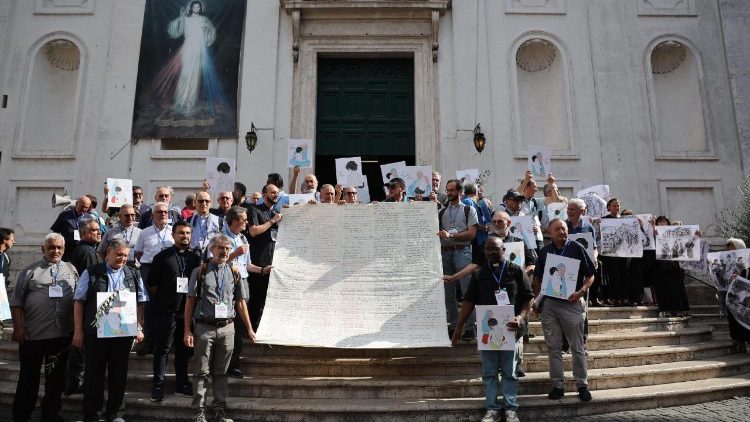
(ZENIT News / Rome, 09.24.2026).- A white shroud bearing the handwritten names of 300 Palestinian and Lebanese children became the stark centrepiece of a prayer march through Rome on September 22, as about 100 priests and bishops from eight countries called for renewed diplomacy, stronger protection of civilians and an end to arms sales that, they argue, help sustain the conflicts.
The gathering marked one year since the international network Priests Against Genocide first met, saying it could no longer remain silent. This year’s march was intended to resist what the organizers described as the normalization and forgetting of genocide, apartheid and ethnic cleansing. The shroud, they said, commemorated children killed in the months after ceasefires were announced in Gaza and Lebanon. The network reported that more than 300 children had died in Gaza since October 2025 and around 150 in Lebanon over the previous five months.
The day began with a private meeting of the network’s clergy, with delegations from Italy, Spain, Britain, Ireland, France, Germany, Denmark and South Africa. Participants heard accounts from the “Pilgrimage for Justice” in the Holy Land, held in cooperation with Pax Christi. In the afternoon, a Divine Mercy Chaplet was celebrated at Santo Spirito in Sassia and livestreamed with prayers for Palestine and Lebanon. The priests then walked from Via della Conciliazione, pausing near the Palestinian and Lebanese embassies before continuing toward the Holy See.
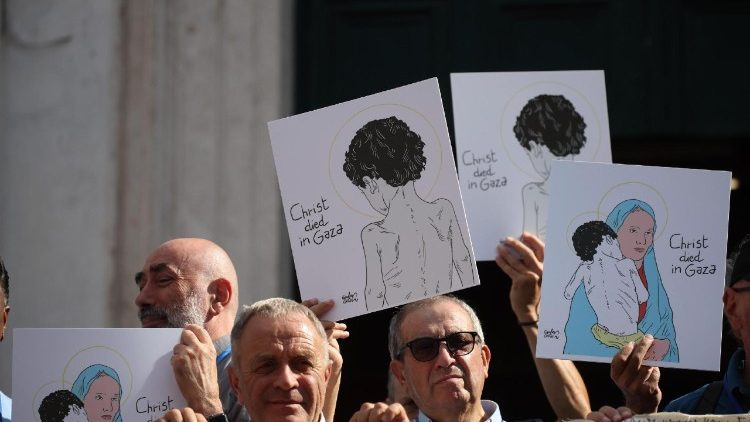
During the procession, they sang “Taybeh,” a hymn composed for the occasion by Father Xavier Morlans, recalling violence against the Christian community in the West Bank. Their route ended outside the Rome headquarters of Leonardo, the Italian defence company in which the Ministry of Economy and Finance holds a 30 percent stake. Citing the 2025 SIPRI report, organizers described Leonardo as the European Union’s second-largest arms company and said its war-related revenue rose 10 percent to $13.8 billion.
The march’s message was directed both at political institutions and at Church leaders. To governments, the network called for suspending arms sales to Israel, applying international law and treating United Nations resolutions as obligations rather than optional opinions. To bishops and pastors, it urged a more direct and concrete public voice. The network argued that cautious silence and diplomacy alone do not protect those facing atrocities.
That appeal was accompanied by an explicit distinction: the group said its criticism of the Israeli leadership and the networks supporting it was not a justification of the violence of October 7, nor a condemnation of Jewish people, toward whom it reaffirmed its respect and its rejection of antisemitism. Its organizers also cited Cardinal Pierbattista Pizzaballa’s warning that the complexity of the conflict should not be used to deny the reality of an oppressed people and an oppressor.
Archbishop emeritus Michel Sabbah, former Latin Patriarch of Jerusalem, sent a message of support describing the continuing death and suffering in the region and calling on leaders to uphold respect for life. Father Nandino Capovilla, one of the march’s participants, said the opening of the United Nations General Assembly made the moment especially urgent: the international community, he argued, must restore diplomatic action, strengthen international law and protect the populations most affected by war.
The event also brought a report of violence in the West Bank into the day’s appeals. On September 22, the Palestinian news agency WAFA reported that the municipality of Al-Mazra’a al-Sharqiya, east of Ramallah, said more than 200 settlers, protected by Israeli soldiers, had attacked the outskirts of the town, damaging homes and vehicles. The march’s organizers framed such incidents as part of the wider need to protect civilians and defend the rights of people living under conflict.
The network says it has grown from 200 priests at its first gathering to more than 2,600 members in 68 countries across five continents. Its stated target is 4,000 members—roughly 1 percent of the world’s Catholic clergy. Coordinator Father Rito Maresca said the figure was not intended to speak for the whole Church, but to challenge it not to look away.
At the end of the march, Archbishop emeritus Giovanni Ricchiuti, president of Pax Christi Italy, urged participants to continue working for justice and peace through nonviolent words and actions, and to keep alive the possibility of reconciliation. The shroud, organizers said, will be sent to the United States to join an international initiative launched by Priests Against Genocide USA and Doctors Against Genocide.
Thank you for reading our content. If you would like to receive ZENIT’s daily e-mail news, you can subscribe for free through this link.

Publicaciones relacionadas:
 Pope Leo XIV publicly notes deterioration of international and humanitarian law
 How many Christians remain in Gaza after nearly two years of war? These are the data
 Caritas Internationalis, the charitable arm of the Church, recalls that famine in Gaza violates the Genocide Convention
 Lebanon, Gaza and the Holy Land: Christians Caught Between War, Humanitarian Collapse and a Struggle for Religious Freedom
