(ZENIT News / Washington, 10.01.2026).- At a time when marriage rates are falling, religious practice is declining and many Americans report increasing loneliness, a new study has identified a striking countertrend: Catholics who regularly attend Mass report substantially higher levels of marital happiness and sexual satisfaction than Catholics who practice their faith less frequently.
The report, “The Devout Difference: Religion, Marital Quality, and Sex Among Americans,” was published September 25 by the Institute for Family Studies. Drawing on data from the General Social Survey, the 2026 IFS Religion and Family Survey, CARA, YouGov, Pew Research and other sources, the study examines how religious practice is associated with marriage, family life, marital stability and sexual relationships.
Its central finding is not simply that religious people marry more often. It is that, among married Americans, active religious practice is associated with a different experience of marriage.
Some 79 percent of churchgoing Catholics describe their marriages as very happy, compared with 66 percent of nonreligious husbands and wives. Among practicing Protestants, the figure is 74 percent. The researchers define churchgoing as attending Mass or religious services at least two or three times a month.
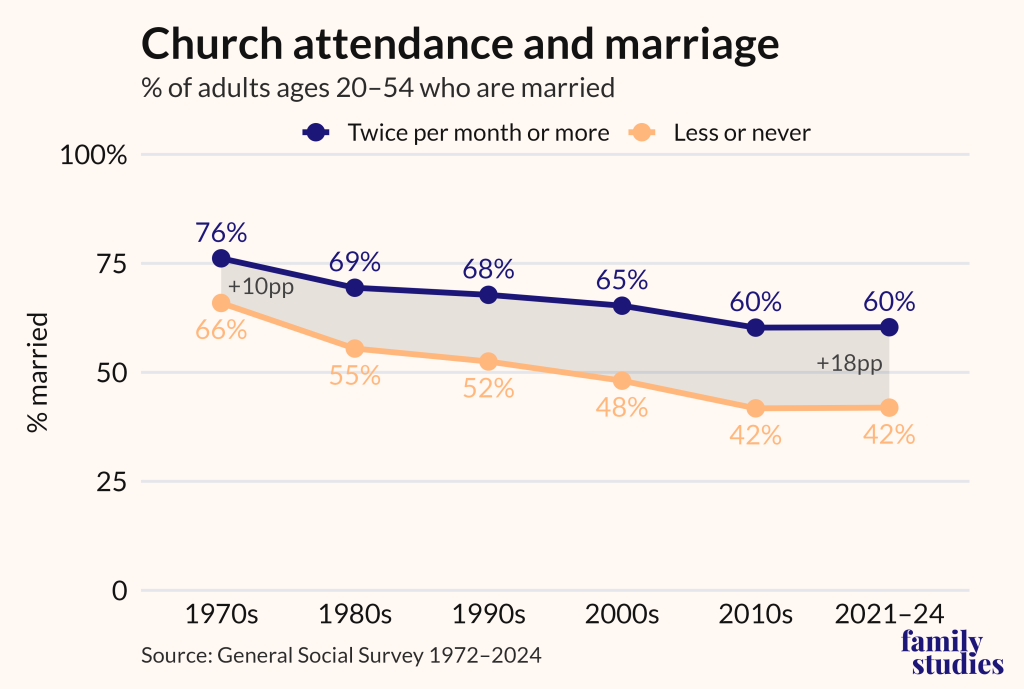
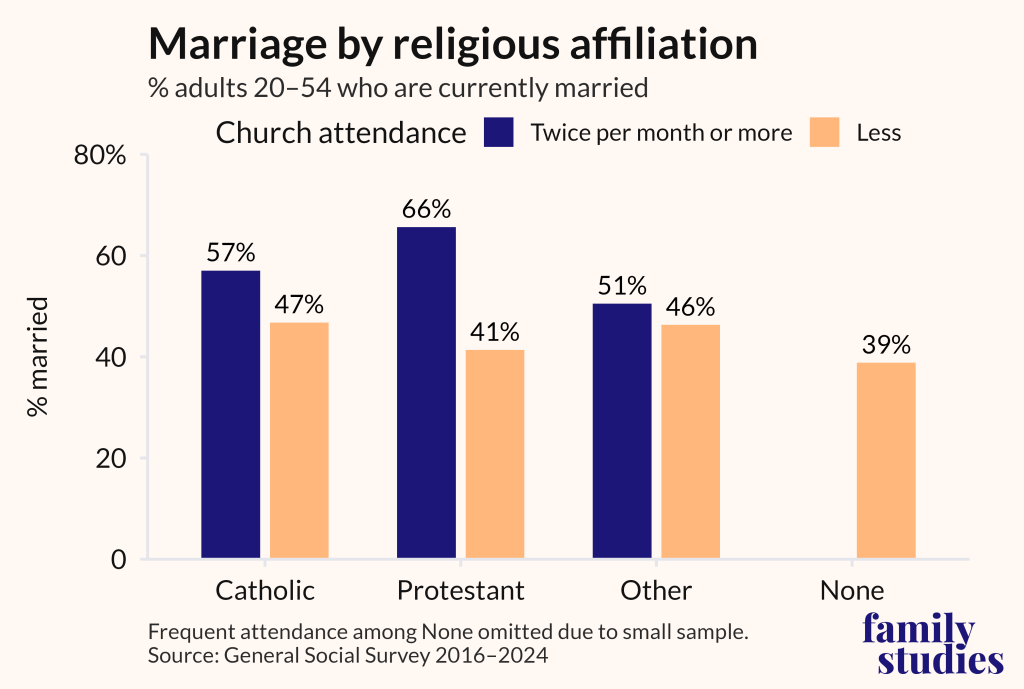
The difference is also visible before marriage. Adults who regularly attend church are 39 percent more likely to be married than their non-churchgoing counterparts. Among Americans aged 20 to 54, 57 percent of churchgoing Catholics are married, compared with 47 percent of Catholics who attend Mass less than twice a month.
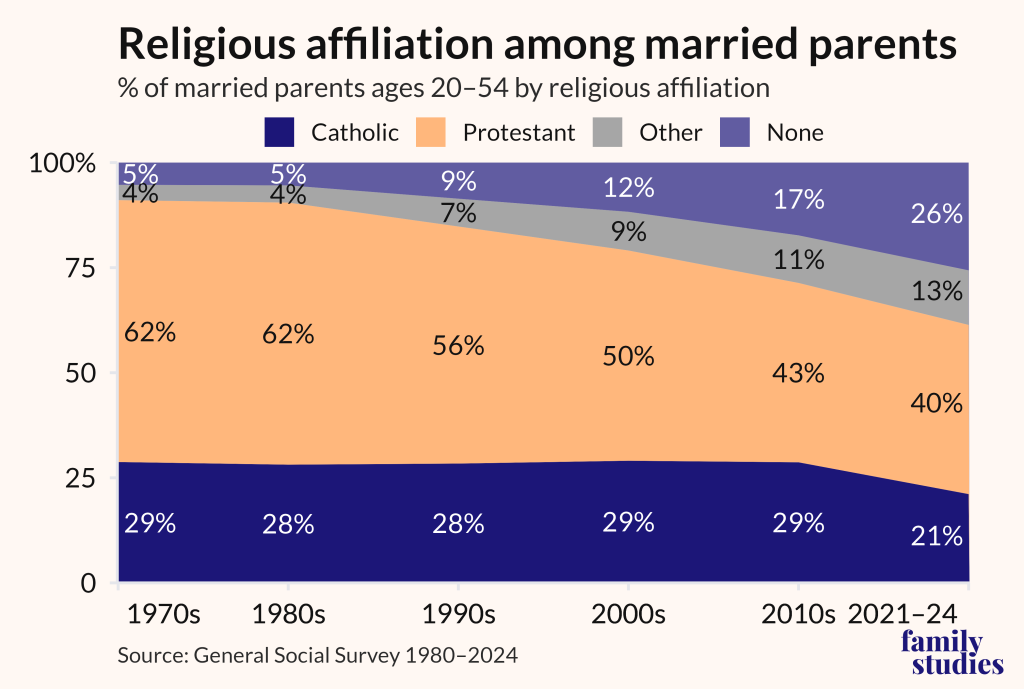
The report describes this as a “faith-family paradox.” Religion and marriage have both lost ground in American society since the 1970s, yet the people who continue to practice their faith remain more likely to marry, have children and maintain family life.
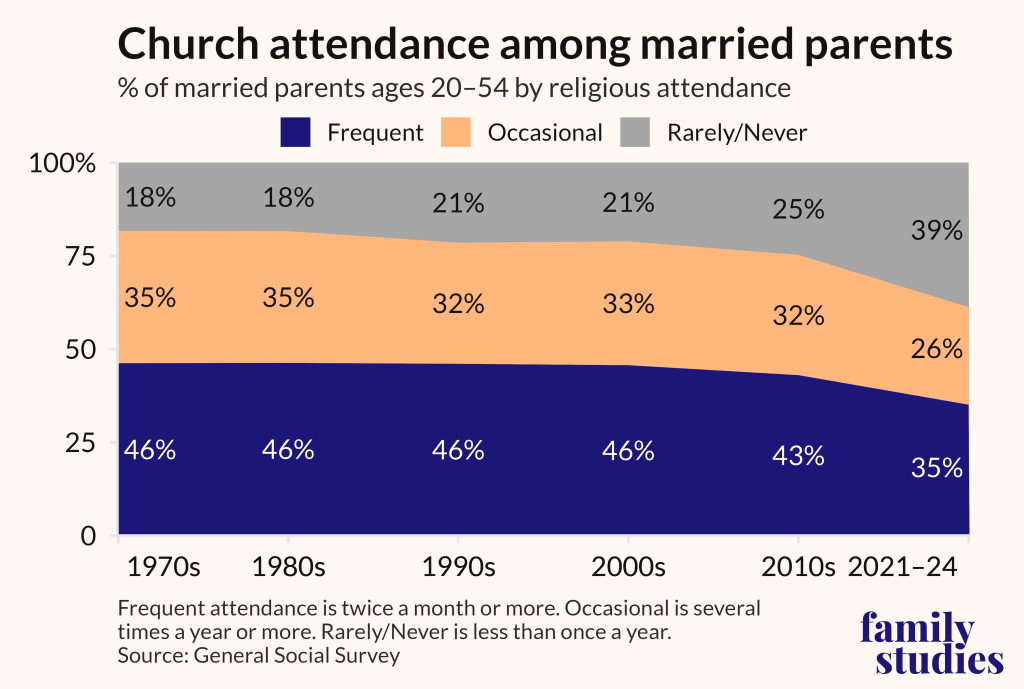
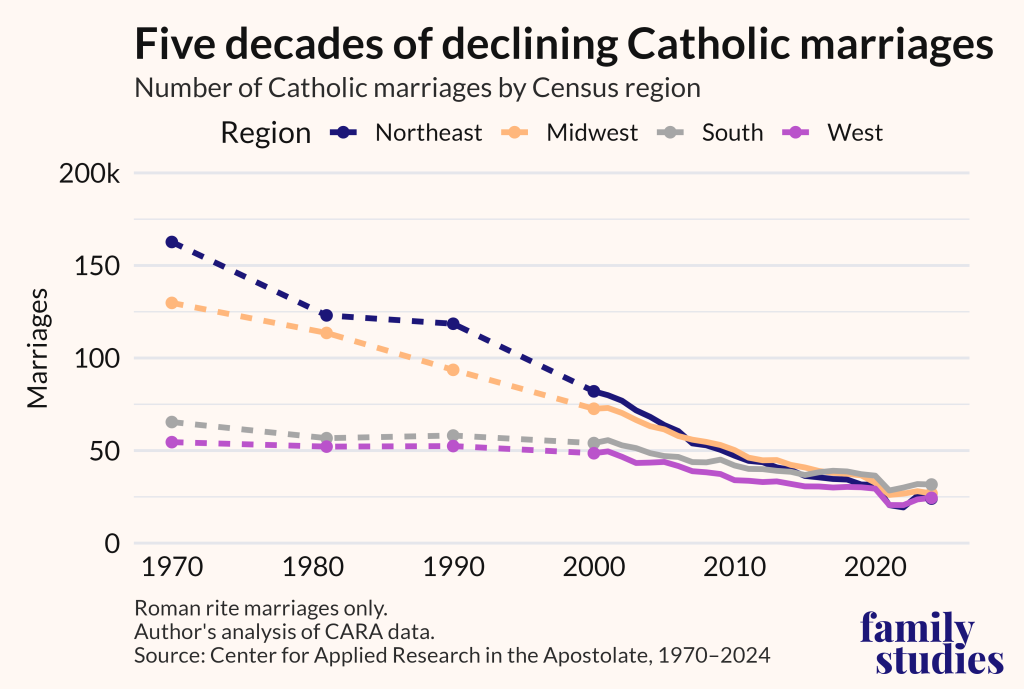
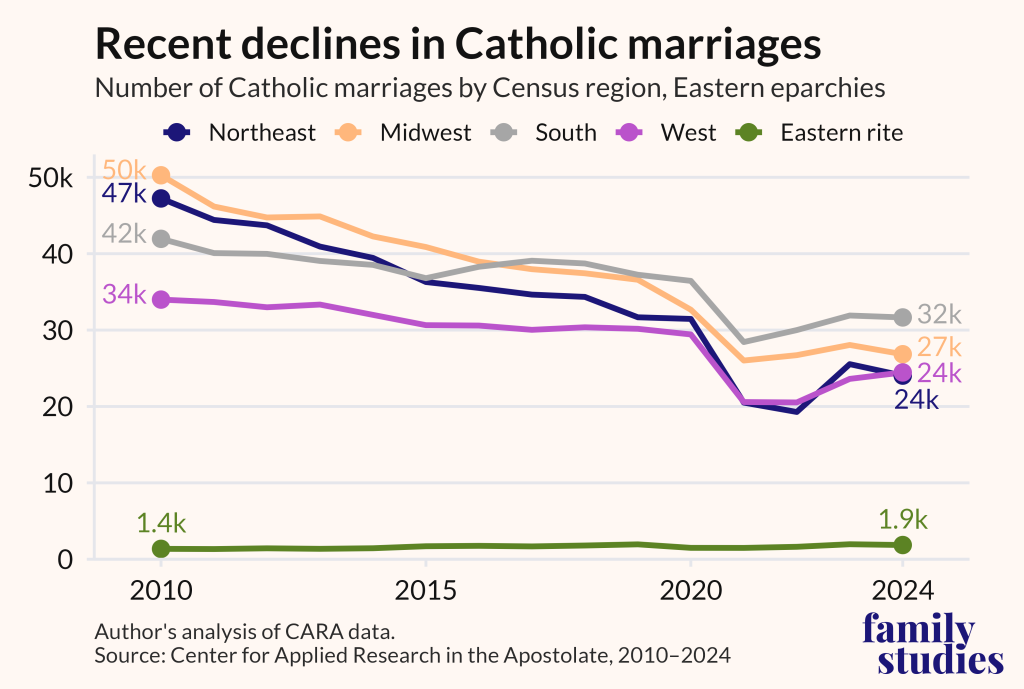
The scale of the religious decline is considerable. The report says frequent religious attendance among Americans fell from 49 percent in 1972 to 32 percent in 2024. Among self-identified Catholics, weekly Mass attendance has fallen from 44 percent in the 1970s to about 18 percent today. Catholic weddings have fallen from 415,000 in 1970 to 109,000 in 2024, a 74 percent decline.
Yet the study suggests that religious commitment may matter more than religious identification alone. Nominal Catholics do not show the same marital advantage as Catholics who regularly participate in parish life. Prayer also appears significant: 67 percent of Catholics who pray daily report stable marriages, compared with 60 percent among those who do not pray daily.
The findings become particularly notable when the researchers examine sexual relationships, an area where religion is often assumed to impose restrictions at the expense of satisfaction.
The data point in the opposite direction. Sixty-nine percent of churchgoing Catholics report having sex at least weekly, compared with 60 percent of nominal Catholics and 47 percent of Americans with no religious affiliation. In sexual satisfaction, 55 percent of practicing Catholics describe their sex lives as “excellent” or “very good,” compared with 45 percent of nominal Catholics and 40 percent of the religiously unaffiliated.
The researchers also found that beliefs about marriage matter. Among Catholics who regard marriage as a permanent commitment, 60 percent report sexual satisfaction, compared with 46 percent of Catholics who do not share that conviction.
Brad Wilcox, one of the report’s authors and director of the Institute for Family Studies’ marriage initiative, argues that these findings challenge the assumption that traditional religious beliefs necessarily undermine marital or sexual fulfillment. According to the study, shared convictions about marriage, family roles, children and the future are associated with stronger relationships.
The report is not, however, a portrait of uniformly healthy Catholic families. One in four churchgoing Catholic husbands reports viewing pornography at least monthly, compared with 35 percent of husbands who rarely or never attend church. The researchers also found that parents in Catholic families with three or more children report lower marital happiness. Wilcox points to inadequate support from parish communities as one possible factor: only 46 percent of practicing Catholic parents say they receive at least “some help” from their parish.
The study also examined 1,219 FOCUS alumni, finding that this group was more likely to marry and report stable, happy marriages than other Catholics, while also showing lower levels of reported sexual satisfaction. The authors connect these results with more consistent religious practice and adherence to traditional Catholic teachings, although the FOCUS sample represents a specific population rather than Catholics as a whole.
The report ultimately makes a broader argument about what happens when religious belief becomes a lived communal practice rather than simply an identity. Its recommendations include more intentional preparation for marriage, stronger parish support for families, and faith formation for adolescents and young adults.
The numbers suggest that committed faith and family life remain closely connected for many Catholics. But they also indicate that belonging to a parish does not automatically create a supportive family environment.
Thank you for reading our content. If you would like to receive ZENIT’s daily e-mail news, you can subscribe for free through this link.