

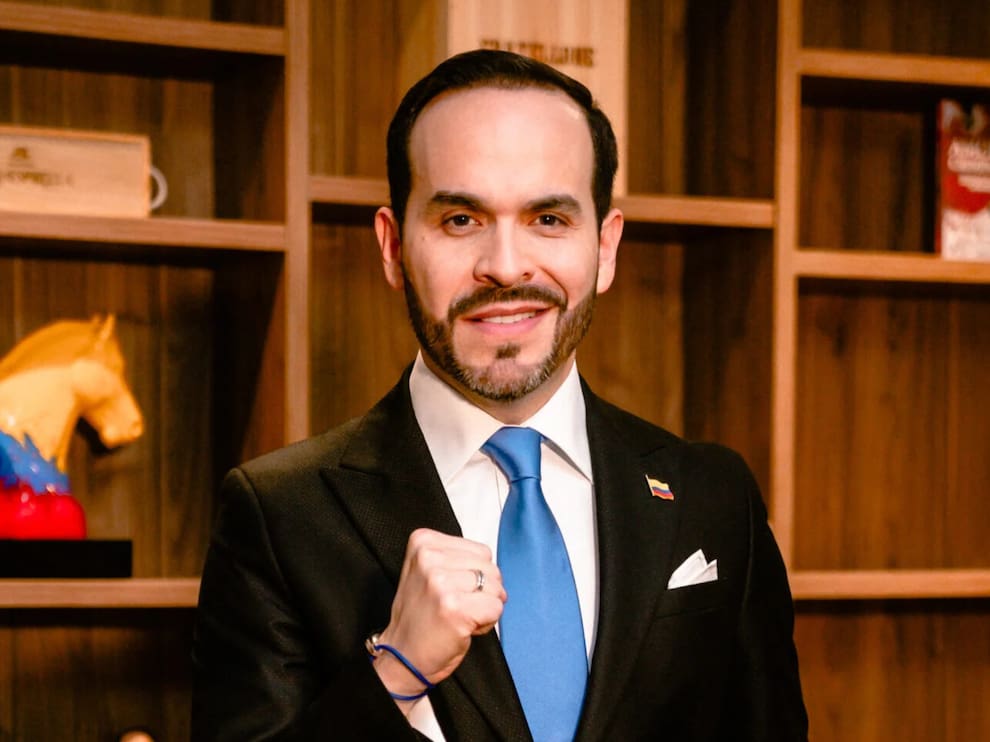
(ZENIT News / Bogotá, 10.03.2026).- A Bogotá court has overturned a ruling that had ordered Colombia’s president and the president of Congress to apologize for including a religious segment in the country’s August 7 presidential inauguration, drawing an important distinction between a secular state and a state that excludes religion from public life.
The Superior Court of Bogotá ruled on September 24 that the ceremony did not violate state neutrality or the fundamental rights of Omar Alberto Franco Becerra, who had brought the legal action against President Abelardo de la Espriella and Senate President Honorio Miguel Henríquez Pinedo.
The dispute arose from an unusual but deliberately broad religious moment incorporated into the inauguration. A statue of Our Lady of Fatima was displayed briefly, while a rabbi, an evangelical pastor and a Catholic priest took part in a period of interfaith prayer and praise. Archbishop Francisco Javier Múnera, president of the Colombian bishops’ conference, also addressed those present, and Colombian singer Maía performed Leonard Cohen’s “Hallelujah.”
The episode became a constitutional controversy because Colombia is a secular state. A lower court, the Fifth Labor Court of Bogotá, had concluded at the end of August that the ceremony crossed the line separating public institutions from religion. It ordered both De la Espriella and Henríquez Pinedo to apologize and instructed them to refrain from conduct suggesting an inclination toward the Catholic Church or any other particular faith. Both men did issue apologies, but they appealed the ruling.
The Superior Court has now rejected the premise that the presence of religion at an official ceremony necessarily amounts to state endorsement of a religion. Its reasoning focused on what the government actually did — and did not do — rather than treating religious expression itself as evidence of unconstitutional favoritism.
The full Congress, the court noted, had not been convened to adopt a particular religion, nor had it formally declared adherence to a church or creed. No legislative measure had been adopted to favor or disadvantage a religion. Moreover, the religious participants represented different traditions and, according to the judgment, did not use their interventions to call on those present to embrace their beliefs or to attack other religions or nonbelievers. That distinction was decisive.
The court specifically considered the performance of “Hallelujah,” the participation of religious representatives and the temporary display of the Fatima image. None, taken in the context of the ceremony as a whole, had sufficient weight to undermine the principles of secular government, neutrality, separation of religion and state, religious freedom or freedom of conscience.
The judges characterized the August 7 event as fundamentally a secular constitutional ceremony — the inauguration of a president — which happened to contain a religious component after the agenda was modified.
Their reasoning also rested on an important feature of Colombia’s constitutional order. Secularism does not mean that the state must behave as though religious belief does not exist. The court recalled that Colombian law does not define the country as atheist, agnostic or indifferent toward the religious sentiments of its citizens.
That point matters beyond this particular ceremony. In constitutional democracies, religious neutrality can be understood in two very different ways: as equal treatment of different beliefs, or as the removal of religious expression from public institutions altogether. The Bogotá court chose the former interpretation.
It also addressed the president’s own words. De la Espriella did not establish or recognize an official church, the court found. His oath invoked God in continuity with the invocation of God by the National Constituent Assembly when it adopted Colombia’s 1991 Constitution. In that context, the judges considered it contradictory to argue that a president could invoke God when taking his constitutional oath but could not subsequently appeal to God when asking for protection for the nation or expressing the aims of his government.
The ruling prompted a strong response from Congress, which welcomed what it described as a clarification of the relationship between secular government and religious liberty.
“Colombia is a secular state, but not an anti-religious one,” the congressional statement said. The Constitution, it argued, guarantees state neutrality toward religious communities while also protecting both the freedom to believe and the freedom not to believe.
That distinction is particularly significant in a country whose public culture remains deeply marked by Christianity while its constitutional framework protects religious pluralism. A secular state must not impose a faith on its citizens, but neither does neutrality necessarily require public officials to conceal every reference to religion.
The congressional leadership also challenged the idea that individual officials should have been ordered to apologize for a decision taken collectively by Congress. The August 7 program had been modified through a collective parliamentary decision, and the statement argued that imposing personal responsibility for that decision could infringe the independence and inviolability of the legislature.
The case is not necessarily over. The Superior Court ordered that the file be sent to Colombia’s Constitutional Court for possible review.
One magistrate also issued a separate opinion warning that requiring a public official to apologize for his or her religious convictions could distort the purpose of constitutional protection and turn judicial proceedings into a form of censorship of conscience.
That observation captures the larger issue raised by the case. Protecting secular government and protecting religious freedom are not opposing constitutional projects. Properly understood, they are supposed to reinforce one another. The state cannot privilege one faith over others, but neither should the principle of neutrality become a justification for treating religious belief as something that must disappear whenever public authority is involved.
For now, the Bogotá ruling has placed the emphasis where religious liberty advocates have long argued it belongs: not on whether religion was visible in a public ceremony, but on whether the state used its authority to compel belief, discriminate among religions or silence those who believe. On the evidence before it, the court concluded that none of those things occurred in Colombia’s August 7 presidential inauguration.
Thank you for reading our content. If you would like to receive ZENIT’s daily e-mail news, you can subscribe for free through this link.

Publicaciones relacionadas:
 Mozambique: clergy forced to flee, churches burned as violence escalates
 United Kingdom joins countries attacking full sacramental stealth
 NC school district pays $95K after censoring student’s Charlie Kirk tribute
 Iraq’s Court of Cassation affirms woman’s right to be classified as Christian in state’s official database
