

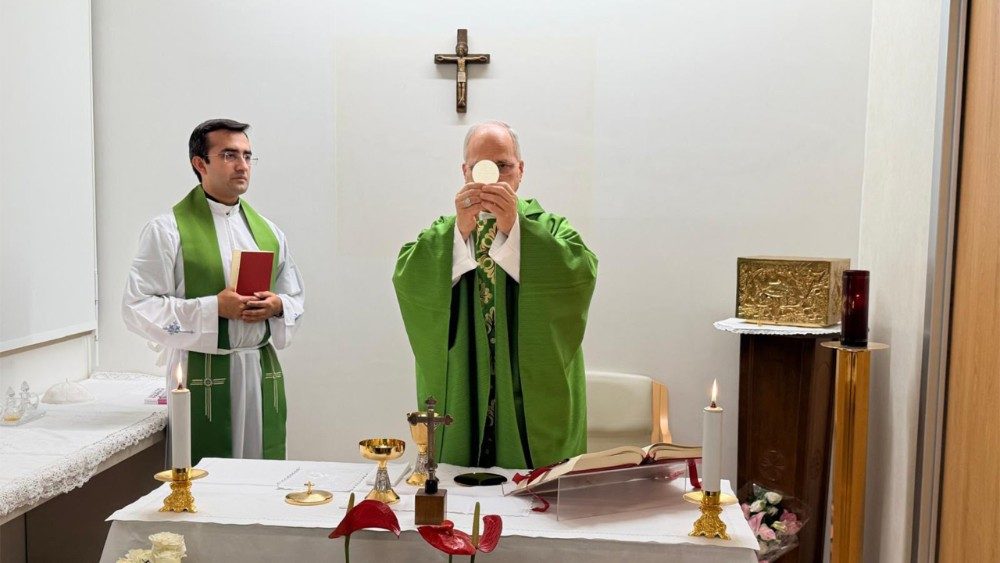
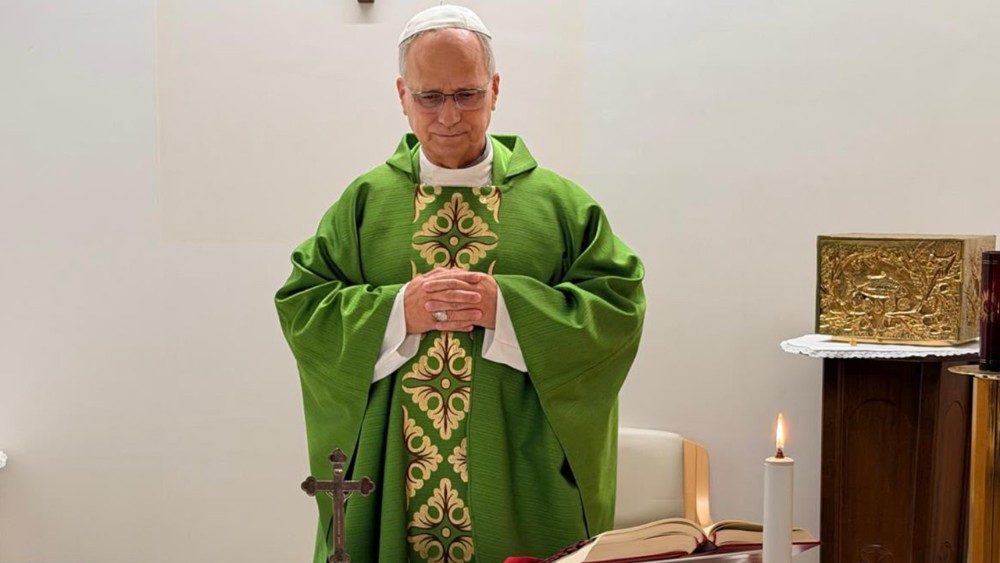
(ZENIT News / Rome, 10.16.2026).- Three days after undergoing surgery for lung cancer, Pope Leo XIV offered a reassuring image of his recovery on Friday, October 16, appearing on his feet in full liturgical vestments during Mass at Rome’s Gemelli Hospital. Yet the day’s most consequential development came beyond the hospital chapel: the Pope spoke by phone with Russian President Vladimir Putin to press for a humanitarian truce in the Ukrainian city of Oleshky, demonstrating that his medical recovery has not entirely interrupted his diplomatic efforts.
Photographs released by the Holy See showed the 71-year-old Pope celebrating Mass in a room prepared on the hospital’s tenth floor. Medical and nursing staff who were off duty, along with members of the Vatican Gendarmerie, attended the celebration. In his homily, Leo thanked doctors, nurses and support staff for their daily care of the sick and vulnerable, expressing particular gratitude for the attention they had shown him.
The images followed another encouraging medical update. Blood tests and a chest X-ray conducted on Friday morning confirmed continued improvement in his general condition. Respiratory physiotherapy continued, while his postoperative recovery allowed him to carry out normal daily activities independently. Although these signs are encouraging, the definitive assessment of his cancer still depends on the analysis of the removed lung tissue.
The Vatican also published the names of journalists authorized to accompany the Pope on his planned November 6–17 apostolic journey to Uruguay, Argentina and Peru. The announcement provided a further indication that preparations were continuing, although it did not constitute definitive confirmation that the trip would proceed. Following the removal of the lower lobe of his right lung on October 13, the timing of any international journey will necessarily depend on his medical progress and the recommendations of his doctors.
Friday also brought visits from two senior Church figures. Cardinal Luis Antonio Tagle, pro-prefect of the Dicastery for Evangelization adn and the new dean of the College of Cardinals, and Cardinal Baldassare Reina, the vicar general for the Diocese of Rome, visited Leo separately, according to sources at the Vatican Press Office.
The most significant diplomatic initiative, however, concerned the war in Ukraine. In a telephone conversation confirmed by both the Holy See and the Kremlin, Leo expressed deep concern about the humanitarian emergency in Oleshky, in Ukraine’s Kherson region, and called for a truce that would allow food and medical supplies to reach civilians and enable those wishing to leave to do so safely and voluntarily.
Vatican Secretary of State Cardinal Pietro Parolin subsequently confirmed that the Pope had initiated the call himself. According to Parolin, approximately 2,000 civilians in the city needed humanitarian corridors to receive assistance or escape the conflict. The Pope sought a suspension of hostilities sufficient to permit the delivery of essential supplies and the evacuation of those who wished to leave.
The Kremlin’s account described the conversation as constructive and respectful. It said Putin had offered his wishes for the Pope’s recovery and discussed cooperation between Russia and the Holy See on spiritual and moral values, the protection of Christians and Christian holy sites, and dialogue between the Russian Orthodox and Catholic Churches.
Regarding Ukraine, the Russian statement presented Moscow’s interpretation of responsibility for the humanitarian crisis, while also reporting Putin’s support for Vatican efforts to establish conditions for civilian safety and the delivery of essential goods. The two sides agreed to cooperate toward that objective, according to the Kremlin.
The different emphases in the two official accounts illustrate the diplomatic complexity. The Vatican placed the immediate humanitarian emergency and the Pope’s appeal for a truce at the center of its statement; Moscow stressed its own interpretation of the conflict.
Parolin expressed hope that Putin would respond positively to the pontiff’s request. Leo’s initiative is notable because it places direct humanitarian advocacy at the center of his engagement with the Russian president, even while the Pope himself remains hospitalized. The Holy See has long sought to maintain channels of communication with parties to the war, arguing that dialogue can serve practical humanitarian purposes even when a comprehensive political settlement remains distant.
A more personal telephone conversation offered a quieter conclusion to the day. Leo spoke with his older brother, Louis Prevost, 74, who is receiving treatment for multiple myeloma in Tampa, Florida. Louis later recounted that the Pope had asked whether he was afraid. He jokingly suggested that Leo should transfer to his hospital because of the quality of its care; the pontiff replied that he, too, was receiving excellent treatment in Rome.
Louis spoke of the importance of prayer in facing illness, saying that he firmly believed they were in God’s hands. The exchange brought together two brothers confronting serious health challenges from different sides of the Atlantic.
According to Louis, the Pope had told him that his doctors believed the cancer might have been completely removed if recovery continued favorably. That remains a provisional assessment rather than a definitive medical conclusion: the final results will depend on examination of the tissue removed during surgery, with further findings expected in a little over a week.
Thank you for reading our content. If you would like to receive ZENIT’s daily e-mail news, you can subscribe for free through this link.

Publicaciones relacionadas:
 “We Are Not Perfect but We Are Fiends of Christ,” the Pope’s Great Address That All Priests Should Read
 This Is How Pope Leo XIV Reaffirms the Role of the Seminary in the Process of Priestly Formation and Urges That It Not Be Underestimated
 Leo XIV Returns to Peru: Government to Invest $18 Million
 Five Reflections by Pope Leo XIV for Bishops (Applicable to Every Priest) on How to Serve Communion in the Church and in Today’s World
