

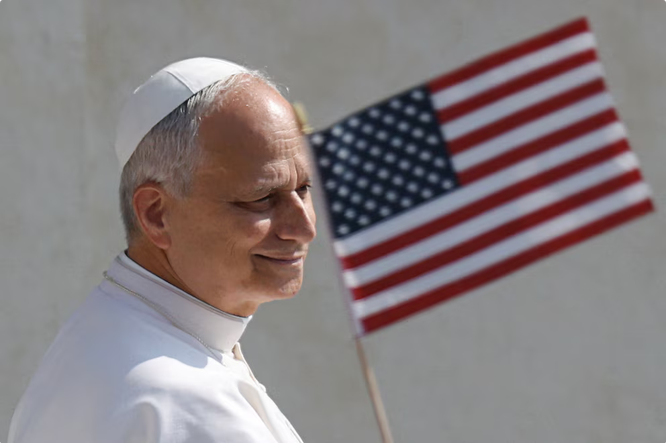
(ZENIT News / Vatican City, 10.30.2026).- Pope Leo XIV has cast a ballot in the United States midterm elections, becoming the first reigning pontiff known to have voted in an American election. The Vatican confirmed on October 30 that the Pope had submitted his vote by mail to Chicago, exercising a right he has maintained throughout his years abroad. The decision is striking not because the Pope has endorsed a political choice — the contents of his ballot remain private — but because it brings an unusual dimension of his personal citizenship into the public life of the country he once called home.
Born Robert Francis Prevost in Chicago in 1955, Leo XIV remains a US citizen despite having lived outside the country for much of his adult life. He also holds Peruvian citizenship, acquired after decades of missionary and episcopal service in Peru. The Vatican said that he had voted whenever circumstances allowed, including during his years in the South American country, and described participation in democratic processes as both a right and a duty of citizens.
The ballot was submitted ahead of the November 3 midterm elections, in which Americans will elect members of Congress and decide a range of state and local contests. In Illinois, voters will also choose a governor, judges and county officials. The Pope is registered in New Lenox, in the Chicago metropolitan area, under his birth name. His request for a postal ballot was recorded on October 3 by the Will County election office, according to information reported by local media and subsequently confirmed by the Vatican.
Leo’s electoral history suggests that voting is not a new interest. Public records indicate that he participated in general elections in 2012, 2014, 2018 and 2024, as well as several party primaries. He voted in Democratic primaries in 2008 and 2010, and Republican primaries in 2012, 2014 and 2016. Illinois does not require voters to register with a political party to participate in its primaries, and voters may choose which party’s ballot to request on each occasion. Nothing in these records reveals his political preferences, and there is no indication of how he voted in any of those contests.
The precise scope of his 2026 ballot has not been disclosed. Americans living abroad can, in certain circumstances, receive a ballot covering federal elections only, depending on their electoral status and their intention to return to the United States. It is therefore not established whether Leo participated in state and local races as well as the federal contests.
The Pope is not simply a religious leader with a foreign passport: he is the sovereign of Vatican City State and head of the Holy See, a distinct subject of international law that maintains diplomatic relations with governments around the world. The Lateran Treaty, in Article 24, declares the Holy See foreign to temporal rivalries among states. A reigning pope taking part in the domestic elections of another country is therefore an exceptional occurrence, even if the act itself is legally available to him as an American citizen.
The Vatican has offered no suggestion that Leo’s vote should be interpreted as an intervention in American politics. That distinction is important, particularly at a time when relations between the Holy See and the Trump administration have been strained by disagreements over issues including the war with Iran, immigration policy and the resumption of federal executions. President Donald Trump has publicly criticised the Pope, while Vice President JD Vance has urged the Vatican to refrain from intervening in US political affairs.
The US Conference of Catholic Bishops welcomed the Pope’s example but was careful to frame it in terms of civic responsibility rather than party allegiance. Its spokesperson, Chieko Noguchi, said Catholics should participate in public life while placing their faith above political preferences. The bishops have urged voters to form their consciences carefully and to defend human dignity and the common good, rather than treating electoral choices as expressions of partisan loyalty.
That message reflects a longstanding Catholic distinction: the Church recognises the legitimacy and importance of political participation, but its moral commitments cannot be reduced to support for any party or candidate. Voting is a civic responsibility; the formation of conscience requires voters to assess public choices in the light of principles that extend beyond electoral competition.
Leo’s decision may nevertheless prove difficult to keep separate from the political debate. Some Catholic publications have already used the news to encourage readers to vote, invoking the Pope’s example. The risk is that a personal act of citizenship could be turned into an endorsement of positions he has neither expressed nor authorised others to attribute to him.
For a pontiff whose office requires him to speak to Catholics across national and political boundaries, discretion is especially important. His ballot does not disclose whom he supports, nor does it alter the Vatican’s diplomatic neutrality. What it does make clear is that Leo XIV regards democratic participation as a responsibility he has not abandoned with his election to the papacy. The unprecedented character of his vote lies precisely in that intersection: a man who now leads a worldwide Church has exercised, quietly and privately, the rights of a citizen in the democracy where his life began.
Thank you for reading our content. If you would like to receive ZENIT’s daily e-mail news, you can subscribe for free through this link.

Publicaciones relacionadas:
 Pope’s moving, grateful and encouraging address to his nuncios (ambassadors) summoned to Rome
 Pope’s first private audience with movie star: who was it? This is the photo of the Oscar winner with Leo XIV
 Pope Leo XIV Sued in Spanish Courts: The Case of the “Templars” Seeking Ecclesiastical Rehabilitation… and Money
 Leo XIV Grants a Private Audience to Europe’s Richest Man: Here Are the Photos
