
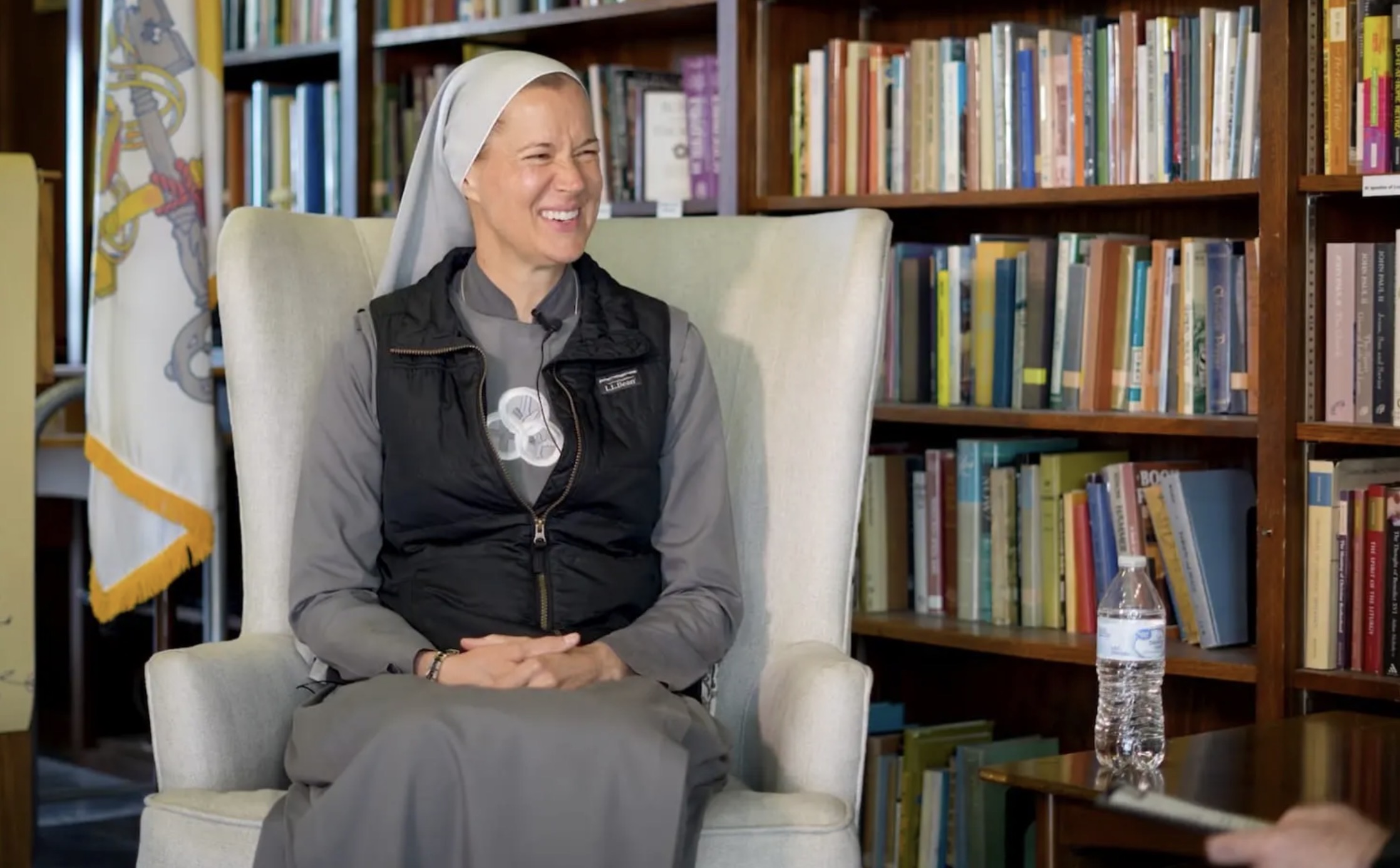
(ZENIT News / Milwaukee, 11.04.2026).- Sister Miriam James Heidland, SOLT, a well-known speaker, podcaster, and author, has stated that she is considering the possibility of establishing a new religious community called «Friends of the Bridegroom.»
She is an American Catholic religious Sister, known for her talks, books, and the podcast Abiding Together. She belongs to the Society of Our Lady of the Most Holy Trinity (SOLT).
Her situation is particularly noteworthy because, on September 21, 2026, she publicly announced that she was beginning a period of discernment regarding the potential founding of a new religious community called «Friends of the Bridegroom.»
Not an Impromptu Initiative
Miriam has spent many years in consecrated life. She joined SOLT in 1998 and has carried out an apostolate focused on spiritual healing, conversion, and the accompaniment of priests and women religious. The inspiration stems from a need within the Church.
Through her work with priests, women religious, and Bishops, she has identified a profound need for healing and renewal among the clergy and consecrated women.
The new community would have a shared mission. The proposal involves bringing together priests, women religious, and laypeople to work toward the renewal of consecrated life and the priesthood. It is not merely about creating another prayer group, but rather about discerning a form of community life with a defined ecclesial mission.
There is ecclesiastical accompaniment. A significant element is that Miriam has the blessing of her current community, SOLT, as well as that of the Archbishop of Milwaukee, Monsignor Jeffrey S. Grob. During this initial phase, the initiative will remain under their pastoral accompaniment and supervision.
The religious Sister explained that her many years working in the healing ministry — collaborating with other women religious, priests, and Bishops — have allowed her to «see and experience the need and the longing for ongoing healing and renewal among our clergy and women religious.»
Furthermore, Miriam has stated that she will remain a member of SOLT on good terms and will continue to wear her religious habit throughout this period of discernment.
«I am deeply grateful for the support of so many people over the years, and I continue to rely on your prayers and support as we discern this very important step… Once again, I extend my profound gratitude to Sister Mary Aloysius of Jesus, General Sister Servant of SOLT, her General Council, and Archbishop Jeffrey Grob,» she wrote.
Heidland was placed for adoption by her biological parents, who were both 17 and unmarried. After spending time in foster care, she was adopted by a Catholic couple and raised in Woodland, Washington.
It was her adoptive parents who instilled the faith in her. However, at age 11, she was sexually assaulted, and at 13, she was raped. She has never publicly revealed the identity of her assailant.
Completely estranged from her faith and devastated, she encountered a priest who left a profound mark on her life. Heidland’s mother also began to pray and fast for her daughter, asking the Lord to guide her toward becoming a nun.
In 1998, Heidland entered the Society of Our Lady of the Most Holy Trinity after feeling a call from Jesus to become His spouse. Today, she speaks openly about the healing and restoration that Jesus has brought about in her life and shares her powerful testimony with people all over the world.
The formation of a new religious community within the Catholic Church does not begin simply because a group of people wishes to live together, share a spirituality, or carry out an apostolic work. It requires a process of communal and ecclesial spiritual discernment, through which one seeks to recognize whether there is a genuine inspiration from the Holy Spirit and whether this can develop into a charism at the service of the entire Church.
It is important to distinguish between a new religious community, an ecclesial movement, an association of the faithful, and a society of apostolic life, as each has a different nature and canonical recognition.
It involves stages of discernment:
- The initial inspiration: an individual or a group discovers a particular call from God, linked to a need within the Church or the world.
- Discernment of the charism: the specific contribution of this inspiration is identified, for example, contemplation, evangelization, education, care for the poor, or spiritual accompaniment.
- Community life: those who feel called begin to share in prayer, formation, mission, and a lifestyle consistent with the charism.
- Accompaniment by the Church: a spiritual director, priests, and individuals with experience in consecrated life help to discern the authenticity of the vocation.
- Ecclesiastical approval: the project is presented to the competent authority, generally the diocesan Bishop in the early stages, to examine its statutes, spirituality, governance, formation, and stability.
- Maturation: the community must demonstrate that it can sustain itself, provide adequate formation for its members, live in ecclesial communion, and bear spiritual and apostolic fruit.
The Church does not recognize a community based solely on the enthusiasm of its founders, but rather on the maturity of its charism, its fidelity to the Gospel, and the fruits it produces.
The process must delve into several aspects: what particular gift does it offer to the Church? It must articulate its spirituality, establish its communal identity, develop a formation process, and demonstrate stability.
Currently, a diocesan Bishop requires prior written authorization from the Holy See to validly establish a new Institute of Consecrated Life. Definitive recognition rests with the authority of the Holy See.
The case of Miriam James allows us to understand something fundamental: a new religious community does not arise merely from an individual’s initiative, but from a charism that must be tested, accompanied, and recognized by the Church.
This proposal does not stem from a desire for personal prominence, but from a sustained apostolic experience in which a specific need is identified: to support the healing and renewal of those who have dedicated their lives to the service of God.