

(ZENIT News / Vatican City, 11.05.2026).- Nearly one-third of German adults believe the country’s Catholic and Protestant churches should unite, according to a new national survey. The finding points to a significant level of public support for overcoming the historic division between Germany’s two largest Christian communities, although opposition remains slightly stronger and a substantial proportion of respondents have yet to form an opinion.
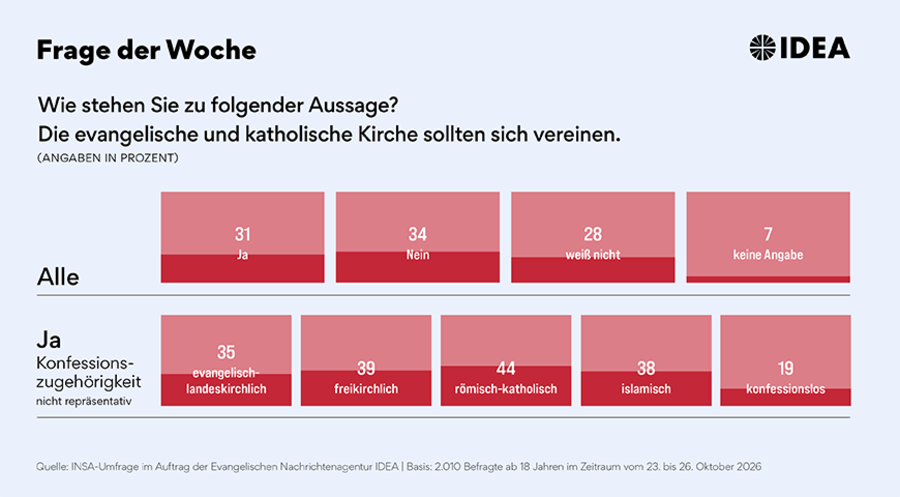
The poll, conducted by the INSA-Consulere institute for the Protestant news agency IDEA between October 23 and 26, 2026, questioned 2,010 adults online. Asked whether the Catholic and Protestant churches should merge, 31% agreed, while 34% rejected the proposal. A further 28% said they did not know, and 7% declined to answer.
The most striking result emerges among Catholics themselves: 44% favour a merger, compared with 30% who oppose it. Support is considerably weaker among members of Germany’s Protestant state churches, where 35% are in favour and 42% against. Among members of free churches, opposition is even more pronounced: 50% reject the idea, while 39% support it.
The figures suggest that enthusiasm for institutional unity is not evenly distributed across Christian communities. Catholics are the most receptive group, while Protestants, particularly those belonging to independent churches, appear more reluctant to dissolve denominational boundaries. The survey does not establish why respondents hold these positions, but the contrast highlights the difference between a general public aspiration for unity and the convictions of those who belong to the churches concerned.
Attitudes also vary according to age and geography. Support is highest among Germans aged 18 to 29 and those over 70, reaching 35% in both groups. It falls to 24% among people aged 60 to 69, the lowest figure recorded across the age categories. Among those aged 30 to 39, 33% favour a merger, compared with 28% in the 40-to-49 age group and 31% among respondents aged 50 to 59.
Western Germans are more favourable than their eastern counterparts, with support standing at 33% and 24%, respectively. Women also show somewhat greater enthusiasm than men, at 33% against 29%.
The political breakdown reveals that support is not confined to one ideological camp. Among supporters of the CDU/CSU, 41% favour a merger, followed by the SPD at 40%, the Greens at 32%, the AfD at 31% and the Left Party at 25%. Interestingly, support among Muslims reaches 38%, while only 19% of people with no religious affiliation favour the proposal.
These results offer an intriguing picture of how institutional unity is perceived in a country whose religious landscape has been shaped by centuries of Catholic-Protestant division. Yet a merger between the two churches would involve far more than bringing together administrative structures. Their differences concern theology, ecclesiology, sacramental life and the understanding of Church authority. In particular, questions surrounding the Eucharist, ordained ministry and the nature of ecclesial communion remain substantial obstacles to full unity.
The distinction matters because Christian unity, in Catholic understanding, cannot be reduced to an institutional arrangement or a response to declining religious affiliation. It requires genuine reconciliation in faith and sacramental life, while respecting the convictions and identities of the communities involved. The pursuit of closer relations between Catholics and Protestants is therefore not necessarily the same as advocating a single organizational structure.
The survey does not measure support for any specific model of union, nor does it establish whether respondents understand the theological implications of such a step. What it does reveal is that the idea has a considerable constituency beyond the churches themselves. With 28% undecided, however, public opinion remains far from settled.
Thank you for reading our content. If you would like to receive ZENIT’s daily e-mail news, you can subscribe for free through this link.

Publicaciones relacionadas:
 United Kingdom: Prime Minister supports initiative to help persecuted Christians
 Reconstruction of the face of St. Teresa of Jesus: this is what her face looked like according to science
 Archdiocese of Chicago brings alleged fraudsters who allegedly posed as abuse victims to trial
 The Pope’s powerful homily on the Feast of Corpus Christi: may religiosity not be a museum of the past, but a school of faith from which we can draw inspiration even today
