

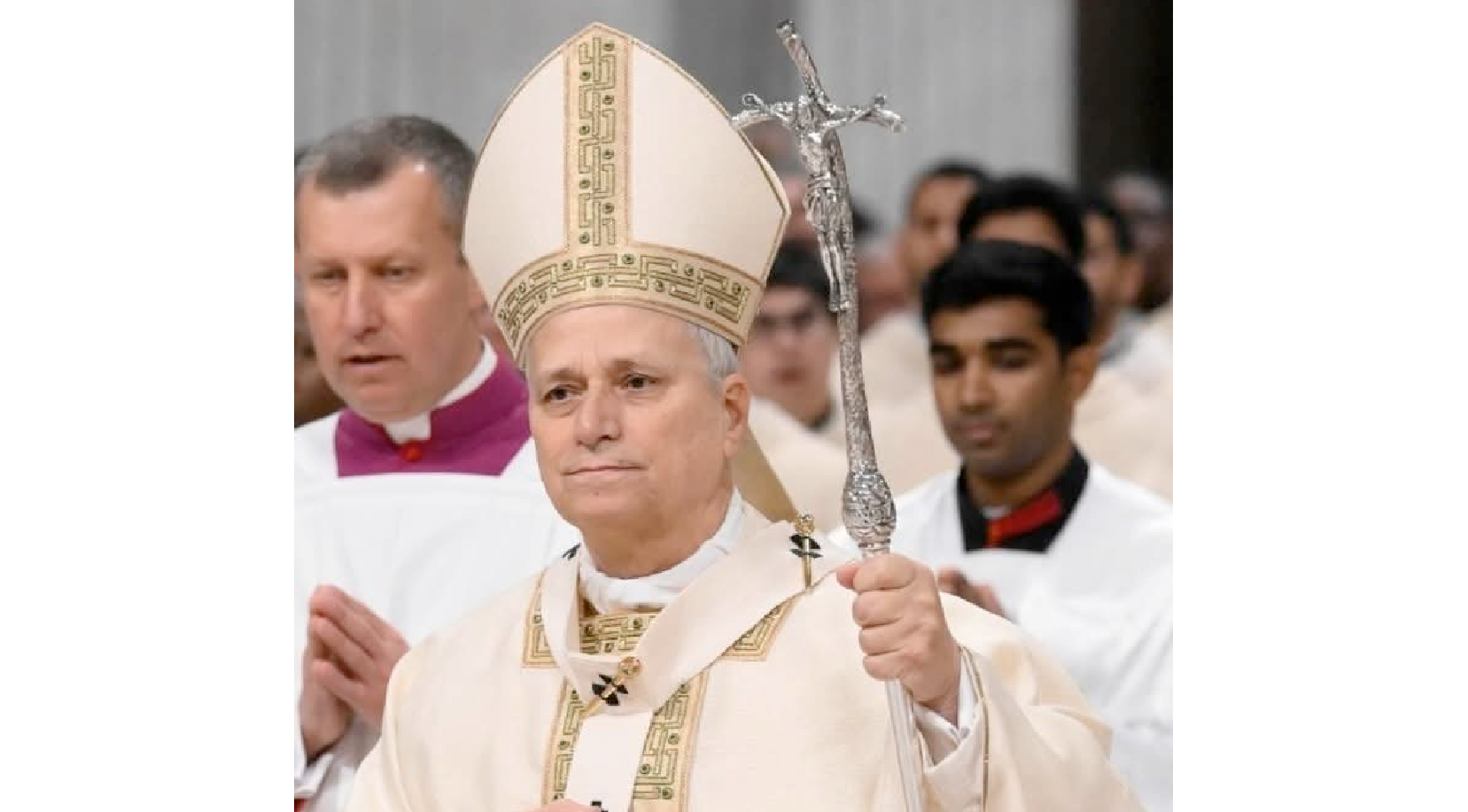
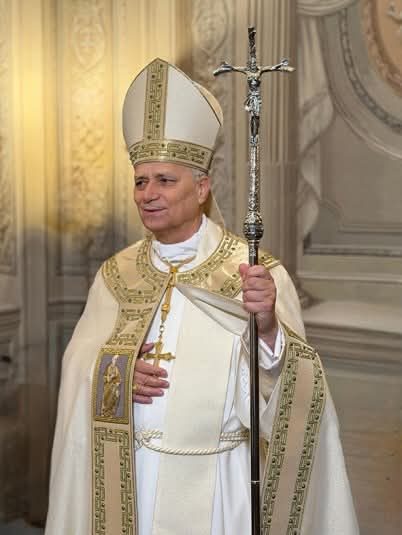
(ZENIT News / Rome, 01.11.2026).- Since January 6, the Solemnity of the Epiphany, Pope Leo XIV has altered one of the most visible symbols of his public ministry. On the same day the Holy Door of St. Peter’s Basilica was closed, marking the end of a major liturgical cycle, the Pope appeared with a new pastoral staff in his hand. At first glance, it may seem like a marginal change. In reality, it is a carefully calibrated statement, rooted in centuries of papal history and shaped by a precise reading of the Church’s mission today.
According to the Office for the Liturgical Celebrations of the Supreme Pontiff, the new staff stands “in continuity” with those used by Leo XIV’s predecessors. That continuity, however, is not merely aesthetic. It expresses a deliberate synthesis between two inseparable dimensions of Christian proclamation: Christ’s self-giving love revealed on the cross and its fulfillment in the Resurrection. In other words, the staff is meant to preach before the Pope even speaks.
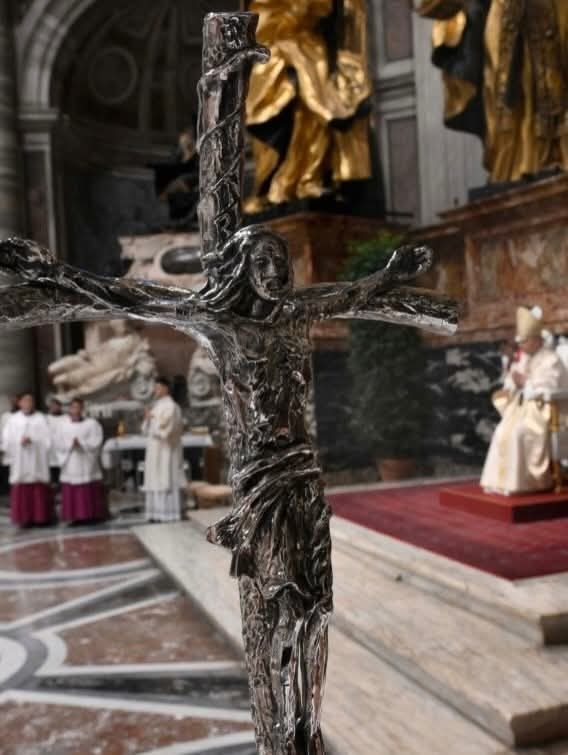
The explanatory note places the emphasis squarely on the Paschal Mystery, described as the “gravitational center” of apostolic preaching. Because Christ has entered death and emerged victorious, death no longer holds ultimate power over humanity. What Christ assumed, the text recalls, he also redeemed. This theological core is translated visually in the new staff’s design. Christ is no longer shown bound by the nails of the Passion. Instead, his body appears glorified, rising toward the Father. Yet the wounds remain visible. Like the Gospel accounts of the risen Christ appearing to his disciples, the scars are not erased; they are transformed into luminous signs of victory. Human suffering is not denied, but transfigured into what the Vatican text calls a “dawn of divine life.”
To understand why this choice matters, it helps to recall that the pastoral staff is not, strictly speaking, a traditional papal insignia. As the Vatican itself notes, the crozier belongs properly to bishops, not to the Bishop of Rome in his universal role. For centuries, popes did not carry a pastoral staff in the way diocesan bishops do. Instead, from the early Middle Ages onward, they used the ferula pontificalis, a symbol of spiritual authority and governance. Its precise medieval form is not fully documented, but it was likely a simple staff topped with a cross.
This ferula was associated above all with the Pope’s taking possession of his cathedral, the Basilica of St. John Lateran. After election, the new pope would receive it as part of assuming his episcopal chair as Bishop of Rome. Even then, its use was limited. The ferula did not normally appear in papal liturgies. Exceptions were rare and highly symbolic: the ritual knocking on the Holy Door, performed three times to inaugurate a Jubilee, or the consecration of a church, when the Pope traced the Latin and Greek alphabets on the floor, signifying the proclamation of the Word to all cultures.
A decisive shift came on December 8, 1965. On that day, at the closing of the Second Vatican Council, Pope Paul VI set aside the ferula and appeared instead with a silver pastoral staff bearing a crucifix. The object was not accidental. It had been commissioned from Italian sculptor Lello Scorzelli, who sought to capture the apostolic vocation of St. Paul, whose name Giovanni Battista Montini had chosen upon his election. Paul’s mission, as expressed in the First Letter to the Corinthians, was to proclaim “Christ crucified” and nothing else as the foundation of faith.
By adopting that staff, Paul VI signaled a change in emphasis. The Pope would not present himself primarily as a sovereign figure wielding authority, but as a shepherd bearing witness to the mystery of the Cross. From that moment on, the pastoral staff began to appear regularly in papal liturgies, and his successors followed suit.
Saint John Paul II made the symbol inseparable from his pontificate. At the beginning of his ministry, he famously raised the pastoral cross as he pronounced the words that would define an era: “Open the doors to Christ.” The gesture was both physical and programmatic. The Cross was not an obstacle to be hidden but the axis around which Christian life and history turn.
Pope Benedict XVI, deeply attentive to liturgical symbolism, also made deliberate choices. At times he used a pastoral staff topped with a gold cross previously associated with Blessed Pius IX. Later, he adopted one bearing the Paschal Lamb and the Christogram at the center of the cross. The message was explicit: the unity of Cross and Resurrection stands at the heart of the kerygma, the Church’s foundational proclamation.
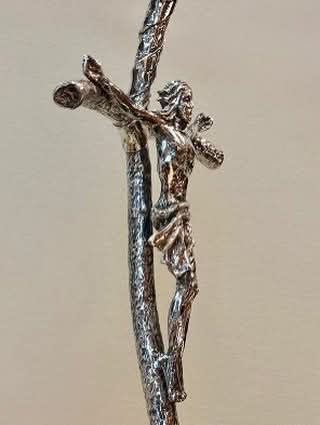
Seen against this background, Leo XIV’s new pastoral staff fits into a long, evolving narrative rather than breaking from it. What is distinctive is the accent he places on the Resurrection without bypassing the Cross. The figure of Christ ascending, wounds exposed yet radiant, suggests a Church that does not deny suffering or historical wounds, but refuses to allow them to have the final word.
The timing is also telling. January 6, the Epiphany, celebrates manifestation: Christ revealed to the nations. The closing of the Holy Door on the same day underscores the end of an extraordinary moment and the return to ordinary time, where faith must be lived without spectacle. In that context, the new staff functions as a quiet catechesis. It proclaims that the Church’s hope does not lie in nostalgia, power, or even in structures, but in the Paschal logic that turns loss into life.
In a Church often scrutinized for its symbols, Leo XIV’s choice is neither ornamental nor nostalgic. It is a visual theology, compressed into metal and form, reminding both shepherd and faithful that the path forward passes through the wounds of history—but does not end there.
Thank you for reading our content. If you would like to receive ZENIT’s daily e-mail news, you can subscribe for free through this link.

Publicaciones relacionadas:
 Pope confirms new Custos of the Catholic Church for the Holy Places in the Holy Land
 Fatigue of living? Pope Leo gives a beautiful, spiritual and profound reflection
 Interiority, Seminary: School of Affections, Wounds, Discernment … Pope Leo XIV Speaks to Seminarians
 The Apostles Peter and Paul explained and applied to today’s Church by Pope Leo XIV
