

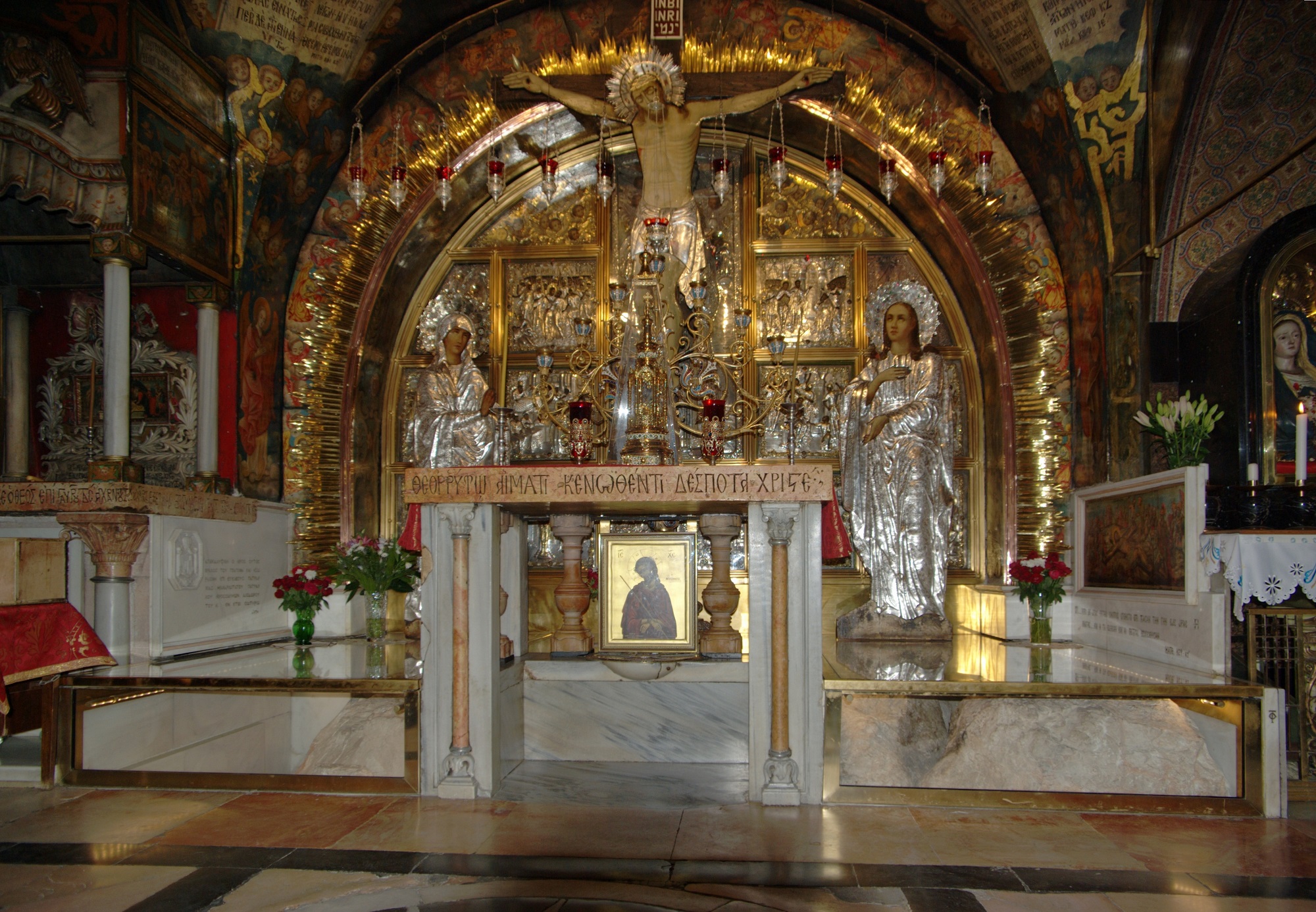
(ZENIT News / Jerusalem, 12.03. 2025). – Recent archaeological excavations indicate that olive trees and grapevines grew 2,000 years ago on the land now occupied by the Church of the Holy Sepulchre in Jerusalem, according to studies of pollen and plant remains found in layers beneath the floor of the present Basilica.
Research by Professor Francesca Romana Stasolla of Sapienza University of Rome shows that this area was not part of the city in Jesus’ time. It was during Hadrian’s reign that the Romans incorporated the area into Aelia Capitolina, a city built on the ruins of Jerusalem in the 2nd century.
Christian history places the crucifixion and burial of Jesus at the site known as Golgotha, a protected area within an 1810 building considered part of the Church. The excavations, begun in 2022 for the renovation of the building’s floor, were agreed upon in 2019 by the three Religious Communities that administer it.
Chapter 19 of the Gospel of John contains details not found in other Gospels: «Now in the place where He was crucified there was a garden, and in the garden a new tomb where no one had ever been laid» (John 19:41). John’s description coincides with the discoveries.
Archaeological analyses by scientists studied the soil layers and indicate an agricultural area from Herod’s time, when the city was not yet fortified. This would be cultivated land outside the city walls. The findings reveal a low wall with soil used for cultivation, as described in John’s Gospel.
New studies are rehabilitating the historicity of the fourth Gospel, such as the latest book by Craig Blomberg, who proposes the need for research on the historical Jesus based on John, an often neglected source. Similarly, scholar B.D. Ehrman of the University of North Carolina considers that «some sources predating the Gospel of John come from the early years of the Christian movement, in the first days of the movement, a few decades before the writing of the Gospel of Mark.»
The Constantinian Basilica was built in the 4th century. Analyses suggest that the plant remains belong to a period prior to Christianity, although radiocarbon dating tests have not yet been carried out.
This restoration represents the most significant intervention since the fire that affected the Basilica in 1808. The Church of the Holy Sepulchre has a temporary floor to facilitate access: the team led by Francesca Romana Stasolla divided the space into separate sections to keep the site open to the public.
The hidden levels beneath the Basilica explain in detail what the area of Jerusalem was like from the Iron Age. Excavations reveal that the building stands on a quarry, a fact that is consistent with much of the subsoil of the Old City. Before the construction of the Church and after the abandonment of the quarry, part of the land was used for agricultural work.
In Jesus’ time, the old quarry contained tombs carved into the rock at different levels. As its use as a quarry diminished, the number of burials increased. Constantine chose one of these tombs, historically associated with the death of Jesus, isolated it, and excavated around it: this is the area that now corresponds to the Basilica’s central rotunda.

Publicaciones relacionadas:
 Monumental statue of Jesus Christ to be placed in Jerusalem
 The Bethlehem organ plays again after eight centuries of silence
 Israel’s “administrative” detentions of Palestinian Christians: the case of Layan Nasir
 Chilean cardinal of Palestinian origin offers to mediate conflict in the Holy Land on behalf of the Pope
