

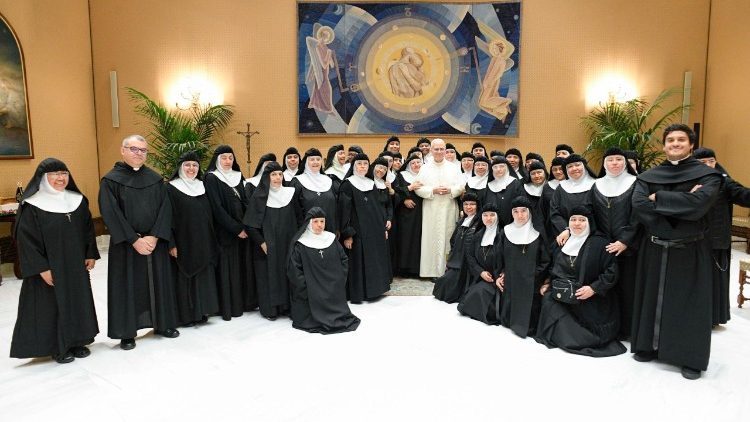
(ZENIT News / Rome, 15.11.2026).- Europe’s demographic decline is usually discussed in terms of expensive housing, insecure employment, delayed parenthood and changing cultural attitudes. But an unusual line of economic research suggests that another factor may have played a part: the disappearance of the religious women who once staffed a vast network of schools, hospitals, care homes and social institutions, helping families raise children at a lower cost.
The argument does not rest on the assumption that more religious belief automatically produces more births. Rather, it points to the practical consequences of losing institutions that provided services on which families had long relied. As religious congregations contracted, some of the support they offered disappeared, became more expensive or had to be replaced by other providers. The result, researchers suggest, may have been an increase in the effective cost of raising children.
This hypothesis was examined by economists Eli Berman, Laurence R. Iannaccone and Giuseppe Ragusa in a study published in 2018 in the Journal of Demographic Economics, entitled “From Empty Pews to Empty Cradles: Fertility Decline Among European Catholics.” Their research covered 13 European countries between 1960 and 2000, a period in which religious practice and fertility both declined across much of the continent.
Rather than measuring religious commitment alone, the researchers used the number of women religious per 10,000 Catholics as an indicator of the institutional presence of the Church. The choice reflected the prominent role of religious sisters in running Catholic schools, hospitals and other welfare services. Their statistical models estimated effects on the order of 300 to 400 children per nun, pointing to a potentially significant relationship between the decline of religious communities and falling fertility.
The national figures reveal how dramatically that institutional landscape changed. In Spain, the number of religious sisters per 10,000 Catholics fell from 21 in 1960 to 15 in 2000. Italy went from 31 to 20, France from 30 to 10, and the Netherlands experienced an even sharper contraction, from 77 to 18. Portugal, by contrast, remained at seven throughout the period examined.
The study does not establish that the loss of religious sisters was the sole, or even the principal, cause of Europe’s fertility decline. Its significance lies in identifying a dimension often overlooked in demographic debates: the relationship between family decisions and the availability of affordable social support.
A separate European study published in July 2026, “Early Public Childcare and Fertility: A Longitudinal Study for Europe,” offers a related perspective. Although it did not examine religious institutions, it found an association between access to public childcare and the likelihood of having children, particularly among women with lower incomes. Taken together, the findings reinforce the importance of the practical conditions in which families make decisions about parenthood
Spain provides a particularly revealing case study of what has happened to the Church’s institutional network. The country had approximately 88,000 professed religious sisters in 1969. By 1987, the number had fallen to around 58,000, and Vatican statistics recorded just 32,996 in 2024. Ageing communities and a shortage of new vocations have forced congregations to close houses, withdraw from institutions or transfer their management to other organisations.
Two recent examples illustrate the change. In Bilbao, the Little Sisters of the Poor closed a care home in 2024 after nearly four decades of service because there were no longer enough sisters to sustain its operation. In Caravaca de la Cruz, the Sisters of the Abandoned left an institution they had managed since 1883 in January 2025; its administration passed to a private company.
Education has undergone a similar, though less dramatic, transformation. According to data from the Spanish Episcopal Conference, the number of Catholic educational institutions fell from approximately 2,635 in the 2010-2011 academic year to 2,536 in 2023-2024. The number of publicly funded Catholic schools declined from around 2,445 to 2,402. More striking is the change in staffing: laypeople now account for 97% of teachers in Catholic schools, while religious personnel represent only 3%.
That shift has financial implications. Congregations historically provided personnel through forms of service that did not necessarily operate like conventional salaried employment. Replacing them with lay professionals entails wages, social security contributions and other employment costs. Whether those expenses are ultimately passed on to families depends on each institution’s funding arrangements and the extent to which public authorities or the institutions themselves absorb them.
The wider social impact is also visible in the Church’s own figures. The number of people benefiting from its social and charitable activities in Spain fell from 4.7 million in 2017 to just over 3.8 million in 2024, a decline of approximately 20% in seven years. This does not mean that every service has vanished, but it points to a contraction in the reach of a network that has long complemented public welfare provision.
The demographic argument therefore raises a question extending beyond the Church: what happens to family life when institutions that once shared the work of education, healthcare and care for the elderly can no longer do so? A service may survive under new management, but its prices, accessibility and operating model can change. Where support becomes less available or more expensive, the burden on households may grow.
For the Catholic Church, the decline of religious vocations is consequently not only an internal question about the future of consecrated life. It also concerns the fate of a social contribution built over generations, often through the largely unseen work of religious women. Their absence may be felt not only in convents and parishes, but in the daily lives of families.
Europe’s birth-rate crisis has no single explanation, and the research does not justify reducing a complex demographic transformation to the decline of religious orders. But it challenges the assumption that fertility is determined exclusively by individual preferences, cultural attitudes or household income. The institutions surrounding families matter, too.
Thank you for reading our content. If you would like to receive ZENIT’s daily e-mail news, you can subscribe for free through this link.

Publicaciones relacionadas:
 Pope Francis on Cardinal Ouellet: There Is Not Enough Evidence to Open a Canonical Investigation for Sexual Aggression
 Re-inauguration of Notre Dame de Paris will be in 2024. Macron invites the Pope
 Communist China recognizes 94-year-old Catholic bishop Melchiorre Shi Honghzen
 Papua New Guinea’s Christian Nation Declaration Sparks Concern Among Catholic Leaders
