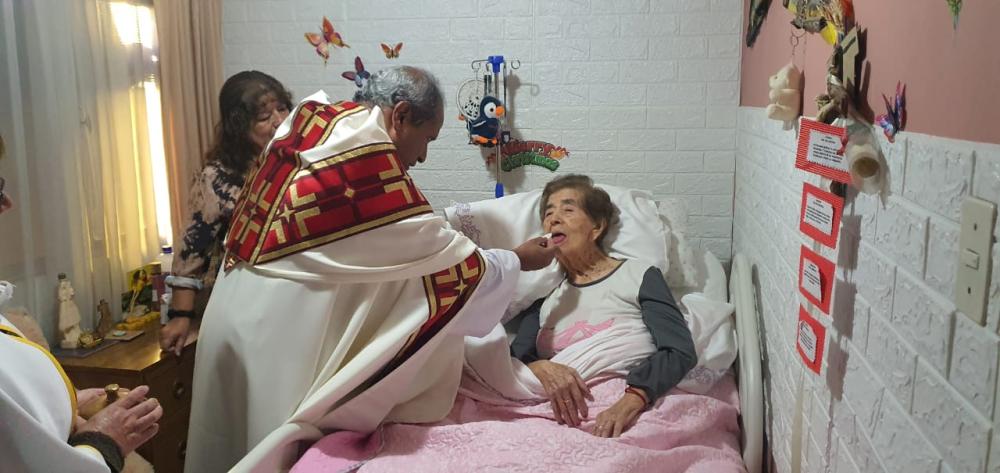
(ZENIT News / Rome, 11.09.2026).- Answered by Legionary of Christ Father Edward McNamara, professor of liturgy and sacramental theology at the Pontifical Regina Apostolorum university.
Q: Many older artistic representations which show Communion being taken to the sick strongly feature the presence of a candle, sometimes borne by a server or servers, but it seems very uncommon for this to happen today. When a cleric or an extraordinary minister of Holy Communion removes hosts from the tabernacle to distribute them to the homebound and the sick, should candles be lit either side of the tabernacle? Should this also occur when Hosts are replaced back in the tabernacle? Should a candle or candles be lit in the homes or hospital rooms where one gives the homebound and sick Communion? Could or should one or more available altar servers carry a candle on the way to each home if this were practically possible? Finally, are there any universal norms about the required liturgical vestments for this rite? — J.D., Wagga Wagga, Australia
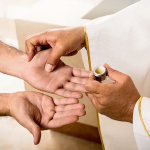
A: The current norms for taking Communion to the sick do not mention using candles in taking the Eucharist from the church to the person’s dwelling place or hospital room. In the case of bringing Communion to the sick, the ritual for the pastoral care of the sick offers the following instruction:
«When the eucharist is brought to the sick, it should be carried in a pyx or small closed container. Those who are with the sick should be asked to prepare a table covered with a linen cloth upon which the blessed sacrament will be placed. Lighted candles are prepared and, where it is customary, a vessel of holy water. Care should be taken to make the occasion special and joyful.»
This is the only mention of candles in this particular context.
The rubrics in the old ritual books were more detailed and called for a procession including a canopy, whenever Communion is brought to the sick. When this is not possible, it says:
«Should the journey be long or difficult, and even perhaps made on horseback, it will be necessary that the receptacle with the sacrament be securely encased in a beautifully made burse, and this fastened to the neck and secured at the breast, so as to prevent the sacrament from falling or being shaken out of the pyx.»
In the above difficult case, the ceremonial formalities, such as candles and canopies, are left aside in favor of what is most essential, bringing the comfort and sustenance of the Eucharist to the infirm.
I think that the present, far simpler, norms are not a concession or a sign of lack of reverence but a practical adaptation to the realities of modern life.
The original ritual forms were developed in Europe where most sick and dying people remained at home within a short distance of their parish church. Bringing the Eucharist to the sick and dying with a canopy and candles was not only a sign of public adoration toward the Blessed Sacrament but was also a pastoral invitation to the whole community to pray for a sick member of an often tight-knit community.
While the current norms do not require any of this, should the local conditions be analogous, I would see no difficulty in a pastor taking the Eucharist to the sick in a solemn manner if it were pastorally fruitful.
In modern times, however, many ill or elderly people are found in hospitals, nursing homes, or even in apartments or condominiums with multiple floors. Even private houses can be quite a distance from a parish.
This means that priests, deacons and extraordinary ministers often have to bring the Eucharist to the sick in their cars. Certainly, during the trajectory they should do all that is possible to keep a reverent silence and recollection while being attentive to traffic.
Given the realities of pastoral attention to the sick in our modern age, I believe that those who reformed and simplified the rite did well to mandate only what was considered essential.
Finally, as we mentioned in an earlier answer regarding extraordinary ministers on January 28, 2024, there are some diocesan norms and ceremonies for the reception of the hosts to bring to the sick, especially when this is done at the end of Mass.
However, there are no current norms that would require lighting candles when the tabernacle is opened to take hosts outside of Mass nor to replace hosts after administrating Communion to the sick.
Indeed, this latter situation of hosts left over should generally be avoided if possible by careful preparation of the visits or even giving two hosts to one of the people assisting the sick person should he or she be unable to receive Communion.
Again, given the variety of situations, the rituals do not make any norms regarding vestments. Except in emergency situations, such as a road accident, the priest or deacon should at least bring a purple or white stole.
With respect to other vestments, the ordained minister may add an alb or surplice and even a cope should this make the celebration of the communion of the sick more prayerful and pastorally fruitful, not just for the person who is ill but also for the family and the wider faith community.
* * *
Readers may send questions to zenit.liturgy@gmail.com. Please put the word «Liturgy» in the subject field. The text should include your initials, your city and your state, province or country. Father McNamara can only answer a small selection of the great number of questions that arrive.
Thank you for reading our content. If you would like to receive ZENIT’s daily e-mail news, you can subscribe for free through this link.