

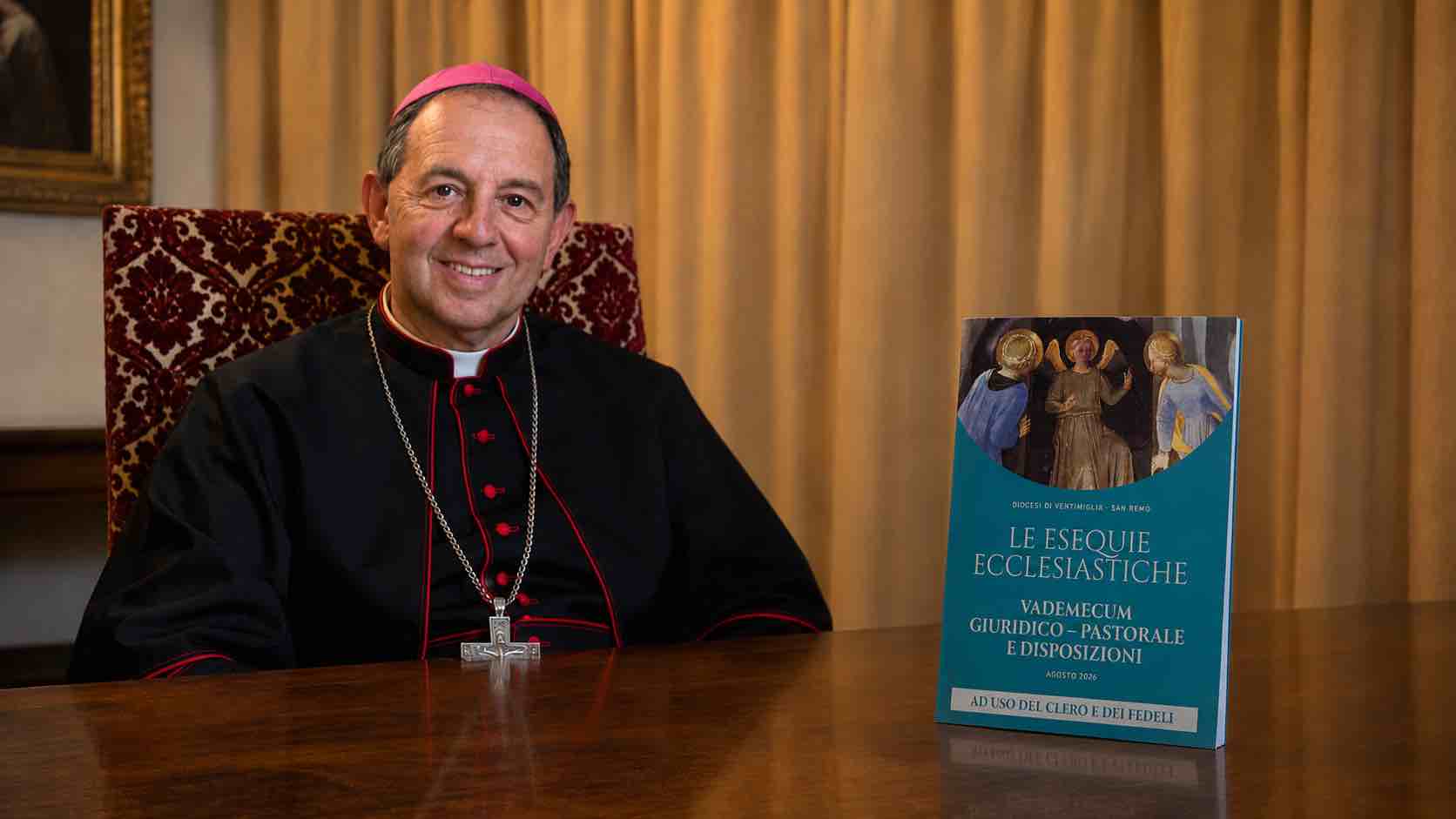
(ZENIT News / Rome, 08.18.2026).- A funeral is one of the few moments when the Catholic Church speaks publicly about death, the human person and the hope of resurrection. That is precisely why Bishop Antonio Suetta of Ventimiglia-San Remo has decided that some funerals need fewer personal tributes and, in certain cases, no church funeral at all.
The Italian bishop’s intervention follows an episode in Camporosso on August 8, when he stopped plans for the Catholic funeral of a prominent Freemason. Rather than leaving the decision as an isolated and potentially controversial pastoral judgment, Suetta published a juridical-pastoral handbook on August 15 setting out how his diocese should handle Catholic funerals.
The document is considerably broader than the controversy that prompted it. It addresses Freemasonry, cremation, public sinners, funeral-home practices, speeches by relatives and friends, personal objects brought into churches and the growing tendency to turn a liturgical funeral into a celebration of the deceased’s personality.
At its heart is a question that reaches well beyond Italy: what exactly is a Catholic funeral for?
Suetta’s answer is deliberately uncompromising. The funeral is not principally a public ceremony in which a community celebrates the life of the deceased. It is an act of the Church: prayer for the dead, reverence for the body in anticipation of the resurrection and consolation for those who remain.
That distinction explains many of the rules that otherwise might appear surprisingly restrictive.
A funeral Mass, for example, is not supposed to become an open microphone for family members recounting anecdotes, political commitments, sporting loyalties or personal passions. The bishop warns against excessive eulogies and interventions that can displace the liturgy itself. References to a favorite football team, political movement or other affiliations may be familiar at secular memorials, but, in his view, they can obscure the distinctly Christian meaning of the occasion.
Any farewell speech must therefore be agreed beforehand, based on an approved written text and delivered outside the central liturgical space. The use of the ambo for spontaneous tributes is not permitted.
The underlying concern is not a rejection of grief. Quite the opposite: Catholic funerals are supposed to address grief by placing it within a larger horizon. The Christian response to death is not simply to preserve someone’s memory but to entrust that person to God.
This is also why Suetta rejects what he describes as the “secularization” of death. When the funeral becomes primarily an exercise in remembering the personality, achievements and preferences of the deceased, the Christian proclamation of death and resurrection can become secondary.
The most contentious section, however, concerns who may receive ecclesiastical funerals.
The bishop invokes Canon 1184 §1 of the Code of Canon Law, which provides for the denial of Catholic funerals in certain circumstances, including notorious apostates, heretics and schismatics, people who chose cremation for reasons contrary to Christian faith, and manifest sinners when granting the funeral would cause public scandal.
Suetta applies that framework to Catholics who deliberately and publicly belong to Freemasonry.
His reasoning is not based on the idea that every Freemason has been condemned personally by the Church. Rather, it rests on the incompatibility that Catholic authorities have repeatedly identified between Catholic faith and formal membership in Masonic organizations. The handbook recalls the 1983 declaration of the Congregation for the Doctrine of the Faith, approved by John Paul II, which reaffirmed that incompatibility. It also cites the Vatican’s 2023 response reiterating that the prohibition applies to Catholics who formally and consciously belong to Masonic lodges and embrace their principles.
Under the criteria laid out by Suetta, someone who has publicly belonged to Freemasonry, remains associated with it and has given no indication of repentance or rupture with that membership should be denied ecclesiastical funeral rites.
There is an important qualification: denying a funeral is not the same thing as declaring that a person’s soul is condemned.
The Church does not claim authority to pronounce the eternal fate of an individual simply because funeral rites are denied. The restriction concerns the public ecclesial act itself and the message conveyed by it. In Suetta’s interpretation, allowing the funeral despite an unresolved public contradiction between the deceased’s professed affiliation and Catholic teaching could create scandal or suggest that the contradiction does not matter.
The same logic leads the handbook to reject a separate blessing of the body when ecclesiastical funerals themselves must be denied. A blessing is not regarded as an empty gesture of politeness but as a public sacramental sign. Turning it into a purely ceremonial farewell, the bishop argues, would undermine its meaning.
The document’s reach into ordinary funeral practice is equally notable.
It reiterates that Catholic funerals should favor burial, while recognizing that cremation is permissible when chosen for reasons compatible with Christian belief. What is not permitted is the scattering of ashes or their transformation into commemorative objects such as jewelry. The distinction reflects the Church’s insistence that cremation does not erase the Christian understanding of the human body or the hope of bodily resurrection.
Suetta also addresses money. Funeral agencies, he states, cannot impose or collect charges for the Church’s liturgical services. An offering made for the funeral is a free act of generosity and is to be given directly according to the Church’s arrangements.
The result is an unusually comprehensive attempt to recover the identity of a rite that has gradually absorbed many features of secular memorial culture.
That may explain why the document matters beyond the immediate dispute over Freemasonry. In many Catholic countries, funerals have become increasingly personalized, with music, speeches, photographs, objects and anecdotes designed to make the ceremony resemble a celebration of an individual’s life. Some families may find that approach natural and comforting. Suetta’s intervention challenges the assumption that what is emotionally appropriate at a memorial is necessarily appropriate within the liturgy.
His argument is ultimately theological rather than aesthetic: the Church does not gather at the grave merely to say that a person was loved and will be remembered. It gathers to pray for the dead and proclaim that death does not have the final word.
That also explains the bishop’s insistence that pastoral charity cannot simply mean agreeing to every request made by grieving relatives. A refusal can be painful, especially at a moment of loss. But, in his understanding, mercy cannot require the Church to make its public rites say something that contradicts what those rites signify.
The Camporosso episode has therefore produced something more lasting than a single disputed funeral. Ventimiglia-San Remo now has written criteria that priests and families can consult before difficult cases arise.
And perhaps that is the most significant development. At a time when Catholic funerals can easily become indistinguishable from secular celebrations of life, Suetta is asking the Church to recover a basic distinction: a Christian funeral is certainly about a person who has died, but it is ultimately about God, judgment, mercy and the resurrection.
The bishop has drawn a line.
The question now is whether other dioceses will consider that line necessary — or whether they will continue allowing the boundaries between a Catholic funeral and a secular farewell to become increasingly difficult to see.
Thank you for reading our content. If you would like to receive ZENIT’s daily e-mail news, you can subscribe for free through this link.

Publicaciones relacionadas:
 USA: Health Care that Truly Heals Must be Grounded in Truth, says Bishop Rhoades
 USA: Publication Shows That Progressive Clergy Is Extinguishing and Conservative Is Growing
 Wave of Church Attacks in 2024 Sparks Concern Over Religious Freedom in the United States
 President of U.S. Bishops Conference Calls for Special Collection for Humanitarian Relief and Pastoral Support in Gaza
