

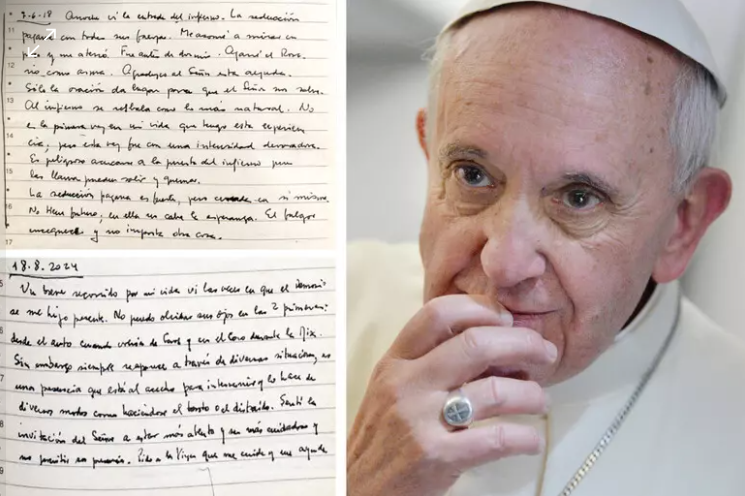
(ZENIT News / Rome, 11.24.2026).- A private diary kept by Pope Francis over more than three decades has offered an unprecedented glimpse into the spiritual struggles, fears and deeply personal experiences of the late pontiff, including three encounters with what he believed to be Satan and a profound crisis of faith during the final years of his pontificate.
The revelations emerged on November 24, 2026, following the publication of The Personal Diary of Pope Francis, a book compiled by Cardinal Víctor Manuel Fernández, prefect of the Dicastery for the Doctrine of the Faith. Published by the Vatican Publishing House, the volume brings together handwritten reflections dating from 1992 to 2024, alongside annotated passages from books and other private documents. Italian newspapers, including Corriere della Sera and La Repubblica, have published excerpts, while Vatican media have interviewed Fernández about the origins and significance of the material.
Among the most striking passages are three accounts in which Bergoglio describes physical manifestations of the devil. The first occurred approximately 15 years before his election as Pope, when he was still Archbishop of Buenos Aires. He recalled seeing a threatening yet seductive figure through a car window. On another occasion, during a celebration in a Carmelite chapel, he saw what he described as eyes of fire. According to his account, he immediately fled, clutching his Rosary and invoking the Virgin Mary.
The third episode allegedly took place in the Vatican following his January 2018 visit to Chile. During a meeting in Rome, Francis wrote that he saw and heard Satan declaring: «Now I have obtained everything I wanted.» He remembered the voice as powerful and hoarse, adding that he was able to leave the meeting and escape what he perceived as the evil presence. Three years later, he returned to the episode in his diary, observing that something had nevertheless remained as a lasting mark.
The accounts provide an unusual insight into the importance Francis attached to spiritual warfare. Fernández explained that the Pope believed one should never engage in dialogue with evil or allow oneself to become fascinated by it. The appropriate response, he said, was to flee immediately rather than attempt to establish any kind of relationship with the demonic.
Yet the most consequential revelations may concern the spiritual crisis that Francis experienced in 2021 and 2022. Fernández describes this period as perhaps the darkest of his pontificate, marked by intense temptation, spiritual desolation and an inner struggle that the Pope himself associated with the danger of power.
In the cardinal’s interpretation, the central temptation was what Francis called «reductive curiosity»: the desire to explore the nature of divine power and, ultimately, to experience what it would mean to be God. For a Pope, entrusted with considerable institutional and spiritual authority, this represented a particularly dangerous temptation. Francis was concerned about becoming someone who manipulated others as though they were puppets.
The diary also records a disturbing vision dated June 7, 2018, in which he described seeing the entrance to hell. He portrayed it as a place of overwhelming pagan seduction, warning that evil could attract people gradually, almost without their realizing it. He wrote that he had been terrified and reached for his Rosary as a spiritual weapon.
According to Fernández, however, these experiences should not be understood merely as frightening supernatural episodes. He believes they forced Francis to confront the deepest questions about his existence and mission. The crisis ultimately led him toward a more complete surrender to God’s love and a deeper respect for the dignity of others.
One entry, dated May 1, 2019, captures the other side of this intensely personal spirituality. Francis described feeling enveloped by God’s love, comparing the experience to a mattress protecting him from disintegration. Fernández considers this passage, together with the account of the vision of hell, particularly revealing of the spiritual journey that shaped the Pope’s final years.
The cardinal also connects this transformation with two of Francis’ major later documents: the apostolic exhortation C’est la confiance, dedicated to St. Thérèse of Lisieux, and the encyclical Dilexit nos, on the human and divine love of the Heart of Jesus. Both, he argues, reflect a spirituality rooted in complete confidence in God’s love, inseparable from concern for other people.
That concern is another recurring theme throughout the diary. Francis repeatedly returned to the suffering of the poor, the sick, migrants, prisoners and people with disabilities. One of the phrases he particularly valued came from Virgil: «There are tears in things.» Fernández sees it as an expression of the Pope’s conviction that every human being possesses an immense dignity that demands a concrete response from the Church.
The diary also exposes the personal anguish Francis experienced over the clerical abuse crisis, particularly in Chile. On January 24, 2021, he wrote that he had been devastated by the situation, acknowledging that he had initially struggled to grasp its full gravity. The episode had forced him to recognize the seriousness of the problem.
His reflections were not limited to spiritual matters. He wrote about his parents and grandmothers, people close to him who had suffered bereavement, and members of the Roman Curia. He described Cardinal Pietro Parolin as an outstanding diplomat with an exceptional understanding of international politics. He praised Robert Prevost, now Pope Leo XIV, as a generous missionary, a great pastor and an irreproachable man. He also defended former doctrinal prefect Cardinal Gerhard Ludwig Müller, describing him as a fundamentally good person despite his apparently aggressive manner.
The diary sheds light, too, on Francis’ relationship with aging and death. He appeared relatively accepting of the prospect of dying, sometimes even offering his death for the benefit of others. Growing old, however, was more difficult for him to confront. Although he was already 74 when a priest pointed out that he was elderly, the observation reportedly came as a considerable shock.
Fernández explained that he discovered the diary while visiting Francis at the Casa Santa Marta. During a private conversation about possible provisions for a Pope who might permanently lose consciousness, Bergoglio showed him a box containing several documents and a personal agenda. He indicated that the material should eventually be used «for the edification» of others.
After Francis’ death on April 21, 2025, Fernández approached Leo XIV, concerned that the documents might disappear or fall into the wrong hands. The new Pope located the box and authorized him to undertake the editorial work.
The published volume does not reproduce every line. Fernández excluded practical reminders, repetitive passages, private information concerning living individuals and certain cryptic writings that he believed Francis had deliberately made inaccessible. He nevertheless insists that the most revealing and even unsettling material has been retained, with contextual explanations to help readers understand the Pope’s reflections.
The final diary entry is dated August 18, 2024. It contains a simple prayer: «I ask the Virgin to protect me and help me.» According to Fernández, Francis wrote nothing further. Eight months later, he would be dead.
Thank you for reading our content. If you would like to receive ZENIT’s daily e-mail news, you can subscribe for free through this link.

Publicaciones relacionadas:
 2 ways Mary guarded her sinless heart (explained by the Pope)
 Where will Pope Francis be buried? He himself makes it known
 This Is What Pope Francis’ Tomb Will Look Like: First Photos from Santa Maria Maggiore
 [PHOTO GALLERY] Family members accompany the closing of Francis’ coffin (and 250 thousand people visited the Pope)
