

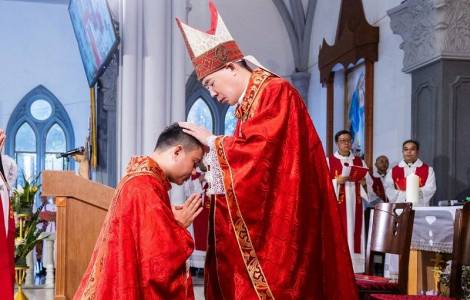
(ZENIT News / Rome, 10.16.2026).- The Catholic Diocese of Haimen in eastern China has a new bishop after more than three years without one. Ignatius Ding Zuyao, 40, was consecrated on October 15, 2026, in Nantong, Jiangsu province, nearly two months after Pope Leo XIV approved his appointment under the provisional agreement between the Holy See and the Chinese government. His ordination brings to 19 the number of Chinese bishops appointed under the framework and consecrated in communion with the pope.
The appointment highlights the Vatican’s continuing efforts to secure a recognized Catholic episcopal hierarchy in China, where the relationship between ecclesiastical authority and state control remains a delicate and unresolved issue.
Ding’s consecration took place at the Catholic Church of Qingnian East Road, where approximately 400 priests, religious sisters and lay representatives attended. Bishop Joseph Shen Bin of Shanghai, who previously led Haimen before moving to Shanghai in 2023, presided over the ceremony. He was joined by four other bishops: John Wang Renlei of Xuzhou, Joseph Xu Honggen of Suzhou, Francis Lu Xinping of Nanjing and Auxiliary Bishop Ignatius Wu Jianlin of Shanghai.
The Vatican announced the consecration on October 15, following Pope Leo’s approval of Ding’s candidacy on August 24. A report published the same day by the state-backed Chinese Catholic Bishops’ Conference said Ding had been elected bishop-designate on May 14, but did not mention the pope’s approval or the agreement with the Holy See.
The difference in how the two institutions presented the appointment illustrates the continuing tension surrounding episcopal appointments in China: the Vatican insists on the pope’s authority to appoint bishops, while Chinese official ecclesiastical bodies operate within a system subject to government oversight.
An agreement that remains essential — and contested
The provisional agreement between the Holy See and Beijing was first signed in 2018 and renewed in 2020 and 2022. In October 2024, it was extended for another four years.
Its central purpose is to establish a process for episcopal appointments that recognizes the pope’s authority while seeking cooperation with Chinese authorities. The agreement addresses one of the most persistent sources of division in Chinese Catholicism, where communities officially recognized by the state have historically existed alongside Catholics who worship in communities outside the government-approved structures.
Ding is the ninth Chinese bishop consecrated under Pope Leo XIV’s pontificate within this framework, according to the information provided. His appointment also brings the total number of bishops consecrated under the agreement to 19.
The arrangement has not eliminated every difficulty. Some bishops appointed by Leo were not immediately recognized by the Chinese government. Two had already been consecrated and belonged to the so-called underground Church, whose communities operate outside official state recognition, before their status was subsequently regularized by the authorities.
For the Holy See, maintaining dialogue offers a means of seeking greater unity among Chinese Catholics and preventing the appointment of bishops without papal approval. Yet the practical success of that approach depends on whether the agreement can be implemented in a way that respects the Church’s spiritual independence and the pope’s role as its supreme pastor.
A priest formed in Jiangsu and Beijing
Born in August 1986 in Qidong, Jiangsu province, Ding began his seminary studies at the Jiangsu section of Sheshan Seminary in Shanghai, where he studied from 2001 to 2004. He subsequently pursued philosophy and theology at Beijing’s Theological Seminary, completing his studies and obtaining a bachelor’s degree.
He was ordained a priest for the Diocese of Haimen on October 27, 2011. His pastoral assignments included the parishes of Haimenzhen, from 2012 to 2013; Linjiang, from 2013 to 2017; and Caojiazhen, from 2017 to 2023. In February 2023, he became parish priest of Qingnian East Road in Nantong, the parish where his episcopal consecration was held.
His appointment places a bishop with local pastoral experience at the head of a diocese whose modern missionary history dates to the 17th century. Haimen became an apostolic vicariate in 1926 and was elevated to diocesan status in 1946.
Ding’s elevation also follows the departure of Shen Bin, who moved to Shanghai in 2023 in a transfer initially carried out without Vatican approval before Pope Francis subsequently accepted the appointment.
Thank you for reading our content. If you would like to receive ZENIT’s daily e-mail news, you can subscribe for free through this link.

Publicaciones relacionadas:
 Iraq: new Catholic day care center opens, «a dream come true»
 7 out of 10 Spanish citizens believe that Leo XIV’s papacy will be good or better than that of Pope Francis
 How many Catholic parliamentarians are there in Germany? This is the religious composition of the German parliament
 Spanish diocese in litigation against Opus Dei makes public its proposal to the Pope for Torreciudad; Opus Dei speaks out
