

(ZENIT News / Rome, 01.22.2026).- For more than a century, Latin America was often described as the world’s largest Catholic stronghold, a region where religious identity seemed almost synonymous with national culture. That picture is now steadily fracturing. New data from the Pew Research Center reveal a profound realignment underway: Catholicism remains the largest religious tradition across the region, but its social dominance is eroding, while a growing share of adults are stepping outside all formal religious labels—without necessarily abandoning belief itself.
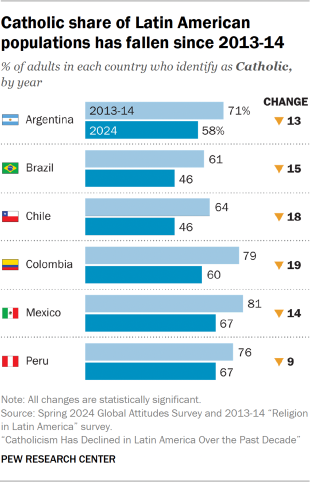
The findings come from large-scale surveys conducted in the spring of 2024 among more than 6,200 adults in six of Latin America’s most populous countries: Argentina, Brazil, Chile, Colombia, Mexico and Peru. Together, these nations account for roughly 495 million people—about three quarters of the population of Latin America and the Caribbean—making the trends they reveal difficult to dismiss as marginal or local.
Today, Catholics still represent the largest religious group in all six countries, ranging from 46 percent of adults in Brazil and Chile to 67 percent in Mexico and Peru. Yet compared with a decade ago, the decline is unmistakable. In every one of these countries, the Catholic share of the adult population has fallen by at least nine percentage points since 2013–2014. Over the same period, the proportion of adults who say they have no religious affiliation—describing themselves as atheist, agnostic or “nothing in particular”—has risen by seven points or more.
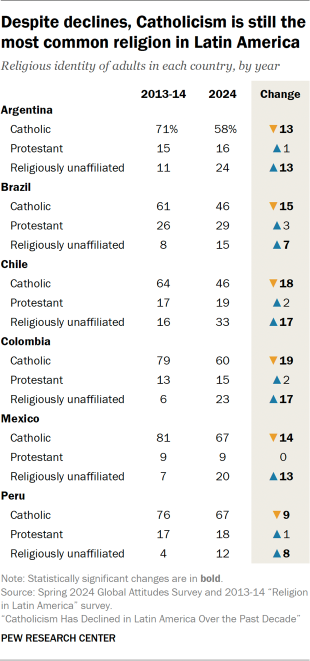
In several cases, the shift is dramatic. Adults with no religious affiliation now account for about one third of Chile’s population (33 percent), nearly a quarter of adults in Argentina (24 percent) and Colombia (23 percent), and one fifth of Mexico’s adult population (20 percent). In Argentina, Chile, Colombia and Mexico, these “religious nones” now outnumber Protestants, a milestone that would have seemed improbable just a generation ago.
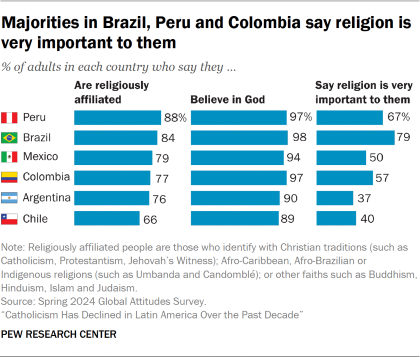
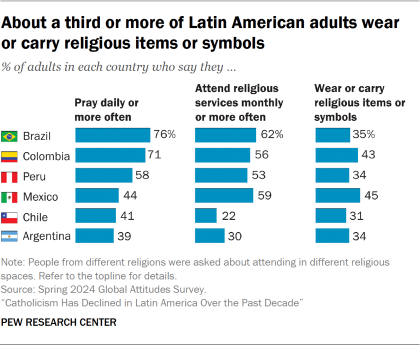
Yet this is not simply a story of secularization in the European sense. By most conventional measures, Latin America remains a deeply religious region. Belief in God is nearly universal: between 89 percent of adults in Chile and 98 percent in Brazil say they believe in God. Roughly half or more of adults in Brazil, Colombia, Mexico and Peru say religion is very important in their lives, and daily prayer remains common—ranging from 39 percent of adults in Argentina to an extraordinary 76 percent in Brazil.
Even among those who claim no religious affiliation, belief often persists. About three quarters of religiously unaffiliated adults in Mexico, for example, still say they believe in God. In this sense, Latin America is not abandoning faith so much as loosening its institutional anchors.
The long arc of change helps explain the present moment. Historical estimates from the World Religion Database show that Catholicism’s decline in the region began decades ago. Argentina illustrates the trajectory: Catholics made up about 97 percent of the total population in 1900, fell to 82 percent by 2000, and now account for 58 percent of adults, according to Pew’s 2024 survey. Similar patterns appear elsewhere, confirming that the current shifts are the acceleration of a long-term process rather than a sudden collapse.
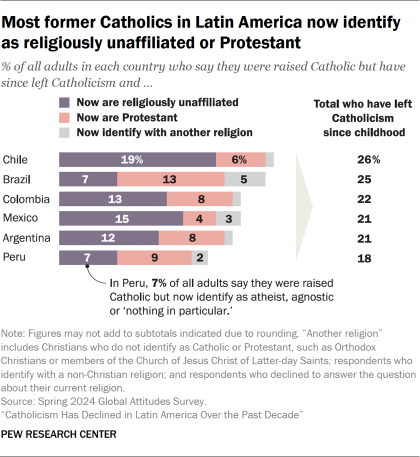
One driver of this change is religious switching. Across the six countries surveyed, roughly two in ten adults say they were raised Catholic but no longer identify as such. What happens next varies by country. In Colombia, 22 percent of adults are former Catholics: 13 percent have become religiously unaffiliated, 8 percent have joined Protestant churches, and 1 percent now belong to another religion. Brazil stands out as the exception, where former Catholics are more likely to become Protestant (13 percent of all adults) than unaffiliated (7 percent). In Peru, the paths diverge more evenly, with similar shares of ex-Catholics becoming Protestant (9 percent) or unaffiliated (7 percent).
Protestantism, often portrayed as Catholicism’s main competitor, has in fact remained relatively stable overall. Brazil continues to have the largest Protestant population among the six countries, at 29 percent of adults, only slightly higher than a decade ago. Pentecostal and charismatic churches still play a major role, though their dominance within Protestantism has softened as other Protestant traditions have grown.
What makes the Latin American case especially complex is the persistence of religious belief and practice across institutional boundaries. Most adults continue to affiliate with some religion—ranging from 66 percent in Chile to 88 percent in Peru—including not only Christians but also followers of Afro-Caribbean, Afro-Brazilian and Indigenous traditions such as Umbanda, Candomblé and Santería, as well as smaller communities of Jews, Muslims, Buddhists and Hindus.
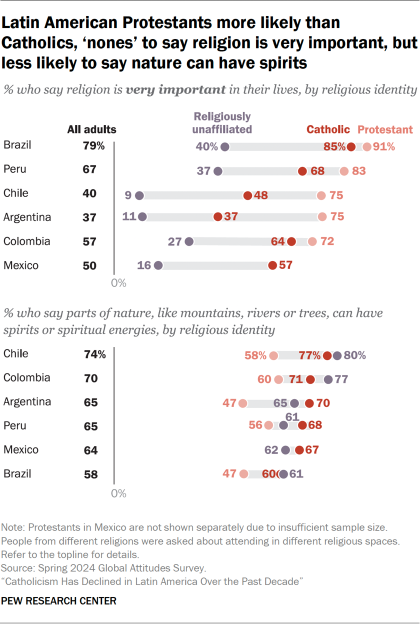
These popular religions, shaped by African, Indigenous, Spiritist and Catholic influences, help explain why belief systems in Latin America often resist neat classification. Many people—especially Catholics and the religiously unaffiliated—express beliefs associated with these traditions, such as the presence of spiritual forces in nature, the influence of ancestors’ spirits, or the power of objects imbued with spiritual energy. Catholics in particular are more likely than Protestants to consult horoscopes or diviners and to believe that ancestors can affect the living.
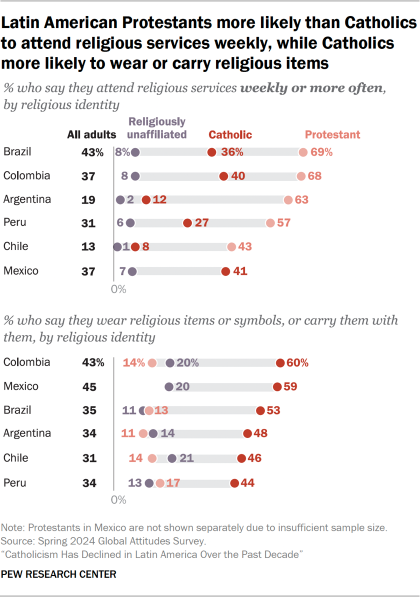
Patterns of religious practice also vary sharply by group. Protestants are generally the most institutionally engaged: in Argentina, for instance, 63 percent of Protestants attend religious services at least weekly, compared with just 12 percent of Catholics and 2 percent of the religiously unaffiliated. Catholics, by contrast, are far more likely to wear or carry religious symbols. In Colombia, six in ten Catholics say they do so, compared with about two in ten Protestants and religious nones.
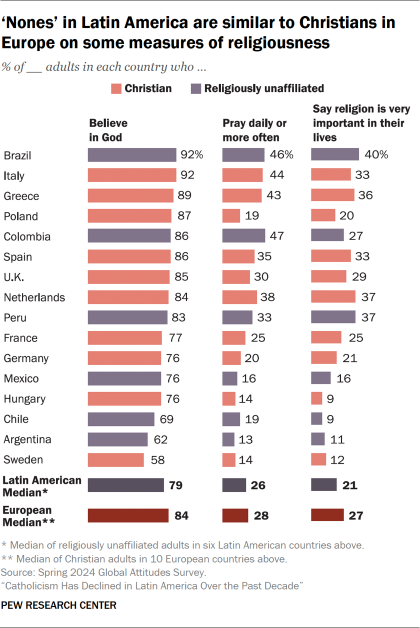
When placed in global perspective, Latin America’s religious profile looks even more distinctive. Pew researchers compared religiously unaffiliated adults in Latin America with Christians in Europe using three indicators: belief in God, frequency of prayer and the personal importance of religion. The results are striking. Between 62 percent of Argentina’s religious nones and 92 percent of Brazil’s say they believe in God—levels comparable to, or higher than, those of Christians in several European countries. Daily prayer among the unaffiliated in Brazil, Colombia and Peru rivals that of Christians in parts of Europe, and around four in ten religious nones in Brazil and Peru say religion is very important in their lives, similar to Christians in Greece or the Netherlands.
A parallel evolution is visible among Hispanics in the United States, a population that reached 68 million in 2024—larger than the population of any Latin American country except Brazil and Mexico. There, the Catholic share has fallen from 58 percent a decade ago to 42 percent today, while roughly one quarter now say they have no religious affiliation. Yet even in this diaspora context, 83 percent of U.S. Hispanics say they believe in God, and nearly half pray daily.
Taken together, these findings point to a transformation that is less about disbelief than about distance from institutions. Latin America is not becoming irreligious; it is becoming post-monolithic. Faith increasingly exists without exclusive labels, mixing belief, practice and identity in ways that challenge traditional assumptions—especially those long held by the Catholic Church.
For church leaders, particularly in Rome, the data pose uncomfortable questions. The erosion of Catholic identification is real and sustained, even as spiritual hunger remains strong. The challenge, then, is not only how to stop the numerical decline, but how to engage a population that still believes, still prays, but no longer feels compelled to belong.
Thank you for reading our content. If you would like to receive ZENIT’s daily e-mail news, you can subscribe for free through this link.

Publicaciones relacionadas:
 Shanghai: Why Did the Chinese Communist Party Violate Its Agreement with the Vatican?
 U.S. elections and the Catholic vote: Washington Post post-election poll shows decisive support for Trump
 Syria: in 14 years, the Christian presence has fallen by 84%: these are the numbers
 Pope Leo XIV, Germany’s silent believers, and unexpected signs of a spiritual awakening opposed to the German synod
