

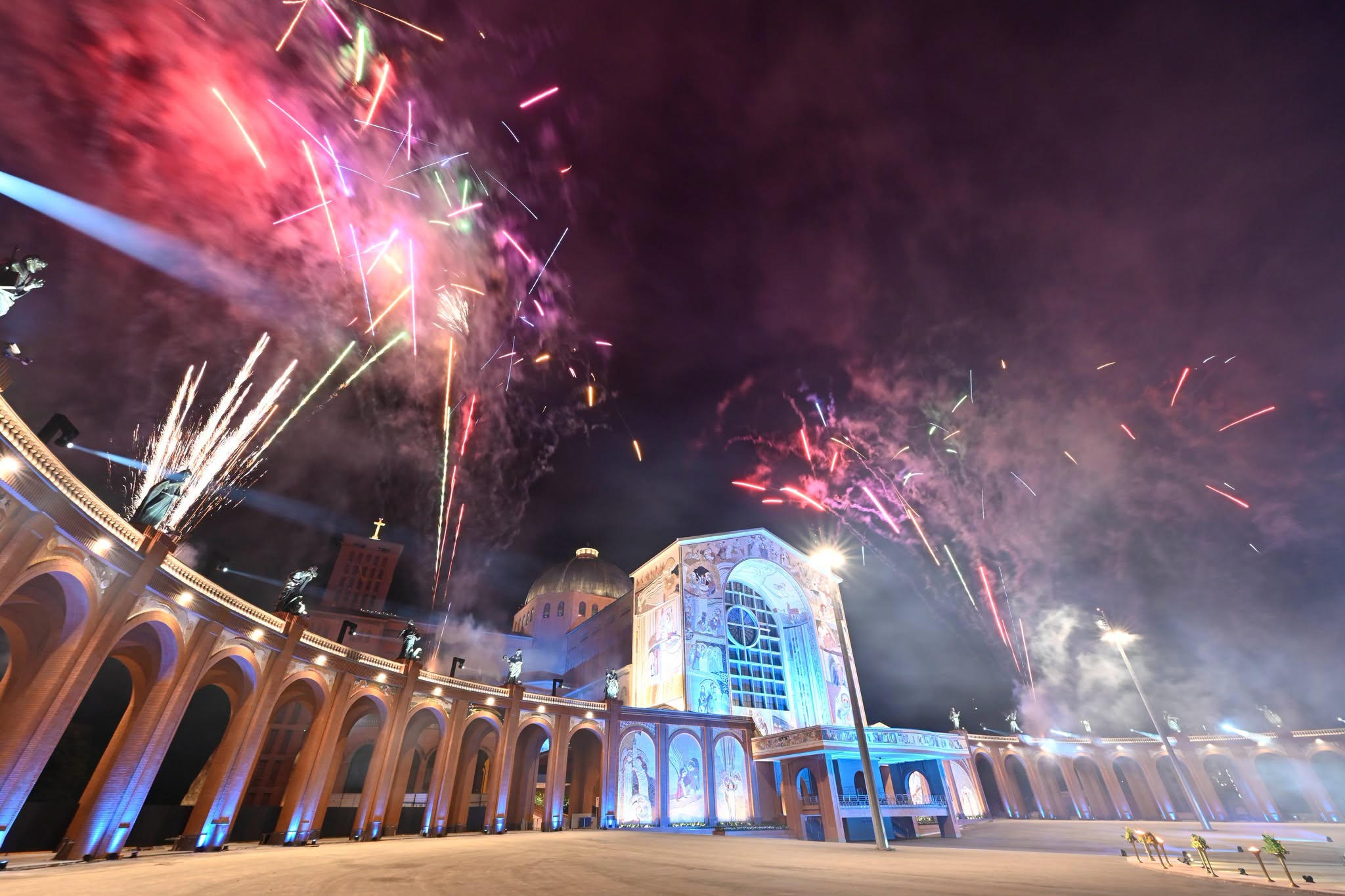
(ZENIT News / Rome, 09.14.2026).- When Pope Leo XIV arrives in Lourdes later this month, one of the most striking features of the sanctuary will be something visitors cannot see. Aluminum panels will conceal the controversial mosaics created by the former Jesuit priest and artist Marko Rupnik, reflecting a decision that has placed the dignity of abuse survivors ahead of the public display of his work. Just days earlier and thousands of miles away, Brazil’s National Shrine of Aparecida unveiled another monumental section of mosaics associated with Rupnik’s artistic workshop.
The contrasting decisions at two of Catholicism’s great Marian shrines have brought an unresolved question inside the Church into unusually sharp focus: how should sacred art be treated when its creator is accused of serious abuse?
View this post on Instagram
The issue is no longer confined to an artist’s reputation. Rupnik’s mosaics are embedded in some of the most prominent Catholic spaces in the world, including the Vatican’s Redemptoris Mater Chapel, as well as sanctuaries in Italy, Portugal, France and Brazil. Removing, covering or retaining them therefore involves pastoral, artistic and practical considerations that cannot be reduced to a simple judgment about whether art can be separated from its creator.
But the circumstances surrounding Rupnik make the question particularly painful.
Allegations of sexual, psychological and spiritual abuse involving more than two dozen women, most of them consecrated religious, became public in 2022. Rupnik was expelled from the Society of Jesus in 2023 after failing to comply with restrictions imposed by his superiors. His canonical case remains before the Vatican’s Dicastery for the Doctrine of the Faith, where a five-judge tribunal was established in 2025.
That ongoing judicial process is important. The Church has not publicly presented a final canonical judgment establishing the allegations as proven. At the same time, the existence of an unresolved legal process does not prevent Church institutions from considering the pastoral consequences of displaying the artist’s work, particularly for people who have experienced clerical abuse.
Lourdes has chosen caution
Bishop Jean-Marc Micas of Tarbes and Lourdes announced that the mosaics on the Basilica of the Rosary would be completely covered indefinitely. The decision followed consultations involving abuse survivors, legal professionals, safeguarding specialists and local chaplains. Micas has explicitly connected the measure with consideration for victims, and the mosaics will remain covered after Leo’s September 26–27 visit.
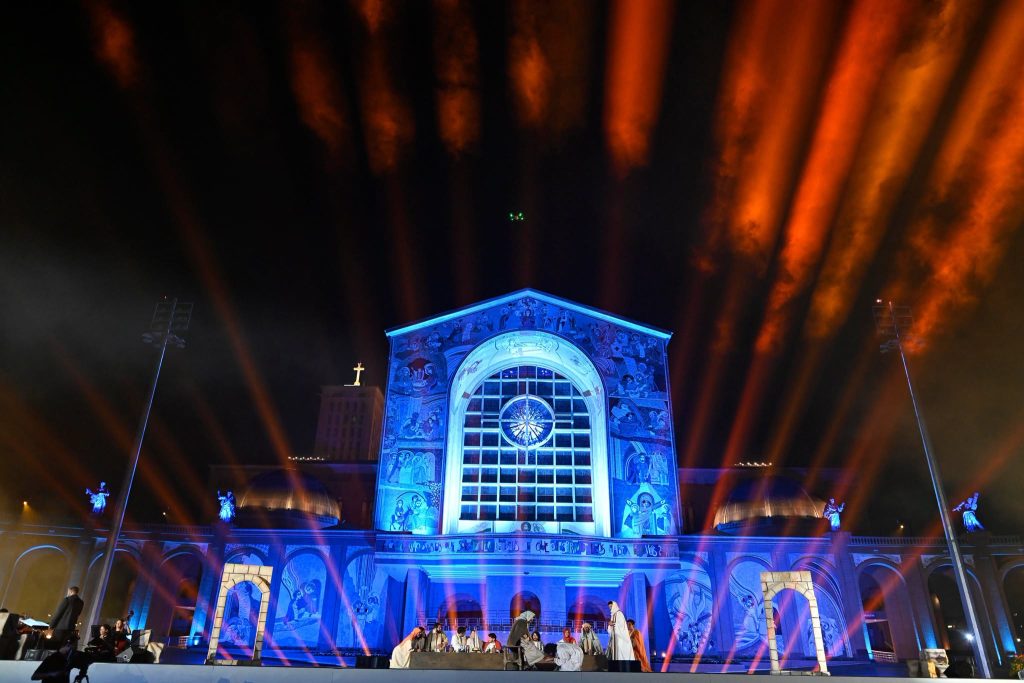
Quarto dia das gravacoes da Inauguracao da Fachada Sul – Aparecida-SP 26/04/2024 – Foto: Thiago Leon/Santuario Nacional de Aparecida
The symbolism will be difficult to miss. Lourdes is one of the Church’s most internationally recognizable places of pilgrimage, built around the memory of a young woman, Bernadette Soubirous, whose experience of suffering and healing has made the sanctuary a place where millions of people come seeking consolation. The decision to hide the mosaics therefore represents not simply an aesthetic alteration but a pastoral statement about who should feel at home in a Catholic sanctuary.
Aparecida has taken the opposite route
On September 12, the Brazilian shrine inaugurated the western façade of its basilica, completing an extraordinary biblical mosaic project begun in 2019. The western façade depicts the Book of Revelation, the Second Coming of Christ and the Last Judgment, presenting what the shrine describes as the triumph of God over evil.
The scale is immense. The latest phase alone covers almost 4,000 square meters and involved 39 mosaic artists connected with the Aletti Center. Stones were brought from countries including Brazil, Italy, Greece and Afghanistan. The four façades together form a vast visual narrative extending from creation and the Exodus to Christ’s incarnation, death and resurrection and finally the Apocalypse.
Aparecida has stressed that the project is now directed by Italian artist and theologian Maria Campatelli, who has led it since 2020. Her management team includes 12 women and nine men, alongside artists of numerous nationalities.
Yet that explanation has not resolved the controversy over Rupnik’s connection to the project.
The shrine has continued the work through the Aletti Center, the institution Rupnik founded, while its current website attributes the mosaics to 39 artists associated with the Rome-based center. In 2024, when asked about the future of the project following the allegations, the shrine said that the work would continue under the direction and execution of the Aletti Center. It also pointed to a canonical visitation of the center by the Vicariate of Rome, which found a healthy community life without specific problems.
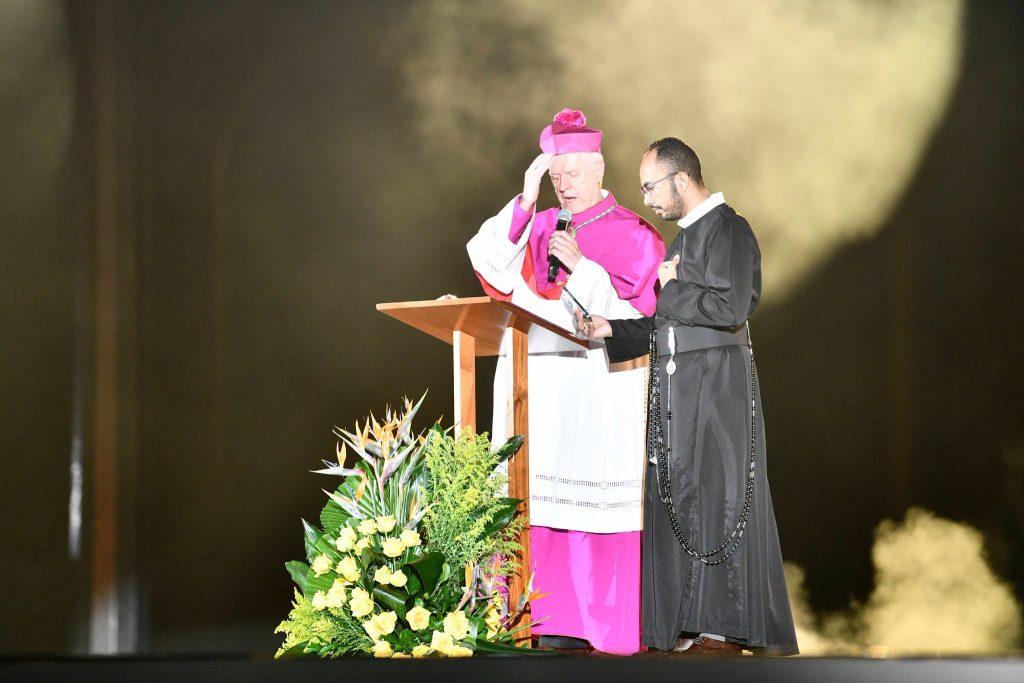
Quarto dia das gravacoes da Inauguracao da Fachada Sul – Aparecida-SP 26/04/2024 – Foto: Thiago Leon/Santuario Nacional de Aparecida
Critics, however, say that the central issue is not simply who physically placed each piece of stone. Some survivors and advocates argue that Rupnik’s authorship and influence remain inseparable from the project and that the sanctuary should have consulted victims before proceeding.
For some survivors, the answer is not necessarily to destroy every mosaic. One Brazilian abuse survivor advocate has argued instead that the Church should tell the complete story behind the works, including the controversy surrounding their creator. In that view, acknowledging the history is not an attempt to erase art but a refusal to allow an aesthetically powerful work to obscure the human suffering connected to its history.
Others take a more uncompromising position and believe Rupnik’s work should ultimately be removed. The disagreement itself reveals why the issue has proved so difficult for Church authorities: there is no universally accepted pastoral formula for dealing with art produced by a disgraced or accused artist.
The Pope has already taken several steps distancing his pontificate from the continued public prominence of Rupnik’s work. During his first Lenten retreat as pope, Leo chose not to use the Redemptoris Mater Chapel, despite its having traditionally hosted papal Curia retreats and being covered from floor to ceiling with Rupnik mosaics.
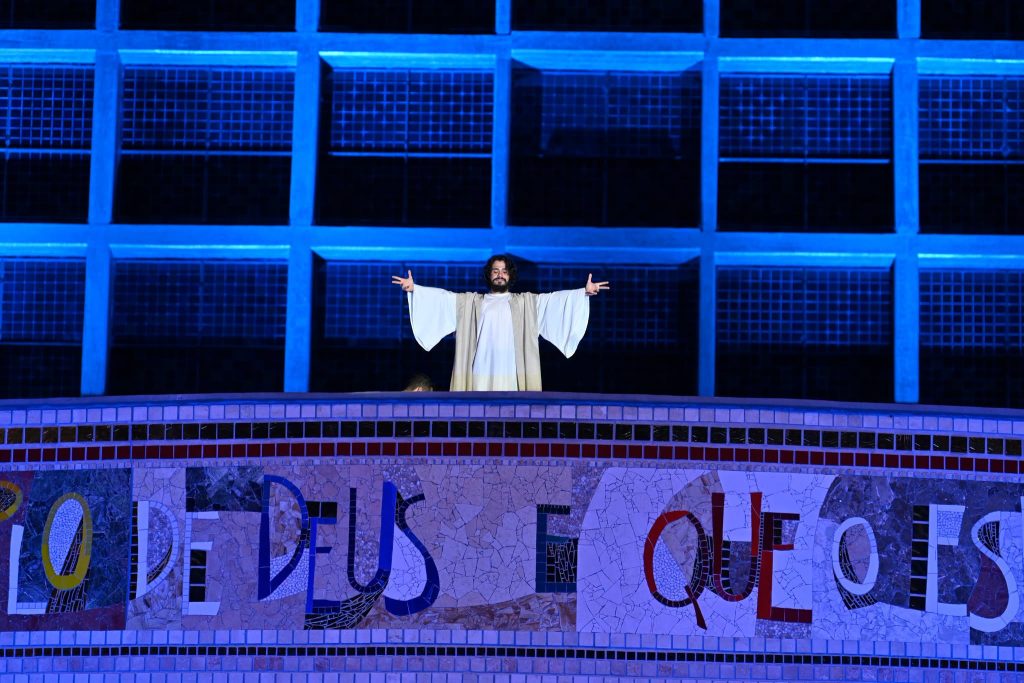
Segundo dia das gravacoes da Inauguracao da Fachada Sul – Aparecida-SP 24/04/2024 – Foto: Thiago Leon/Santuario Nacional de Aparecida
After Leo’s election, Rupnik’s artwork was also removed from Vatican communications materials that had continued to use it to illustrate religious celebrations. Bishop Micas subsequently said that Leo had asked the Vatican communications office to stop using Rupnik’s works and supported Lourdes’ decision to cover its mosaics.
Even the papal visit to France has acquired an architectural dimension because of the controversy. The chapel at the Paris nunciature, which also contains Rupnik’s work, will not host a celebration during Leo’s visit.
The Pope’s position therefore appears significant beyond Lourdes itself. Whatever he says—or chooses not to say—while visiting the sanctuary may be closely watched by Catholic institutions elsewhere that face the same dilemma.
Aparecida has meanwhile entered a new phase under Archbishop Mário Antônio da Silva, appointed by Leo in March and installed in May. The archbishop visited the sanctuary’s façades in August and praised their evangelical value. His presence gives the Brazilian controversy an additional dimension, since the local Church is now operating under a bishop appointed by a pope who has otherwise moved to reduce Rupnik’s visibility.
The contrasting approaches of Lourdes and Aparecida should not be reduced to a simplistic choice between being “for” or “against” art. They represent two different pastoral judgments about how a Church should respond when a work of religious art has become inseparable, in the public mind, from allegations of abuse.
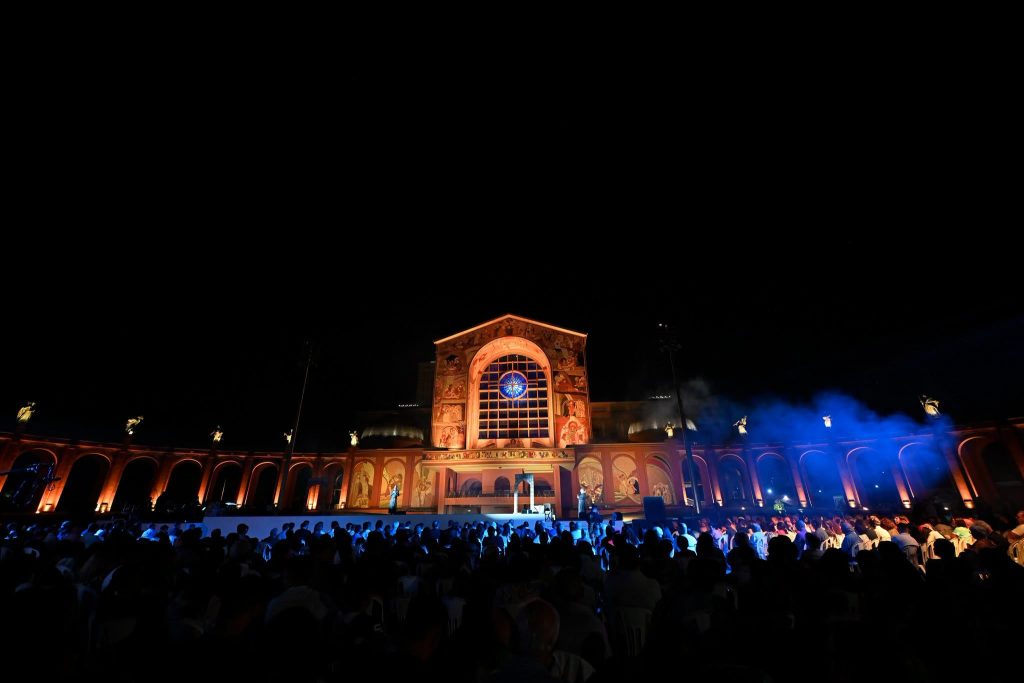
Quarto dia das gravacoes da Inauguracao da Fachada Sul – Aparecida-SP 26/04/2024 – Foto: Thiago Leon/Santuario Nacional de Aparecida
There is no indication that Aparecida plans to reverse course, while Lourdes has chosen concealment rather than removal. Neither decision settles the larger question.
What the two shrines have made unmistakable, however, is that the Church can no longer treat Rupnik’s mosaics as an exclusively artistic matter. For survivors, the images may carry memories of an institution that failed to protect them. For pilgrims, they may still communicate biblical truths independently of their maker. For Church leaders, the challenge is to determine which pastoral responsibility should take precedence when those realities collide.
Thank you for reading our content. If you would like to receive ZENIT’s daily e-mail news, you can subscribe for free through this link.

Publicaciones relacionadas:
 Philippines: Corner Stone Is Laid of a Center for Exorcisms, Investigation of Visions and Extraordinary Phenomenons
 Israeli Radicals Seek to Appropriate Properties of the Church, Alerts Catholic Patriarch of Jerusalem
 Syro-Malabar Church convenes extraordinary synod to resolve liturgical dispute
 Barcelona’s Sagrada Familia Prepares to Crown Its Skyline with the Tower of Christ, the highest in Europe
