

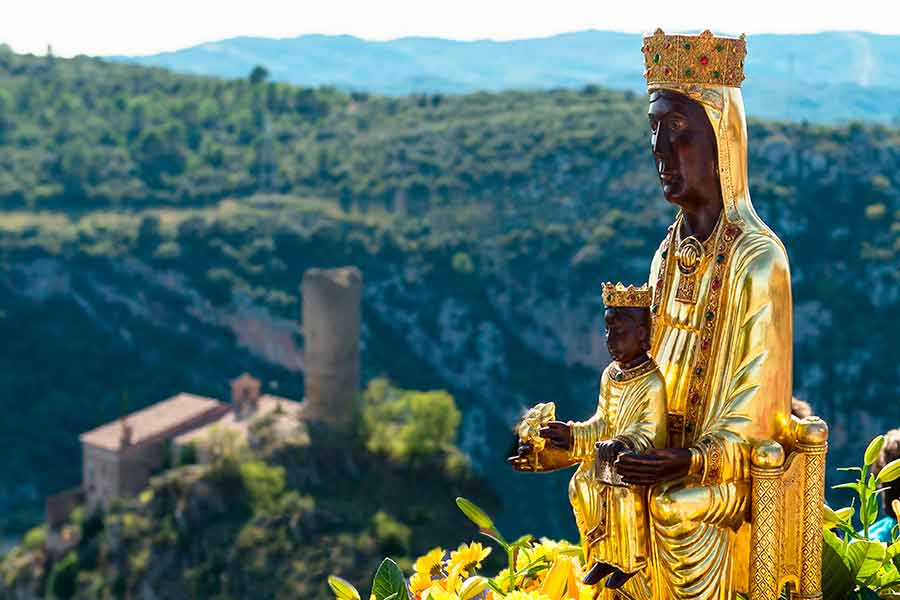
(ZENIT News / Barbastro, 09.11.2026).- The long-running dispute over the original statue of Our Lady of the Angels of Torreciudad has entered a new phase, as the Diocese of Barbastro-Monzón has formally renewed its demand that the Romanesque image be returned to the small shrine where it was venerated for more than a millennium.
In a statement issued on September 11 by diocese, presented the matter not simply as a disagreement with Opus Dei, which has managed the Torreciudad sanctuary for decades, but as a question of ecclesial stewardship, historical continuity and the rights of a local Church over an image it says has belonged to the diocese for more than 1,000 years.
The statue has stood in the present Torreciudad sanctuary for approximately 50 years. The original hermitage, however, is only about some meters away. For the diocese, that physical proximity makes the dispute all the more striking: it is not asking for the Virgin to leave Torreciudad altogether, but for the original image to return to its historic home.
The controversy reaches back to the construction of the new sanctuary. In a public deed dated September 24, 1962, concerning the emphyteutic lease granted by the Diocese of Barbastro to Inmobiliaria General Castellana, an entity associated with Opus Dei, one of the stated obligations was not to remove the image from the hermitage.
According to the diocese, the statue was nevertheless taken from the hermitage in 1975, when the new sanctuary was completed, in order to undergo restoration in Madrid. After the restoration, it was placed in the new church and did not return to the hermitage.
That decision was challenged at the time. Bishop Ambrosio Echebarría Arroita, then Bishop of Barbastro, wrote to Florencio Sánchez Bella, then Opus Dei’s vicar in Spain, arguing that the image had been installed in the new sanctuary with the intention that it remain there without documented diocesan authorization. He requested its return.
Opus Dei responded by producing a notarial record referring to a private document attributed to Jaime Flores Martín, a former Bishop of Barbastro. According to that testimony, Flores had authorized the image’s placement in the new sanctuary.
The central difficulty, according to the diocese, is that the underlying original document has never been provided to it despite repeated requests. Nor, it says, do the cathedral chapter’s records or diocesan archives contain authorization for the permanent removal of the statue from the hermitage or an agreement transferring its permanent use.
The current bishop has therefore continued a dispute inherited from his predecessor. Among the formal requests for restitution was a registered legal notice sent on September 7, 2022, to Desarrollo Social, the company linked to Opus Dei that succeeded Inmobiliaria General Castellana.
There is an important distinction at the heart of the case. The diocese does not dispute that the statue has been physically located in the new sanctuary for half a century. Its argument is that possession and ownership are not necessarily the same thing. In its view, five decades in the larger church do not by themselves establish a right to dispose permanently of an image whose title belongs to the diocese.
The bishopric also rejects the idea that the greater prominence or pastoral usefulness of the new sanctuary can settle the matter. It points to other Catholic sanctuaries in which historic images have remained in their original settings even after larger churches were built nearby, citing Lourdes and Fatima as examples. Within Barbastro-Monzón itself, it notes that religious communities entrusted with sanctuaries such as Pueyo and Guayente have traditionally understood their role as caring for Marian images in their established places rather than acquiring permanent control over them.
Yet the diocese’s position contains an element that could leave room for a negotiated settlement. It says that once the statue has been formally returned to the diocese and its original hermitage, the bishop could authorize temporary transfers to the Torreciudad sanctuary or elsewhere when pastoral reasons warrant them, provided that the arrangements are properly coordinated and the necessary guarantees are in place.
In practical terms, that could eventually produce an unusual compromise: the statue could return to its historic shrine, while remaining available for periods of devotion at the much larger sanctuary. A new agreement could then regulate such movements on terms recognized by both sides.
The dispute therefore concerns more than the location of a centuries-old work of sacred art.
The diocese portrays itself as defending continuity rather than seeking a new privilege: an image that, in its account, remained in its original sanctuary for more than a thousand years should not have been permanently transferred without clear authorization.
That position now places the future of the statue squarely before both the diocese and Opus Dei. The possibility of a temporary loan means that restitution need not necessarily end the statue’s presence at Torreciudad. But before any such arrangement can be contemplated, the bishop insists that the original image must first be returned to the custody and historic home of the Diocese of Barbastro-Monzón.
After half a century in the new sanctuary, the dispute has thus come back to an unusually small geographical space: barely some meters separating two churches, but a much wider distance between competing interpretations of an old agreement, ecclesial authority and the meaning of custodianship.
Thank you for reading our content. If you would like to receive ZENIT’s daily e-mail news, you can subscribe for free through this link.

Publicaciones relacionadas:
 Irish Parliament Moves Closer to Legalizing Assisted Dying Despite Heated Debate
 USA: use of cell phones in confessional forbidden
 Colombian Bishops Push Back After President’s Remarks on Jesus Spark National Outcry
 After one month of Nicolás Maduro’s imprisonment, the Venezuelan government restores Cardinal Porras’ passport
