

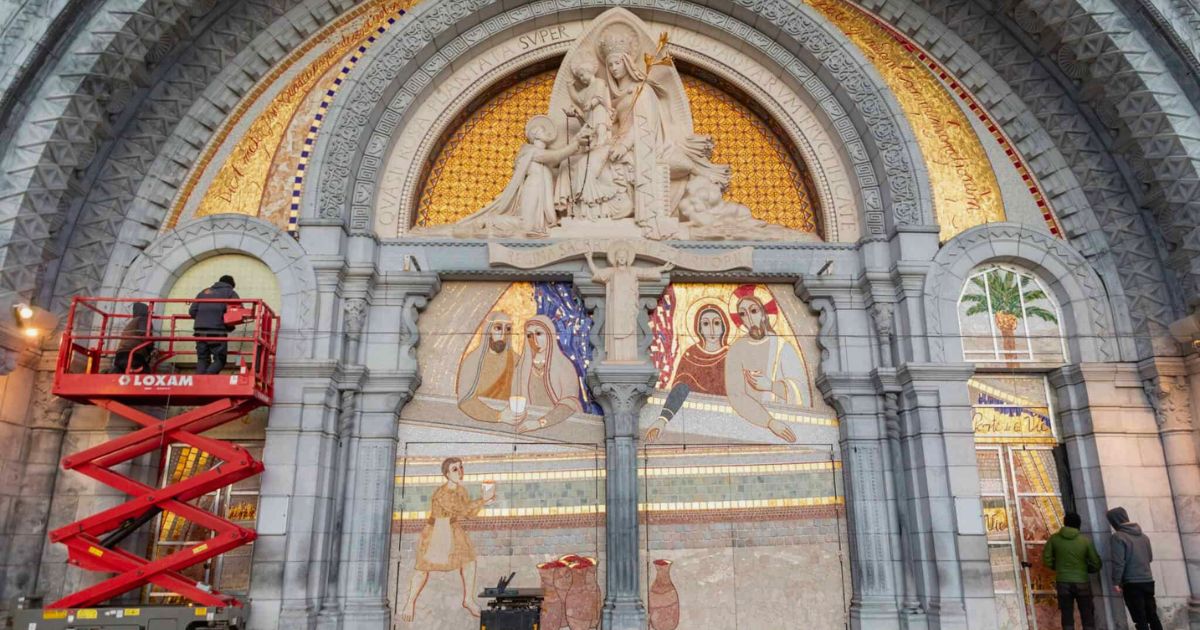
(ZENIT News / Lourdes, 08.21.2026).- The façade of the Basilica of the Rosary at Lourdes will soon lose one of its most recognizable artistic features. All of the mosaics created by the former Jesuit Marko Rupnik will be covered, and unlike earlier measures, this time the change is intended to be permanent.
Bishop Jean-Marc Micas of Tarbes and Lourdes has made clear that the decision is not simply a temporary adjustment for Pope Leo XIV’s visit to the French shrine on September 26 and 27. The mosaics will remain concealed after the Pope leaves, while the diocese begins a new process to determine how the façade should ultimately be redecorated. Artists and theologians are expected to join the commission already examining the future of the site.
The timing is nevertheless significant. Leo XIV will spend just over a day in Lourdes, where he is scheduled to celebrate Mass, meet the sick and their caregivers and participate in the traditional candlelight Rosary procession. A private meeting with abuse survivors is also planned somewhere during his French journey, although the Vatican has not specified whether it will take place in Paris or Lourdes.
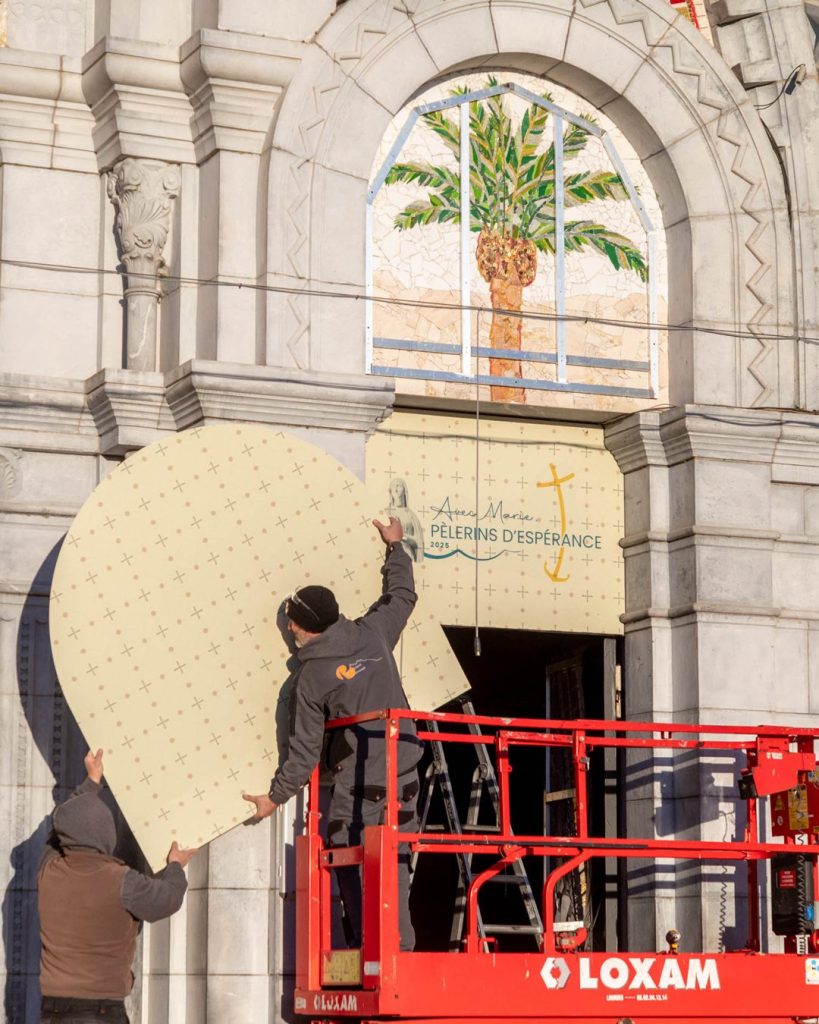
The mosaics on the doors of the facade of the Basilica of Our Lady of the Rosary, at the Sanctuary of Our Lady of Lourdes in southwestern France, are being covered in an undated photograph provided by the sanctuary. The doors showcase the artwork of Father Marko Rupnik, a priest and former Jesuit, who is currently under investigation after accusations of spiritual, psychological and sexual abuse by multiple adult women. Bishop Jean-Marc Micas of Lourdes and Tarbes said March 31, 2025, that the sanctuary will cover the mosaics on the door of the facade of the basilica, citing a need for a symbolic step to help those unable to cross its threshold. (OSV News photo/courtesy Lourdes Sanctuary)
Micas insists that the papal visit is an opportunity to move the discussion forward, rather than the reason for the decision. His position has been shaped by conversations with abuse survivors, some of whom have told him that encountering Rupnik’s work makes it difficult for them to return to Lourdes. For the bishop, that creates a pastoral problem in a sanctuary whose fundamental vocation is to receive precisely those who are wounded and seeking consolation.
“My role is to ensure that the sanctuary welcomes everyone, especially those who suffer,” Micas has said.
That reasoning gives the decision a significance beyond the fate of a particular collection of artworks. The question facing Lourdes is whether a sacred space can continue prominently displaying the work of an artist accused of serious abuses when some alleged victims experience that work itself as an obstacle to returning to the sanctuary.
Rupnik’s case remains legally unresolved. He was expelled from the Society of Jesus in 2023 after disciplinary problems, and he is now facing a canonical process at the Vatican over allegations of sexual, spiritual and psychological abuse involving numerous women. The Vatican press office rejected reports in July that the tribunal had already acquitted him, stating that the judges were still examining the documentation. The tribunal consists of five judges who are external to both the Dicastery for the Doctrine of the Faith and the Roman Curia.
That unresolved status makes Micas’s latest decision particularly noteworthy. The bishop has explicitly said that the future of the mosaics will not depend on the verdict. Even an acquittal, according to his stated position, would not automatically lead to their restoration. The rationale is therefore pastoral rather than a declaration of judicial guilt.
Lourdes has arrived at this point gradually. The mosaics were installed in 2008 to mark the 150th anniversary of the apparitions and depict the Luminous Mysteries of the Rosary. Their position on the main façade made them almost impossible for pilgrims to overlook.
After the allegations against Rupnik became public, the diocese created a commission in 2023 that included abuse survivors, sacred-art specialists, lawyers, prevention officials and sanctuary chaplains. In July 2024, the works ceased to be illuminated during nighttime candlelight processions. In March 2025, further Rupnik artworks on the basilica’s doors were covered, with Micas explaining that their presence could make it harder for survivors to enter the church.
The latest decision completes that progression: from reflection, to reduced visibility, to partial concealment, and finally to the covering of the entire façade.
There is also a wider Catholic dimension to the controversy. Rupnik’s studio contributed to projects in more than 200 liturgical spaces worldwide, including major Catholic shrines and churches. Consequently, Lourdes is not dealing with an isolated artistic commission but with a problem confronting numerous institutions that must decide what to do with prominent works associated with an artist facing grave allegations.
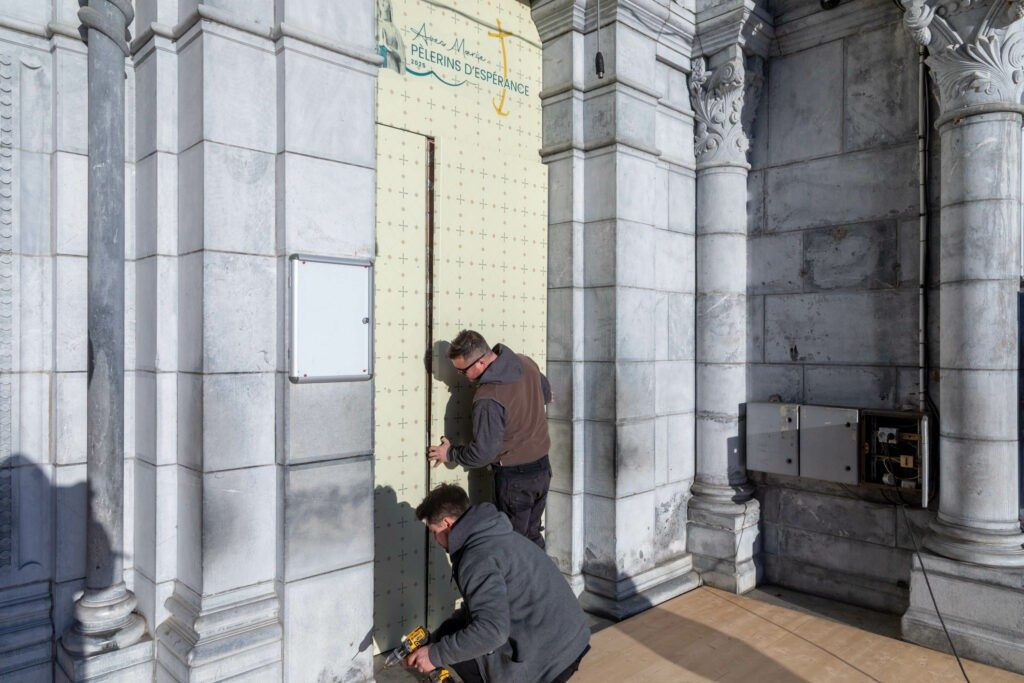
The diocese’s choice does not erase the religious meaning of the mosaics, nor does it prejudge the canonical tribunal. Instead, it establishes a different priority for the sanctuary: that the visual environment of a place dedicated to healing should not become, for abuse survivors, another source of anguish.
That principle is particularly powerful at Lourdes. The shrine’s identity is inseparable from the sick, the vulnerable and those who come carrying wounds that cannot always be seen. Micas’s decision suggests that, in such a setting, pastoral care may require changing even something artistically valuable when its continued presence has become an impediment to the people the sanctuary exists to receive.
The mosaics will therefore disappear from view, but not necessarily from the Church’s conversation. After the Pope’s pilgrimage, Lourdes intends to reopen the question with artists and theologians and determine what should eventually replace them.
The forthcoming redesign will thus be more than an architectural project. It will be an opportunity for the shrine to decide what kind of visual language best expresses its mission in the aftermath of an abuse crisis — and whether sacred art can once again become, above all, a sign of consolation for those who come to Lourdes in search of healing.
Thank you for reading our content. If you would like to receive ZENIT’s daily e-mail news, you can subscribe for free through this link.

Publicaciones relacionadas:
 Shanghai: Why Did the Chinese Communist Party Violate Its Agreement with the Vatican?
 Interview with the Person in Charge of Aid to the Church in Need’s Projects in Africa, to Understand the Situation in Sudan
 For the first time a Catholic cardinal actively participates in the coronation of an English King
 The schism resumes: Superior General of Lefebvrians announces new episcopal consecrations for July 1
