

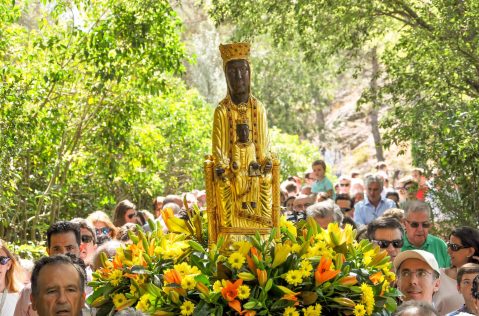
(ZENIT News / Rome, 09.05.2026).- A centuries-old Marian image has become the focal point of one of the ecclesial disputes currently facing the Catholic Church in Spain.
The controversy surrounding Torreciudad is not, at its core, about who owns the medieval image of Our Lady of the Angels. On that point, the Opus Dei Prelature says there is no disagreement: ownership belongs to the Diocese of Barbastro-Monzón. The real conflict concerns a more complicated question — who has the right to determine where the image should remain and how the agreements governing its custody and use should be interpreted.
The latest exchange has sharpened the divide between Bishop Ángel Pérez Pueyo of Barbastro-Monzón and the Opus Dei Prelature, while the final resolution remains in the hands of the Holy See.
The bishop has insisted that the original Romanesque image should permanently return to the ancient hermitage where generations of local Catholics venerated it. The Prelature, however, has firmly rejected any suggestion that the image was unlawfully taken or improperly retained in the modern sanctuary, where it has been publicly venerated since 1975.
Behind the dispute lies a history stretching back more than six decades.
According to the Opus Dei’s latest statement, a public deed signed on September 24, 1962 granted in perpetuity the useful domain — while not transferring ownership — of both the old hermitage and the image. The agreement included responsibilities for restoration, conservation, the promotion of worship and access for pilgrims.
A second agreement, dated September 8, 1966, established that the Torreciudad foundation would build and finance a new sanctuary on the express condition that the Marian image would receive worship and veneration there. The same arrangement envisioned the ancient hermitage and the new church as part of a single religious complex.
For the Prelature, those documents fundamentally undermine the accusation that the image was somehow removed without authorization.
It argues that the statue never left Torreciudad, was moved only a short distance to the new church, and remained within the same devotional site. The image, the Prelature says, was restored in 1964 and again around 1970 with episcopal authorization before taking its place in the sanctuary’s main altarpiece in 1975.
The Diocese of Barbastro-Monzón reads the history differently.
Bishop Pérez Pueyo has said that diocesan historical and legal research does not establish, in the diocesan archives, an authorized and legally documented departure of the image from its original location. He has made clear that, for him, the future of the sanctuary and the future of the medieval statue are separate questions.
The diocese, he has said, is not seeking control of the new church, its assets, finances or organizations connected with its management. Nor is it demanding financial compensation. Its principal claim concerns the permanent location of the original image.
The bishop has even indicated that he would rather place his resignation at the disposal of the Pope than accept what he regards as an unacceptable loss of the historic image’s connection with his people.
That language prompted an unusually direct response from the Opus Dei Prelature.
A legitimate disagreement over the legal effects of historical agreements, it argued, should not be transformed into an accusation of theft, usurpation or illegal retention. The question, the Prelature maintains, is precisely the kind of dispute that should be resolved by the competent ecclesiastical authority rather than through increasingly severe public accusations.
That authority is already involved.
The appointment of Archbishop Alejandro Arellano as pontifical commissioner with full powers for Torreciudad was made by Pope Francis following a request from Bishop Pérez Pueyo himself, according to the Prelature. The Diocese of Barbastro-Monzón publicly welcomed Rome’s intervention in October 2024 and expressed confidence in the Holy See’s eventual decisions.
Today, however, the bishop has expressed reservations about how the commissioner’s role has developed, particularly if the process is perceived as reducing a dispute over rights and responsibilities to a negotiation in which the diocese is expected simply to make concessions.
The disagreement therefore involves more than the location of a sacred object. It touches on ecclesiastical governance, the interpretation of historical agreements, the relationship between a diocese and a pilgrimage center, and the proper role of the Holy See when those questions can no longer be resolved locally.
The scale of Torreciudad also explains why the dispute has attracted such attention.
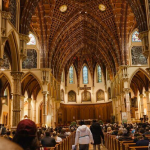
The modern sanctuary, inaugurated in 1975, has welcomed more than 10 million pilgrims over the past half-century and currently receives around 200,000 visitors each year, according to figures cited by the Prelature. It argues that the new church made devotion to Our Lady of the Angels accessible to a far wider public, particularly to elderly pilgrims and people with disabilities.
At the same time, the Prelature insists that the old hermitage was never abandoned. It was restored, preserved within the same complex and remains open for worship and visitors.
That dual history is perhaps the most important element in understanding the present conflict. The question is not simply whether a new sanctuary replaced an old shrine. Both places continue to exist, and both carry religious meaning. What remains unresolved is whether the original image should continue to serve as the spiritual center of the modern sanctuary or return permanently to the smaller hermitage where its local devotion developed over centuries.
The dispute briefly acquired a highly symbolic dimension during the 47th Pilgrimage of the Virgins of Ribagorza and Sobrarbe. The original statue was temporarily returned to the old hermitage for the celebration, with authorization from the pontifical commissioner. For the subsequent procession toward the new sanctuary, however, a specially prepared pilgrim copy was used instead of the historic original.
That arrangement allowed the celebration to take place without prejudging the permanent solution.
For now, Rome still holds the decisive responsibility.
The Opus Dei Prelature says it remains committed to dialogue, cooperation with the pontifical commissioner and acceptance of whatever decision the Holy See ultimately makes. It has also recalled that, as early as 2020, it sought an updated legal framework for Torreciudad and had even considered the possibility of the new church becoming a diocesan sanctuary.
Bishop Pérez Pueyo, meanwhile, has proposed another possible future: international recognition for Torreciudad under the direct authority of the Holy See, with Rome overseeing its pastoral and economic reality while the historic image remains in its original hermitage.
The competing proposals reveal how much more is at stake than the physical location of a medieval statue.
Torreciudad has become a place where local memory meets international pilgrimage, where centuries-old popular devotion encounters modern ecclesiastical structures, and where two Catholic institutions now await a judgment capable of protecting both legitimate rights and the unity of the Church.
That unity may ultimately be the most important issue of all. A Marian sanctuary is meant to gather believers around prayer, reconciliation and faith — not become a permanent symbol of division.
Thank you for reading our content. If you would like to receive ZENIT’s daily e-mail news, you can subscribe for free through this link.

Publicaciones relacionadas:
 Is Brazil on the Way to No Longer Being the Country with the Greatest Number of Catholics in the World?
 Most celebrate Christmas, few know what they celebrate: surprising revelations from a study
 The Middle East, the spread of war, and the position of the Pope and the Catholic Church
 What’s Driving the Rise in Catholic Conversions Across the US?
